 TireGeoCalc
How Tread Wear Changes Tire Diameter and Circumference
Quick answer
Nominal geometryTable example: 225/65R17 → 225/65R17 · original-size calibration assumed
- 225/65R17 diameter
- 28.52in
- Diameter change
- 0.00%
- Actual at indicated 60 mph
- 60.00mph
Calculated from size markings. Not measured rolling dimensions or vehicle fitment approval.
Published
Tread loss changes the outside of a tire while its size marking remains the same. This illustration starts with the nominal geometry of 225/65R17 and removes an assumed uniform radial amount. It explains why the diameter changes by more than the radial loss and why the circumference then becomes smaller. The wear amounts are hypothetical inputs for geometry. They do not describe the measured condition of a tire, and no replacement threshold can be inferred from the calculation.
Nominal geometry for these tire sizes
The first size is the reference. Dimensions are nominal calculations, not measured rolling data or vehicle fitment approval.
| Tire size | Width (mm) | Width (in) | Sidewall (mm) | Sidewall (in) | Wheel (mm) | Wheel (in) | Diameter (mm) | Diameter (in) | Circumference (mm) | Circumference (in) | Revolutions / mile | Revolutions / km | Diameter change (%) |
|---|---|---|---|---|---|---|---|---|---|---|---|---|---|
| 225/65R17 | 225 | 8.86 | 146.3 | 5.76 | 431.8 | 17 | 724.3 | 28.52 | 2275.5 | 89.58 | 707.3 | 439.5 | 0 |
Nominal size-code geometry. Reference: 225/65R17. Display rounding only; not fitment approval.
- Tire size
- 225/65R17
- Width (mm)
- 225
- Width (in)
- 8.86
- Sidewall (mm)
- 146.3
- Sidewall (in)
- 5.76
- Wheel (mm)
- 431.8
- Wheel (in)
- 17
- Diameter (mm)
- 724.3
- Diameter (in)
- 28.52
- Circumference (mm)
- 2275.5
- Circumference (in)
- 89.58
- Revolutions / mile
- 707.3
- Revolutions / km
- 439.5
- Diameter change (%)
- 0
| Radial loss (mm) | Diameter (mm) | Circumference (mm) |
|---|---|---|
| 0 | 724.3 | 2275.5 |
| 2 | 720.3 | 2262.9 |
| 4 | 716.3 | 2250.3 |
Hypothetical radial loss, not a safety threshold or measured rolling result.
- Radial loss (mm)
- 0
- Diameter (mm)
- 724.3
- Circumference (mm)
- 2275.5
- Radial loss (mm)
- 2
- Diameter (mm)
- 720.3
- Circumference (mm)
- 2262.9
- Radial loss (mm)
- 4
- Diameter (mm)
- 716.3
- Circumference (mm)
- 2250.3
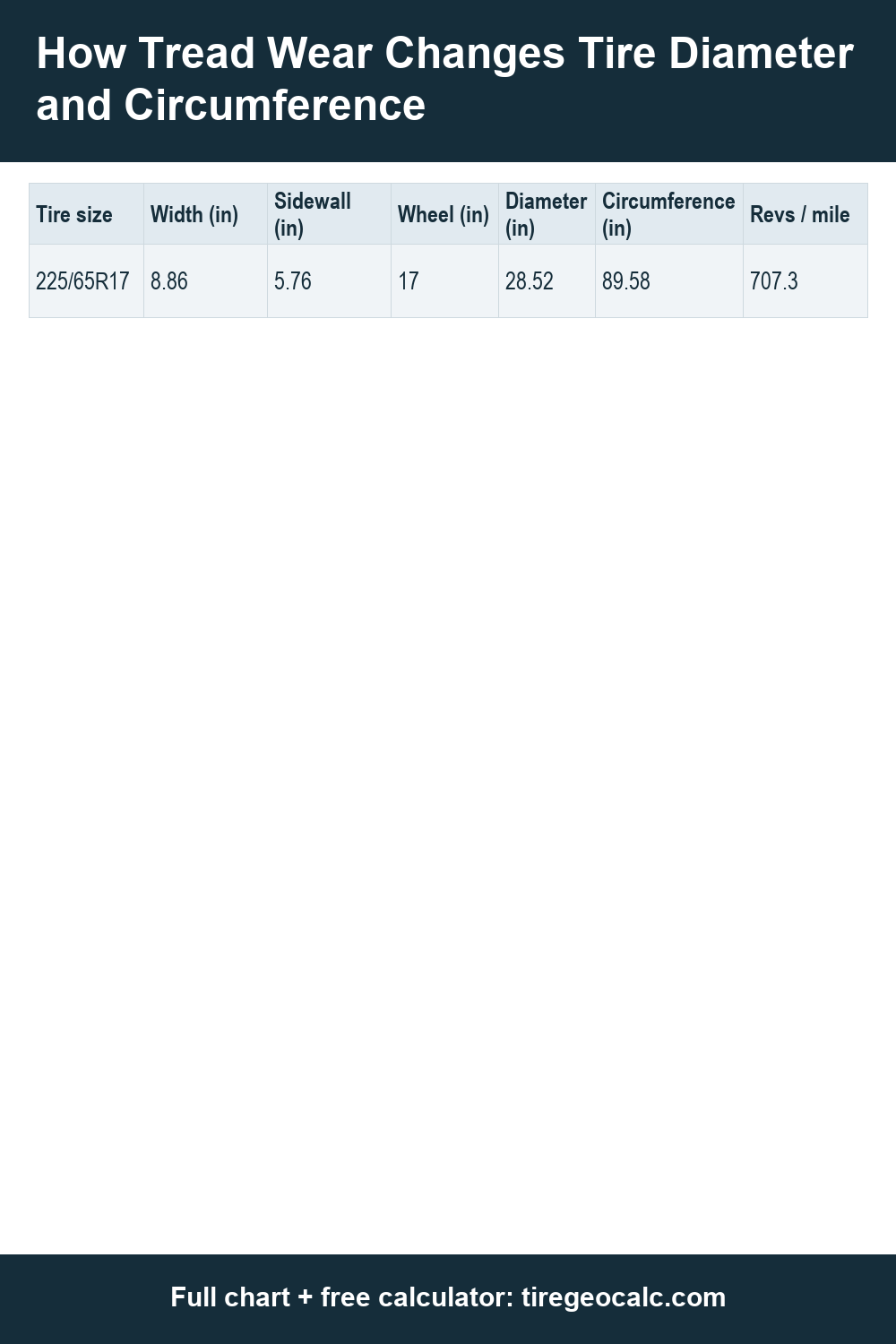
Calculated dimensions are nominal, not measured rolling dimensions or vehicle fitment approval.
Establish what the unworn reference represents
The reference row has a displayed diameter of 724.3 mm and a displayed circumference of 2275.5 mm. Its sidewall height is displayed as 146.3 mm. These values come from the size code, rather than from measuring a new tire on a wheel. The model begins with that nominal outer circle and changes its radius.
The marking 225/65R17 identifies nominal width, aspect ratio, radial construction, and wheel diameter. It does not report how much usable tread a particular product has when new. In particular, the calculated sidewall height is not a tread depth measurement and must not be treated as a budget of rubber available to wear away.
Understand the radial loss assumption
Radial loss means a reduction measured inward from the outside toward the center. The example assumes this happens evenly around the ideal circle. A diameter crosses that circle from edge to edge, so both ends move inward when the radius shrinks. In words, the worn diameter equals the starting diameter minus twice the radial loss.
The supplied scenarios use 0 mm, 2 mm, and 4 mm of radial loss. They are comparison inputs, not a sequence that any tire is expected or permitted to follow. No starting tread depth, remaining groove depth, wear indicator measurement, or product-specific limit has been supplied for this exercise.
Read the diameter and circumference examples together
With 0 mm of radial loss, the derived row gives a diameter of 724.3 mm and a circumference of 2275.455558995087 mm. At 2 mm of assumed radial loss, those entries become 720.3 mm and 2262.889188380728 mm. At 4 mm, the table gives 716.3 mm and 2250.3228177663686 mm.
These results are taken directly from the derived table. Circumference follows the circle formula: diameter multiplied by pi. The long circumference values preserve the supplied output rather than adding a different rounding rule. They express ideal geometry and should not be read as a claim that a physical tire can be measured to that precision.
Distinguish a circle from a rolling tire
A smaller ideal circumference corresponds to less distance per revolution in this model. That explains the geometric direction of a wear effect without predicting a measured instrument error. The example does not include a vehicle calibration, a rolling test, or the tire's behavior under load.
A loaded tire deforms, and nominal circumference is not measured rolling circumference. The assumed uniform removal also cannot describe uneven tread wear across the tire or around its surface. If observations differ from this illustration, do not force them into the table by changing the meaning of radial loss. Keep physical measurements and modeled dimensions in separate records.
Use the exercise without inventing a wear limit
Nothing in these rows establishes an acceptable remaining tread depth or tells a driver when to replace a tire. There is no threshold for continued use derived from the calculation. A smaller diameter alone cannot assess tread condition, damage, age, or any other inspection finding.
For a real assessment, identify the exact tire and follow the applicable inspection and replacement guidance. Record actual tread observations using the relevant measurement method rather than inferring them from the nominal size. A numerical difference in outside diameter is not a substitute for inspecting the tread, and the hypothetical loss amounts must not become targets for continued driving.
Keep the wear comparison within its scope
A close nominal diameter does not grant vehicle fitment approval. This wear example also supplies no inflation setting, load rating, comfort result, or fuel consumption estimate. Wheel and vehicle requirements remain separate from the geometry of the outer circle.
When sharing these results, include the original size, the radial loss assumption, and the units alongside each row. Keep the derived circumference values distinct from the rounded reference display. This makes it possible to reproduce the explanation without suggesting that the model contains information about a particular tire's remaining service life or suitability for use.
Frequently asked questions
Is radial loss the same as remaining tread depth?
Radial loss is an assumed change from the modeled starting surface. Remaining tread depth requires a separate reference and a physical measurement.
Why does diameter shrink by twice the loss?
A diameter spans opposing edges of the circle. Uniform inward movement reduces the radius on both sides of the center.
Do the example wear amounts define a replacement point?
They do not. The scenarios illustrate geometry only and cannot determine a permissible condition or a replacement threshold.
Does the size marking change as tread wears?
The marking remains the tire's nominal size designation. It does not continuously report the outside dimensions or measured tread condition.