TireGeoCalc
Moving from a 17 inch wheel to an 18 inch wheel sounds like a big change, but the wheel is only part of the story. The tire wrapped around it also changes. This page compares 225/60R18 with 225/65R17 and keeps the width at 225 mm for both, so you can see what the wheel size and the aspect ratio do to the total height. The key lesson is simple. A larger wheel with a shorter sidewall can end up almost the same overall height as a smaller wheel with a taller sidewall. Every number below comes from the table on this page, with 225/60R18 as the starting size, and every value is nominal geometry rather than a measurement from a vehicle.
Read these exact size markings
In 225/60R18 the width is 225 mm, the ratio is 60 and the wheel is 18 inches. In 225/65R17 the width is again 225 mm, the ratio is 65 and the wheel is 17 inches. Two things differ. The wheel is one inch smaller in the second size, and the sidewall is a larger share of the width.
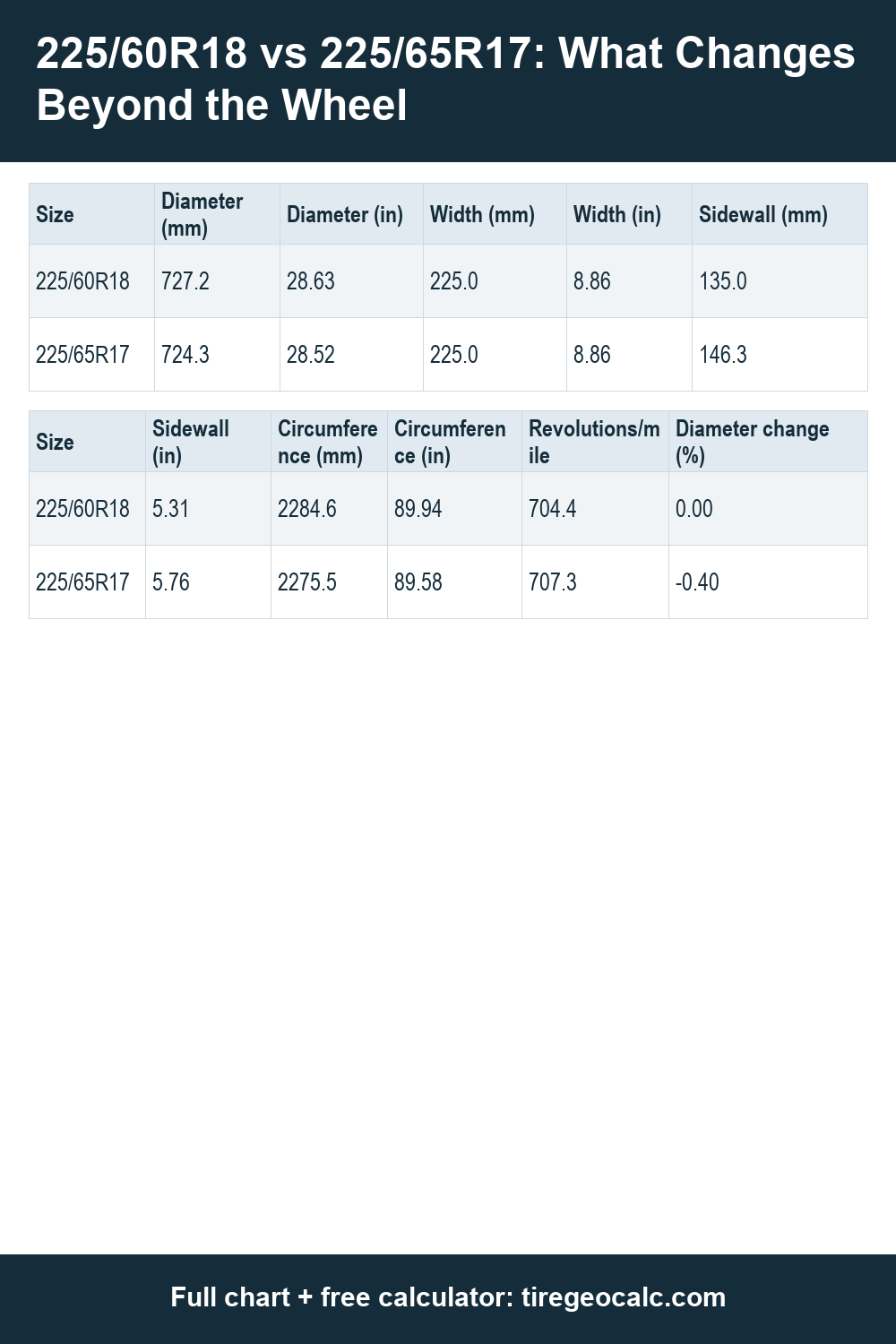
The rim values in the table show the wheel part clearly. The 18 inch rim measures 457.2 mm and the 17 inch rim measures 431.8 mm. The sidewall values go the other way. The 225/60R18 sidewall is 135 mm, while the 225/65R17 sidewall is 146.3 mm. One change makes the wheel bigger and the other makes the rubber thinner, and the two partly cancel.
Work through this page's numerical example
Take the starting size first. The 225/60R18 tire has an overall diameter of 727.2 mm, or 28.63 inches. Its circumference is 2284.6 mm, or 89.94 inches, and it turns 704.4 times per mile and 437.7 times per kilometer.
Now the comparison size. The 225/65R17 tire has an overall diameter of 724.3 mm, or 28.52 inches. Its circumference is 2275.5 mm, or 89.58 inches, and it turns 707.3 times per mile and 439.5 times per kilometer. The table lists the diameter change as minus 0.40 percent, measured from the 225/60R18 size. The negative sign means the 225/65R17 tire is the slightly smaller one. So moving to the smaller wheel with the taller sidewall gives a total height that is a little lower, not higher.
Explain the practical geometry difference
Think of the tire as a stack. The wheel sits in the middle, and a sidewall sits on each side of it. The overall diameter equals the rim plus two sidewalls. With 225/60R18 the rim is large and the sidewalls are short. With 225/65R17 the rim is smaller and the sidewalls are taller. The two stacks end at nearly the same height, which is why the diameters read 727.2 mm and 724.3 mm.
This is why comparing wheel size alone can mislead. A one inch jump in wheel diameter does not mean a one inch jump in tire height. The ratio change takes most of it back. What stays the same is the width at 225 mm, so the tread width in the nominal figures does not change at all between these two sizes. What changes is the share of the height that is wheel and the share that is rubber.
See what the speedometer would read
A speedometer that counts wheel turns assumes one tire size. If you switch to a slightly smaller tire, the real speed ends up a little below the dial. The table assumes the 225/60R18 size is the one the speedometer expects. With 225/65R17, a dial reading of 30 mph means 29.9 mph in real speed. A dial reading of 60 mph means 59.8 mph. A dial reading of 75 mph means 74.7 mph.
The gap is small because the two diameters are close. Still, it is a gap, and it points in one direction. These figures only apply if the original calibration was for 225/60R18, so check the starting point for your own vehicle before relying on any of them.
Understand nominal dimensions and rounding
The numbers on this page are nominal. They come from the markings on the tire and from standard geometry. A tire on a vehicle sags under load, grows with wear in the opposite direction, and differs a little by maker and model, so a measured rolling circumference can differ from the nominal circumference shown here.
The table also rounds only for display. The sidewall that appears as 146.3 mm is really 146.25 mm behind the scenes, and the speed that appears as 59.8 mph is slightly more precise in the calculation. If you redo the math with the rounded values you may land a hair away from the table, and that is only a rounding effect.
Check what the calculation cannot decide
A close match in diameter does not approve a size for your vehicle. This page does not say whether either size will mount on your wheel, clear the brakes and suspension, or meet what the maker specifies. It also says nothing about inflation pressure, load capacity, ride comfort or fuel use.
Use the figures to understand how wheel size and aspect ratio trade against each other. Then confirm the details with the vehicle placard, the owner manual and a qualified tire professional. The comparison answers one question only, and that question is geometry.