 TireGeoCalc
Tire Diameter and Ground Clearance: Why the Change Is Halved
Quick answer
Nominal geometryTable example: 245/75R16 → 265/75R16 · original-size calibration assumed
- 265/75R16 diameter
- 31.65in
- Diameter change
- +3.88%
- Actual at indicated 60 mph
- 62.33mph
Calculated from size markings. Not measured rolling dimensions or vehicle fitment approval.
Published
A taller tire does not raise its center by the full increase in outside diameter. This comparison uses 245/75R16 as the starting size and 265/75R16 as the candidate to explain the distinction. The table describes ideal geometry, with a theoretical radius increase of 15.0 mm. That is a useful starting point for understanding axle height, but it is not a measured increase in the lowest point of a loaded vehicle.
Nominal geometry for these tire sizes
The first size is the reference. Dimensions are nominal calculations, not measured rolling data or vehicle fitment approval.
| Tire size | Width (mm) | Width (in) | Sidewall (mm) | Sidewall (in) | Wheel (mm) | Wheel (in) | Diameter (mm) | Diameter (in) | Circumference (mm) | Circumference (in) | Revolutions / mile | Revolutions / km | Diameter change (%) |
|---|---|---|---|---|---|---|---|---|---|---|---|---|---|
| 245/75R16 | 245 | 9.65 | 183.8 | 7.23 | 406.4 | 16 | 773.9 | 30.47 | 2431.3 | 95.72 | 661.9 | 411.3 | 0 |
| 265/75R16 | 265 | 10.43 | 198.8 | 7.82 | 406.4 | 16 | 803.9 | 31.65 | 2525.5 | 99.43 | 637.2 | 396 | 3.88 |
Nominal size-code geometry. Reference: 245/75R16. Display rounding only; not fitment approval.
- Tire size
- 245/75R16
- Width (mm)
- 245
- Width (in)
- 9.65
- Sidewall (mm)
- 183.8
- Sidewall (in)
- 7.23
- Wheel (mm)
- 406.4
- Wheel (in)
- 16
- Diameter (mm)
- 773.9
- Diameter (in)
- 30.47
- Circumference (mm)
- 2431.3
- Circumference (in)
- 95.72
- Revolutions / mile
- 661.9
- Revolutions / km
- 411.3
- Diameter change (%)
- 0
- Tire size
- 265/75R16
- Width (mm)
- 265
- Width (in)
- 10.43
- Sidewall (mm)
- 198.8
- Sidewall (in)
- 7.82
- Wheel (mm)
- 406.4
- Wheel (in)
- 16
- Diameter (mm)
- 803.9
- Diameter (in)
- 31.65
- Circumference (mm)
- 2525.5
- Circumference (in)
- 99.43
- Revolutions / mile
- 637.2
- Revolutions / km
- 396
- Diameter change (%)
- 3.88
| Candidate | Radius increase (mm) |
|---|---|
| 265/75R16 | 15 |
Ideal static axle rise; actual loaded ground clearance needs measurement.
- Candidate
- 265/75R16
- Radius increase (mm)
- 15
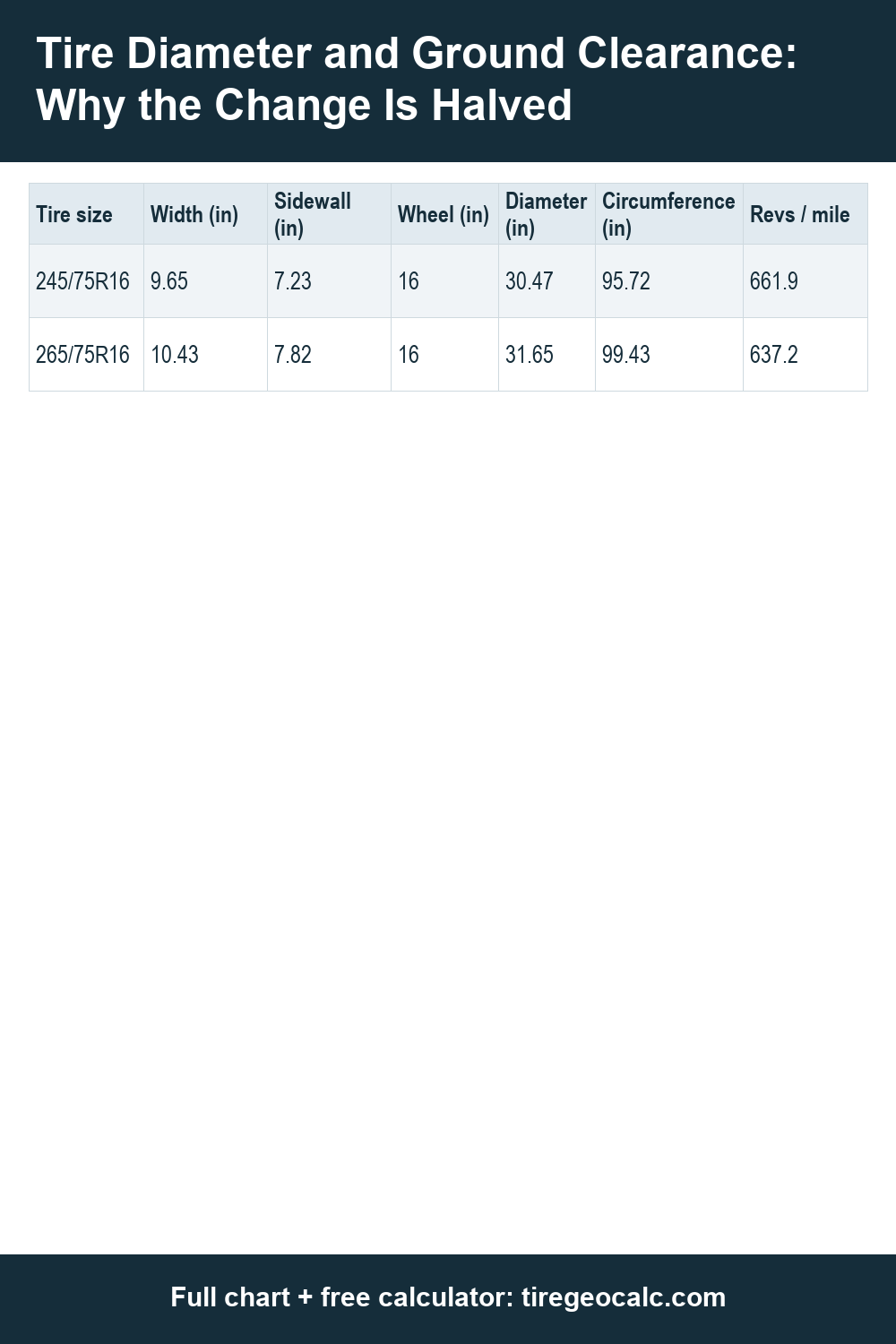
Calculated dimensions are nominal, not measured rolling dimensions or vehicle fitment approval.
Find the center before thinking about clearance
Picture an ideal round tire resting on a level surface. Its center is a radius above that surface. Diameter measures all the way across the circle, while axle height in this simplified picture depends on the distance from the ground to the center. This is why a diameter change cannot be used directly as a lift measurement.
The upper edge also moves relative to the center when the tire gets larger. Counting that upper portion as extra ground clearance mixes different measurements. Keep these ideas distinct throughout the comparison: outside diameter, center height above the ground, and the height of the particular vehicle component you want to assess.
Read the size codes before comparing height
The reference 245/75R16 and candidate 265/75R16 share the aspect ratio and wheel diameter shown in their markings. Their nominal widths differ, so the same aspect ratio produces different sidewall heights. A matching ratio is not a fixed sidewall measurement independent of width.
The displayed sidewall heights are 183.8 mm for the reference and 198.8 mm for the candidate. The corresponding displayed diameters are 773.9 mm and 803.9 mm. These entries show why reading only the final wheel diameter in the code would miss the overall height change. The outer tire dimension includes sidewall geometry as well as the wheel.
Work through the radius result from the table
The formula in words is: theoretical radius increase equals the new diameter minus the original diameter, divided by two. Using the supplied diameters of 803.9 mm and 773.9 mm gives the table's derived radius increase of 15.0 mm. The direction here is from the narrower reference size to the wider candidate.
This is an ideal static axle rise, assuming a circular tire resting on the same level plane. It does not include deflection under vehicle weight. Reversing the comparison would reverse the direction of the geometric change; it would not justify keeping a positive rise simply because the same size pair appears on the page.
Ask which vehicle point needs clearance
Ground clearance needs a defined reference point. The axle center is not necessarily the lowest component, and a number attached to the tire radius does not identify the lowest part of a vehicle. A measurement at one location cannot automatically stand in for measurements elsewhere underneath.
Before comparing real results, name the component and the surface from which its height is measured. Use comparable vehicle loading and conditions, and retain the original measurement. This allows an actual observation to be compared with the theoretical radius change without claiming that every part of the vehicle moved by precisely the same amount.
Treat nominal geometry as a starting estimate
The table is calculated from nominal size markings rather than from the exact tire product. Its dimensions are not measured loaded radii or measured rolling circumferences. Product construction and operating conditions can affect the relationship between the ideal circle and the tire supporting a vehicle.
The displayed circumference entries, 2431.3 mm and 2525.5 mm, describe the same nominal model. They do not validate the clearance result through a separate physical test. Likewise, the inch diameters of 30.47 and 31.65 are alternate displayed units, not more accurate input data. Keep the supplied radius result rather than recalculating it from those rounded inch values.
Check the limits before planning a change
Similarity in diameter does not establish vehicle fitment approval for this pair. A taller outer profile also raises separate questions about clearance around the tire, including when steering and suspension position change. The radius calculation cannot answer those questions or establish wheel suitability.
Use the vehicle documentation and the exact tire and wheel specifications for compatibility, load, and inflation requirements. Nothing here predicts comfort or fuel consumption. If the aim is more clearance at a specific point, obtain measurements of that point under defined conditions. Present the theoretical axle rise as an explanation of geometry, with actual clearance evidence recorded separately.
Frequently asked questions
Why is the full diameter increase not the axle rise?
The center sits a radius above the ground in the ideal circle model. Diameter spans the lower and upper halves, so only half its increase changes that center height.
Does matching aspect ratio mean matching sidewall height?
The aspect ratio acts on nominal width, so changing width can change sidewall height even when the ratio stays the same.
Is the derived rise a measured ground clearance gain?
It is a nominal radius result. Real clearance requires a defined vehicle point and measurements with the vehicle under stated conditions.
Can this calculation approve the larger size?
No approval follows from the radius result. Exact tire, wheel, vehicle, and clearance requirements must be checked independently.