 TireGeoCalc
245/75R16 vs 265/75R16: Height and Width Differences
Quick answer
Nominal geometry245/75R16 → 265/75R16 · original-size calibration assumed
- Diameter difference
- +1.18in
- Diameter change
- +3.88%
- Actual at indicated 60 mph
- 62.33mph
Calculated from size markings. Not measured rolling dimensions or vehicle fitment approval.
Published
Moving from 245/75R16 to 265/75R16 changes more than the width printed on the sidewall. The wider size also has a taller calculated sidewall and a larger overall diameter. This comparison uses 245/75R16 as the baseline and reads 265/75R16 as the candidate. That order matters when describing an increase. Start with the width and diameter rows separately, then consider the radius. They describe different directions around the tire, so a larger number in one row cannot answer every clearance question.
Nominal geometry for these tire sizes
The first size is the reference. Dimensions are nominal calculations, not measured rolling data or vehicle fitment approval.
| Tire size | Width (mm) | Width (in) | Sidewall (mm) | Sidewall (in) | Wheel (mm) | Wheel (in) | Diameter (mm) | Diameter (in) | Circumference (mm) | Circumference (in) | Revolutions / mile | Revolutions / km | Diameter change (%) | Actual at indicated 30 mph | Actual at indicated 60 mph | Actual at indicated 75 mph | Actual minus indicated at 60 mph |
|---|---|---|---|---|---|---|---|---|---|---|---|---|---|---|---|---|---|
| 245/75R16 | 245 | 9.65 | 183.8 | 7.23 | 406.4 | 16 | 773.9 | 30.47 | 2431.3 | 95.72 | 661.9 | 411.3 | 0 | 30 | 60 | 75 | 0 |
| 265/75R16 | 265 | 10.43 | 198.8 | 7.82 | 406.4 | 16 | 803.9 | 31.65 | 2525.5 | 99.43 | 637.2 | 396 | 3.88 | 31.2 | 62.3 | 77.9 | 2.3 |
Nominal size-code geometry. Reference: 245/75R16. Display rounding only; not fitment approval.
- Tire size
- 245/75R16
- Width (mm)
- 245
- Width (in)
- 9.65
- Sidewall (mm)
- 183.8
- Sidewall (in)
- 7.23
- Wheel (mm)
- 406.4
- Wheel (in)
- 16
- Diameter (mm)
- 773.9
- Diameter (in)
- 30.47
- Circumference (mm)
- 2431.3
- Circumference (in)
- 95.72
- Revolutions / mile
- 661.9
- Revolutions / km
- 411.3
- Diameter change (%)
- 0
- Actual at indicated 30 mph
- 30
- Actual at indicated 60 mph
- 60
- Actual at indicated 75 mph
- 75
- Actual minus indicated at 60 mph
- 0
- Tire size
- 265/75R16
- Width (mm)
- 265
- Width (in)
- 10.43
- Sidewall (mm)
- 198.8
- Sidewall (in)
- 7.82
- Wheel (mm)
- 406.4
- Wheel (in)
- 16
- Diameter (mm)
- 803.9
- Diameter (in)
- 31.65
- Circumference (mm)
- 2525.5
- Circumference (in)
- 99.43
- Revolutions / mile
- 637.2
- Revolutions / km
- 396
- Diameter change (%)
- 3.88
- Actual at indicated 30 mph
- 31.2
- Actual at indicated 60 mph
- 62.3
- Actual at indicated 75 mph
- 77.9
- Actual minus indicated at 60 mph
- 2.3
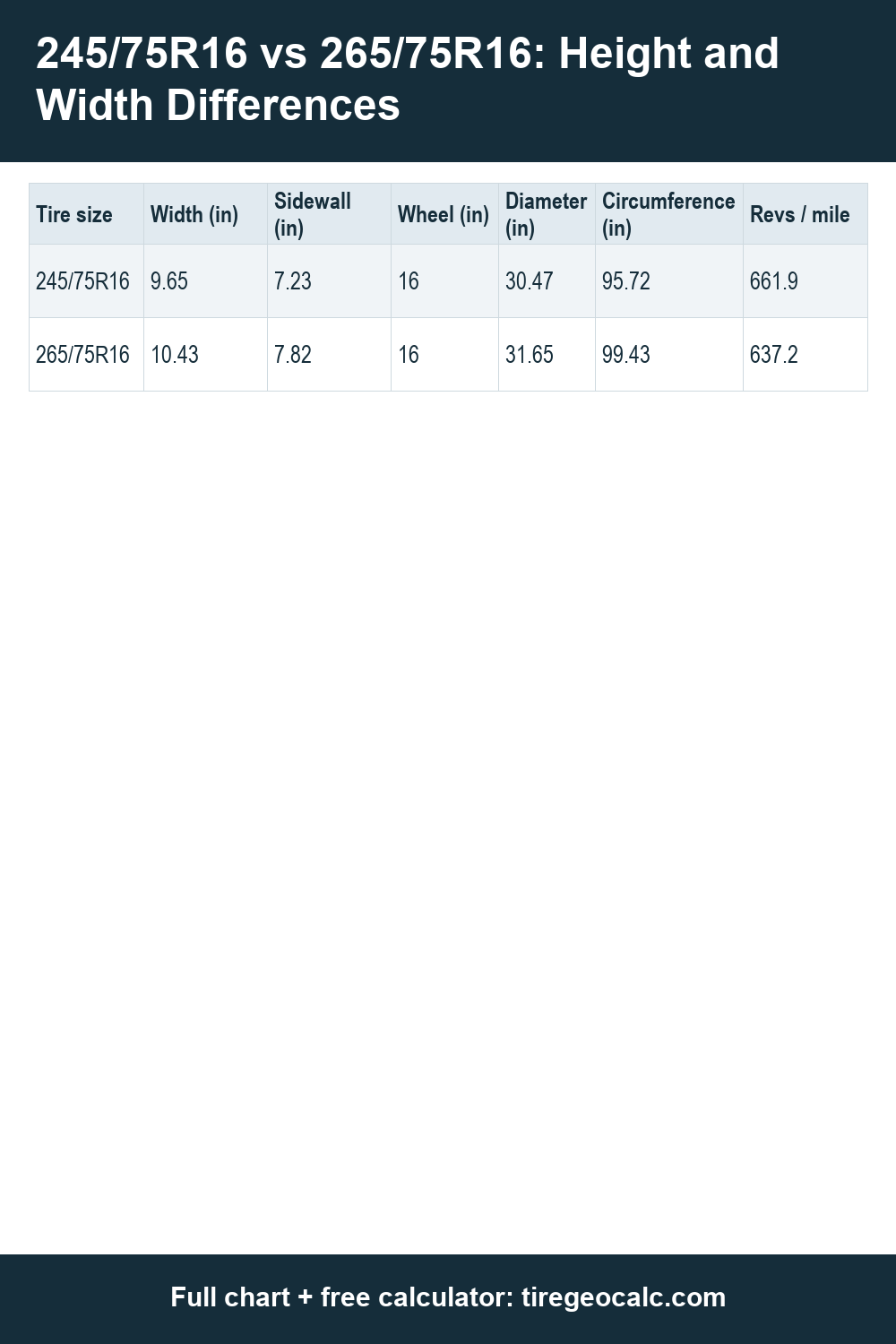
Calculated dimensions are nominal, not measured rolling dimensions or vehicle fitment approval.
Why the shared aspect ratio still produces different heights
Both markings end in R16, and both use the same aspect ratio. The letter describes radial construction, while the final number identifies the wheel diameter in inches. The first number gives nominal section width in millimeters. The middle part expresses sidewall height relative to width rather than naming a fixed height. Keeping that proportion while increasing width therefore makes the sidewall taller as well.
The table gives widths of 245 mm and 265 mm, or 9.65 inches and 10.43 inches. Those are section widths, not measured tread widths. Reading them as the width of the rubber touching the road would give the comparison a meaning it does not have. The size code describes geometry, not the shape of a contact patch.
Follow the width change through the diameter row
Work through the baseline row first. Its sidewall is 183.8 mm, displayed as 7.23 inches, and its overall diameter is 773.9 mm, or 30.47 inches. Now follow the candidate row: the sidewall becomes 198.8 mm, or 7.82 inches, and the diameter becomes 803.9 mm, or 31.65 inches. The wheel diameter stays at 406.4 mm, equivalent to 16 inches.
This example shows where the extra overall height comes from. The wheel has not become larger; the sidewalls account for the change. Overall diameter spans the tire from top to bottom through its center. Sidewall height describes the radial distance between the wheel and the outer tire in the nominal model. Comparing those rows prevents a width change from being mistaken for a wheel change.
Separate axle height from total tire height
A taller circle has a larger radius, but the increase in radius is only half the increase in total diameter. For this pair, that is the geometric reason the full height difference should not be quoted as an axle height increase. The comparison has no loaded radius measurement, so it does not supply a measured change in ground clearance.
Width raises a different question. It concerns the space across the assembly rather than the distance from its center to the ground. Wheel position and the actual tire shape matter when assessing that space. Do not assume the added nominal width divides into a known amount of inward and outward movement on a vehicle.
Use circumference to understand the direction of rotation change
The baseline circumference is 2431.3 mm, or 95.72 inches. For the candidate it is 2525.5 mm, or 99.43 inches. In this circular model, the larger circumference corresponds to fewer turns over the same distance. The revolutions per mile entries follow that direction: 661.9 for the baseline and 637.2 for the candidate.
These entries are calculated from nominal size, not collected during a road test. A real tire under load is not a rigid circle. The displayed figures also use presentation rounding, so they should be read directly rather than used to rebuild a more precise calculation. Keep the metric and inch labels attached when recording either row.
Turn the comparison into specific checks
The useful conclusion is that the candidate is wider and taller on paper while retaining the same nominal wheel diameter. Similar dimensions do not approve either tire for a particular vehicle. This table does not establish wheel width suitability, body clearance, steering clearance or the vehicle requirements for load and speed ratings.
Before treating the candidate as a replacement, compare the exact tire and wheel specifications with the vehicle documentation. Ask the installer to resolve the details that the size code leaves out. Geometry alone cannot set inflation pressure or predict comfort, fuel use or carrying capacity. Keep this page as a dimensional comparison and keep any mounting decision tied to the actual equipment being assessed.
Frequently asked questions
Does the matching R16 ending make the tires interchangeable?
It identifies the same nominal wheel diameter. It does not establish an acceptable rim width or vehicle clearance for either tire.
Which size is taller in this comparison?
The candidate 265/75R16 has a nominal diameter of 803.9 mm, compared with 773.9 mm for the baseline.
Can I use the diameter change as a ground clearance figure?
No. Radius changes by half the diameter change in the geometric model, and loaded radius has not been measured here.
Is the width entry the tread width?
Section width and tread width describe different features. The table supplies nominal section width, not a measured tread footprint.
Continue your comparison
Reference tables: Load index chart and Speed rating chart.