 TireGeoCalc
265/70R17 vs 265/75R16: Diameter and Revolutions per Mile
Quick answer
Nominal geometry265/70R17 → 265/75R16 · original-size calibration assumed
- Diameter difference
- +0.04in
- Diameter change
- +0.14%
- Actual at indicated 60 mph
- 60.08mph
Calculated from size markings. Not measured rolling dimensions or vehicle fitment approval.
Published
The question in this comparison is which assembly turns fewer times over the same distance. A larger wheel does not settle that question because the tire sidewall contributes to total diameter. Here, 265/70R17 is the reference and 265/75R16 is the alternative. Their nominal widths match, but the wheel and sidewall dimensions differ. The circumference and revolutions rows show how those differences combine. Read the rows in that order before deciding what a wheel size label tells you about the complete assembly.
Nominal geometry for these tire sizes
The first size is the reference. Dimensions are nominal calculations, not measured rolling data or vehicle fitment approval.
| Tire size | Width (mm) | Width (in) | Sidewall (mm) | Sidewall (in) | Wheel (mm) | Wheel (in) | Diameter (mm) | Diameter (in) | Circumference (mm) | Circumference (in) | Revolutions / mile | Revolutions / km | Diameter change (%) | Actual at indicated 30 mph | Actual at indicated 60 mph | Actual at indicated 75 mph | Actual minus indicated at 60 mph |
|---|---|---|---|---|---|---|---|---|---|---|---|---|---|---|---|---|---|
| 265/70R17 | 265 | 10.43 | 185.5 | 7.3 | 431.8 | 17 | 802.8 | 31.61 | 2522.1 | 99.29 | 638.1 | 396.5 | 0 | 30 | 60 | 75 | 0 |
| 265/75R16 | 265 | 10.43 | 198.8 | 7.82 | 406.4 | 16 | 803.9 | 31.65 | 2525.5 | 99.43 | 637.2 | 396 | 0.14 | 30 | 60.1 | 75.1 | 0.1 |
Nominal size-code geometry. Reference: 265/70R17. Display rounding only; not fitment approval.
- Tire size
- 265/70R17
- Width (mm)
- 265
- Width (in)
- 10.43
- Sidewall (mm)
- 185.5
- Sidewall (in)
- 7.3
- Wheel (mm)
- 431.8
- Wheel (in)
- 17
- Diameter (mm)
- 802.8
- Diameter (in)
- 31.61
- Circumference (mm)
- 2522.1
- Circumference (in)
- 99.29
- Revolutions / mile
- 638.1
- Revolutions / km
- 396.5
- Diameter change (%)
- 0
- Actual at indicated 30 mph
- 30
- Actual at indicated 60 mph
- 60
- Actual at indicated 75 mph
- 75
- Actual minus indicated at 60 mph
- 0
- Tire size
- 265/75R16
- Width (mm)
- 265
- Width (in)
- 10.43
- Sidewall (mm)
- 198.8
- Sidewall (in)
- 7.82
- Wheel (mm)
- 406.4
- Wheel (in)
- 16
- Diameter (mm)
- 803.9
- Diameter (in)
- 31.65
- Circumference (mm)
- 2525.5
- Circumference (in)
- 99.43
- Revolutions / mile
- 637.2
- Revolutions / km
- 396
- Diameter change (%)
- 0.14
- Actual at indicated 30 mph
- 30
- Actual at indicated 60 mph
- 60.1
- Actual at indicated 75 mph
- 75.1
- Actual minus indicated at 60 mph
- 0.1
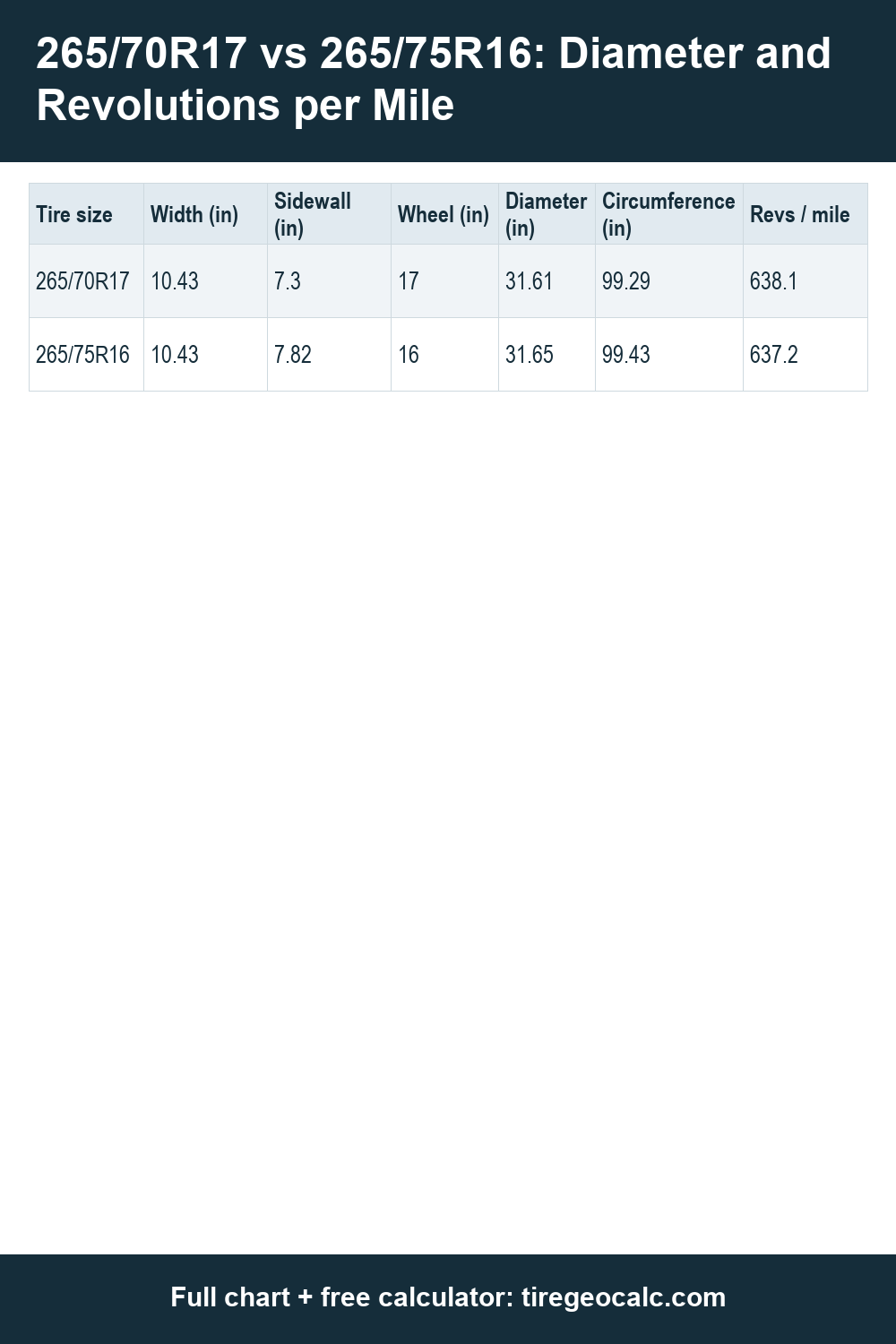
Calculated dimensions are nominal, not measured rolling dimensions or vehicle fitment approval.
Start with the complete assembly instead of the wheel
The reference uses a wheel diameter of 17 inches, shown as 431.8 mm. The alternative uses 16 inches, or 406.4 mm. Looking only at those entries would suggest that the alternative must be shorter. Its sidewall is taller, however, and the overall diameter row includes the sidewall above and below the wheel.
Width remains 265 mm, equivalent to 10.43 inches, in both rows. Equal nominal width helps isolate the relationship between sidewall height and wheel diameter. It does not mean the tires have identical construction, tread or installed dimensions. Those details are outside the size comparison and should not be inferred from the repeated width value.
Work from circumference to turns per mile
For a worked reading, take the reference diameter of 802.8 mm, or 31.61 inches. Its circumference is 2522.1 mm, displayed as 99.29 inches, and its revolutions per mile value is 638.1. Then read the alternative: diameter 803.9 mm, or 31.65 inches; circumference 2525.5 mm, or 99.43 inches; revolutions per mile 637.2.
The alternative has the larger nominal circumference and the lower turn count. This is the expected direction in the model: each turn covers a longer geometric distance, so fewer turns cover a mile. No new subtraction or conversion is needed to identify the result. The existing entries provide the comparison without adding another rounded estimate.
Keep wheel revolutions separate from engine speed
Revolutions per mile describes how often the modeled tire rotates over a distance. It is not engine revolutions per minute. The table contains no transmission ratio, driving gear or operating condition from which to describe engine speed. A lower tire turn count therefore should not be presented as a measured change in engine behavior.
Likewise, this is not an odometer calibration test. If a vehicle uses wheel rotation to estimate distance, the reference circumference is relevant to that calculation, but this page does not know the vehicle calibration. The baseline is simply the first tire size named here. Reversing the comparison changes which assembly is the reference; it does not change the dimensions printed in either row.
See how the taller sidewall offsets the smaller wheel
Sidewall height is 185.5 mm, or 7.3 inches, for the reference and 198.8 mm, or 7.82 inches, for the alternative. That added nominal sidewall height helps explain why the smaller wheel does not produce the smaller outside diameter in this pair. The size marking must be read as a connected description rather than a ranking based on its final number.
Millimeters, abbreviated mm, and inches are length units. Revolutions per mile is a count over distance, so it cannot be compared directly with a length entry. Keep each unit visible when copying figures into notes. Display rounding is already applied in the table; recomputing turn counts from rounded circumference can give a slightly different result.
Know what a close diameter comparison leaves unresolved
The near match in total height is a useful geometric observation, not vehicle fitment approval. These tires specify different wheel diameters, so the comparison is not a proposal to mount both on the same wheel. Matching the outside height cannot substitute for checking the complete wheel and tire assembly.
Consult the vehicle information and the specifications for the exact equipment under consideration. Rim width, clearance, load requirements and speed requirements need their own checks. Nominal circumference is not measured rolling circumference under load, and the table has no road test results. It cannot establish inflation pressure, ride comfort, fuel consumption or capacity. Its narrow answer is that the alternative makes fewer theoretical turns per mile despite using the smaller wheel diameter.
Frequently asked questions
Which row has fewer revolutions per mile?
The 265/75R16 row lists 637.2, while the reference 265/70R17 row lists 638.1.
Why can a smaller wheel have a larger tire diameter?
The alternative has a taller sidewall. Overall diameter includes the wheel and the sidewalls on opposite sides of it.
Are these measured rolling figures?
They are nominal geometric results from the size markings. They do not describe a loaded tire measured during driving.
Does the lower turn count prove lower fuel use?
The table has no fuel use evidence. A rotation count by itself cannot establish a consumption result.