 TireGeoCalc
265/75R16 in Inches: Diameter and Revolutions per Mile
Quick answer
Nominal geometry265/75R16 · nominal size-code geometry
- Overall diameter
- 31.65in
- Section width
- 10.43in
- Sidewall height
- 7.82in
Calculated from size markings. Not measured rolling dimensions or vehicle fitment approval.
Published
Revolutions per mile connects a tire's circular outline to distance. For 265/75R16, the table reports 637.2 nominal revolutions per mile, alongside an outside diameter of 31.65 inches. Understanding how the calculation reaches that count is more useful than treating it as a stand-alone vehicle reading. It starts with the full size marking, builds an ideal diameter, then uses circumference to relate distance to turns. No road test or loaded rolling measurement is included in these figures.
Nominal geometry for these tire sizes
The first size is the reference. Dimensions are nominal calculations, not measured rolling data or vehicle fitment approval.
| Tire size | Width (mm) | Width (in) | Sidewall (mm) | Sidewall (in) | Wheel (mm) | Wheel (in) | Diameter (mm) | Diameter (in) | Circumference (mm) | Circumference (in) | Revolutions / mile | Revolutions / km | Diameter change (%) |
|---|---|---|---|---|---|---|---|---|---|---|---|---|---|
| 265/75R16 | 265 | 10.43 | 198.8 | 7.82 | 406.4 | 16 | 803.9 | 31.65 | 2525.5 | 99.43 | 637.2 | 396 | 0 |
Nominal size-code geometry. Reference: 265/75R16. Display rounding only; not fitment approval.
- Tire size
- 265/75R16
- Width (mm)
- 265
- Width (in)
- 10.43
- Sidewall (mm)
- 198.8
- Sidewall (in)
- 7.82
- Wheel (mm)
- 406.4
- Wheel (in)
- 16
- Diameter (mm)
- 803.9
- Diameter (in)
- 31.65
- Circumference (mm)
- 2525.5
- Circumference (in)
- 99.43
- Revolutions / mile
- 637.2
- Revolutions / km
- 396
- Diameter change (%)
- 0
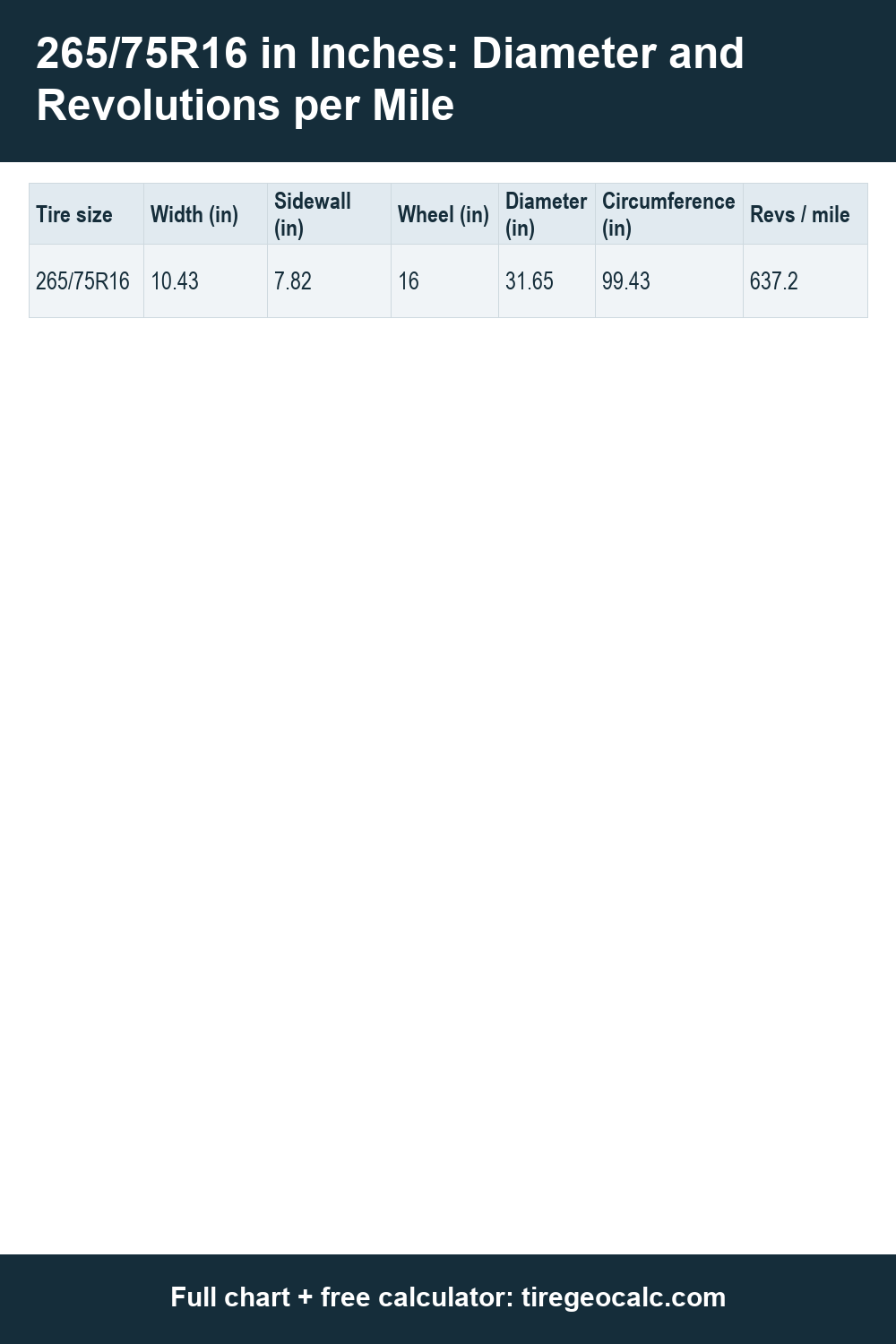
Calculated dimensions are nominal, not measured rolling dimensions or vehicle fitment approval.
Begin with the full size before counting turns
In 265/75R16, the opening part gives nominal section width in millimeters. The aspect ratio that follows relates the sidewall height to that width. R marks radial construction, and the ending specifies wheel diameter in inches. None of these parts on its own gives revolutions per mile. The complete marking is needed to establish the outside outline used in the calculation.
The wheel diameter here is 16 inches, represented as 406.4 mm. It occupies the center of the outline, but the tire reaches beyond it. Both opposing sidewalls contribute to overall diameter. A calculation based only on the wheel would describe the wrong circle, and a calculation based only on width would omit the aspect ratio and wheel altogether.
Trace the numerical path to circumference
Take the nominal width first: 265 mm appears as 10.43 inches. The width and aspect ratio produce a sidewall height displayed as 198.8 mm, or 7.82 inches. Combining the wheel with the opposing sidewalls gives 803.9 mm overall diameter, which the inch column presents as 31.65 inches. The engine carries full precision between these stages.
Next, the circular geometry turns that diameter into a circumference of 2525.5 mm, or 99.43 inches. Circumference is the distance around the ideal outside edge, not the distance across it. This is the relevant distance for the next step because a complete ideal turn corresponds to travel around that circle. Read the circumference already supplied rather than deriving a new value from the rounded diameter.
Divide distance by distance to obtain a turn count
Express the mile distance in inches and divide it by circumference expressed in inches. The distance units cancel, leaving a count of nominal tire revolutions over the mile. Using the engine's unrounded circumference gives the displayed result of 637.2. This explains the method without turning rounded table entries into replacement inputs or confusing inches with millimeters.
The direction of comparison follows from that division. For the same distance, a larger nominal circumference produces fewer geometric turns, while a smaller circumference produces more. If you compare another tire, keep the existing tire as the named reference and compare the candidate directly against it. A rotation count for this size alone cannot provide a difference from an original size that has not been specified.
Keep geometric turns apart from vehicle readings
A nominal rotation count is not a measured rolling specification. The table calculates dimensions from the size code and does not measure the tire under load. The actual product specification may differ, and rolling behavior requires its own evidence. Do not label this figure as a tested result for a particular vehicle, tire model or operating condition.
Revolutions per mile is also different from revolutions per minute. The former relates turns to distance; the latter relates turns to time. This table supplies no driving speed, gearing or engine information. It therefore does not state engine rpm or a speedometer correction for an unspecified vehicle. Those conclusions would require additional inputs beyond this single-size conversion.
Carry the right evidence into the next decision
If a manufacturer provides a rolling figure, check what was measured and under which conditions before comparing it with this nominal count. A product measurement and an ideal geometric result can answer different questions. Record the source beside each value so that a measured circumference is not silently replaced with a calculated circumference during later work.
Similarity in diameter is not vehicle fitment approval. Confirm application requirements through vehicle documentation and exact tire and wheel specifications, with professional fitting advice where needed. Geometry does not prescribe pressure, establish load capacity, or predict comfort or fuel consumption. The practical value of this page is the transparent path from size to nominal turns, not authorization to install a replacement.
Frequently asked questions
What does 637.2 represent?
It is the nominal number of tire revolutions per mile derived from the ideal circumference, not engine revolutions per minute.
Why does greater circumference mean fewer turns?
Each ideal turn accounts for more distance. Dividing the same travel distance by a larger circumference therefore gives a smaller turn count.
Can I use 99.43 inches for an exact recalculation?
That is a rounded display value. Preserve the provided rotation result rather than expecting arithmetic with rounded inputs to reproduce every digit.
Does a matching rotation count establish compatibility?
A similar count does not resolve wheel suitability, vehicle requirements or clearance. Those need an application-specific review.