 TireGeoCalc
Odometer Error After a Tire Size Change: A 100-Mile Example
Quick answer
Nominal geometryTable example: 205/55R16 → 205/60R16 · original-size calibration assumed
- 205/60R16 diameter
- 25.69in
- Diameter change
- +3.24%
- Actual at indicated 60 mph
- 61.95mph
Calculated from size markings. Not measured rolling dimensions or vehicle fitment approval.
Published
A tire size change can alter the distance an odometer reports even when the route stays the same. This example follows a change from 205/55R16 to 205/60R16 and keeps the original tire as the calibration reference. The replacement has a larger nominal diameter, so each modeled revolution covers more ground. The useful question is whether the instrument still assigns the original distance to each rotation after the tire dimensions have changed.
Nominal geometry for these tire sizes
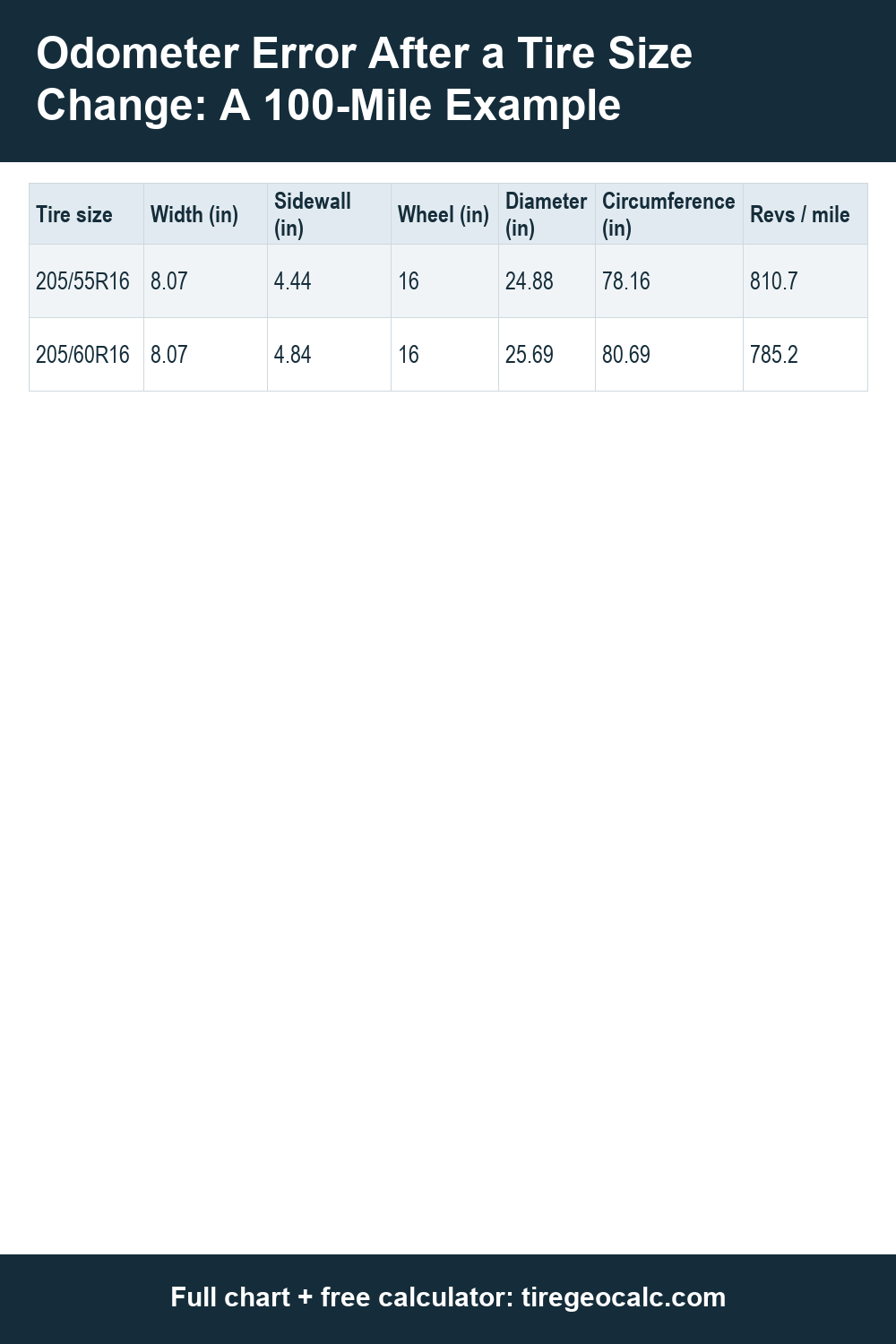
The first size is the reference. Dimensions are nominal calculations, not measured rolling data or vehicle fitment approval.
| Tire size | Width (mm) | Width (in) | Sidewall (mm) | Sidewall (in) | Wheel (mm) | Wheel (in) | Diameter (mm) | Diameter (in) | Circumference (mm) | Circumference (in) | Revolutions / mile | Revolutions / km | Diameter change (%) |
|---|---|---|---|---|---|---|---|---|---|---|---|---|---|
| 205/55R16 | 205 | 8.07 | 112.8 | 4.44 | 406.4 | 16 | 631.9 | 24.88 | 1985.2 | 78.16 | 810.7 | 503.7 | 0 |
| 205/60R16 | 205 | 8.07 | 123 | 4.84 | 406.4 | 16 | 652.4 | 25.69 | 2049.6 | 80.69 | 785.2 | 487.9 | 3.24 |
Nominal size-code geometry. Reference: 205/55R16. Display rounding only; not fitment approval.
- Tire size
- 205/55R16
- Width (mm)
- 205
- Width (in)
- 8.07
- Sidewall (mm)
- 112.8
- Sidewall (in)
- 4.44
- Wheel (mm)
- 406.4
- Wheel (in)
- 16
- Diameter (mm)
- 631.9
- Diameter (in)
- 24.88
- Circumference (mm)
- 1985.2
- Circumference (in)
- 78.16
- Revolutions / mile
- 810.7
- Revolutions / km
- 503.7
- Diameter change (%)
- 0
- Tire size
- 205/60R16
- Width (mm)
- 205
- Width (in)
- 8.07
- Sidewall (mm)
- 123
- Sidewall (in)
- 4.84
- Wheel (mm)
- 406.4
- Wheel (in)
- 16
- Diameter (mm)
- 652.4
- Diameter (in)
- 25.69
- Circumference (mm)
- 2049.6
- Circumference (in)
- 80.69
- Revolutions / mile
- 785.2
- Revolutions / km
- 487.9
- Diameter change (%)
- 3.24
| Indicated miles | Actual miles |
|---|---|
| 10 | 10.3 |
| 100 | 103.2 |
| 1000 | 1032.4 |
Original calibration assumed; actual distance = indicated × new / original diameter.
- Indicated miles
- 10
- Actual miles
- 10.3
- Indicated miles
- 100
- Actual miles
- 103.2
- Indicated miles
- 1000
- Actual miles
- 1032.4
Calculated dimensions are nominal, not measured rolling dimensions or vehicle fitment approval.
Identify the original distance reference
Start by separating the original size from the replacement size. Here, 205/55R16 is the original and 205/60R16 is the replacement. Both markings use a metric width, an aspect ratio, and a wheel diameter in inches. Keeping the width and wheel diameter unchanged does not keep the outside diameter unchanged: the aspect ratio affects the sidewall height.
The model assumes the odometer was correctly calibrated to the original nominal geometry and has not been adjusted since the change. That is an assumption for the example, not a finding about a particular vehicle. An existing instrument error or a later calibration adjustment would change how this calculation should be applied.
Follow the diameter ratio through the trip
The original diameter in the table is 631.9 mm, and the replacement diameter is 652.4 mm. The formula in words is: actual distance equals indicated distance multiplied by the new diameter divided by the old diameter. For this direction of change, the new diameter belongs above the old diameter in the ratio.
The supplied derived rows give 10.324418420636176 miles for 10 indicated miles, 103.24418420636177 miles for 100 indicated miles, and 1032.4418420636177 miles for 1000 indicated miles. Those values are reproduced from the calculation table without a new rounding step. Their many decimal places describe the mathematical output, not the accuracy of a road measurement.
Explain why the odometer counts less
Imagine the instrument counting wheel revolutions and assigning the original distance to each count. A larger tire travels farther during that rotation in the geometric model. The odometer therefore credits less distance than the vehicle would cover under the stated assumptions. The direction matters: this example estimates more actual distance than indicated distance.
This is a proportional relationship, not a fixed number of miles to add to every trip. A correction that belongs to a short trip cannot simply be added unchanged to a longer trip. Keep the indicated trip distance attached to its own result, and label which column is indicated and which is modeled actual distance.
Keep circumference and display precision in context
The displayed circumference changes from 1985.2 mm to 2049.6 mm. These are nominal geometric circumferences calculated from size markings. They are not measurements of the distance a loaded tire rolls on pavement. Tire construction, wear, load, and operating conditions are outside this simple diameter comparison.
Use the supplied derived distance results rather than rebuilding the ratio from rounded inch values or rounded circumference entries. A displayed value is intended to make a table readable. Reusing it as a fresh calculation input can introduce another rounding difference. Preserve the original calculation precision and round only when presenting results under a defined display rule.
Apply the estimate to records with clear labels
For a trip log, retain the original indicated mileage and record any geometric estimate separately. That preserves the evidence if you later learn the vehicle had already been recalibrated. Applying this correction after a suitable recalibration could count the size change again and make the record less accurate.
The calculation does not establish a fuel consumption change, a service interval, or an official mileage adjustment. It only illustrates a distance scale under an explicit calibration assumption. If measured distance is needed, compare suitable independent distance evidence with the instrument and document the conditions. Agreement with a nominal table is not proof of instrument accuracy.
Separate the distance lesson from replacement approval
Similar dimensions do not provide vehicle fitment approval for either tire. The distance example cannot decide wheel suitability, body clearance, load capacity, inflation pressure, or compatibility with vehicle systems. Those questions require the vehicle instructions and the exact tire and wheel specifications.
Before using the correction outside this example, establish the actual original size, the replacement size, and the current calibration status. If any of those inputs are uncertain, keep the estimate labeled as hypothetical. The conclusion available here is the direction and scale of a nominal distance change, with its assumptions visible beside the numbers.
Frequently asked questions
Does this example show the odometer overcounting?
No. With the original calibration retained and the larger replacement fitted in the model, the indicated distance is less than the modeled actual distance.
Can I add the same mileage correction to every journey?
The relationship uses a diameter ratio, so the correction depends on the indicated journey length. A fixed addition would not represent that relationship.
Why are the derived distances shown with many decimals?
They are copied directly from the supplied calculation output. Decimal length does not establish corresponding precision in an actual vehicle measurement.
What changes if the instrument has been recalibrated?
The original reference assumption may no longer apply. Establish the current calibration before using an original-to-replacement diameter ratio.