TireGeoCalc
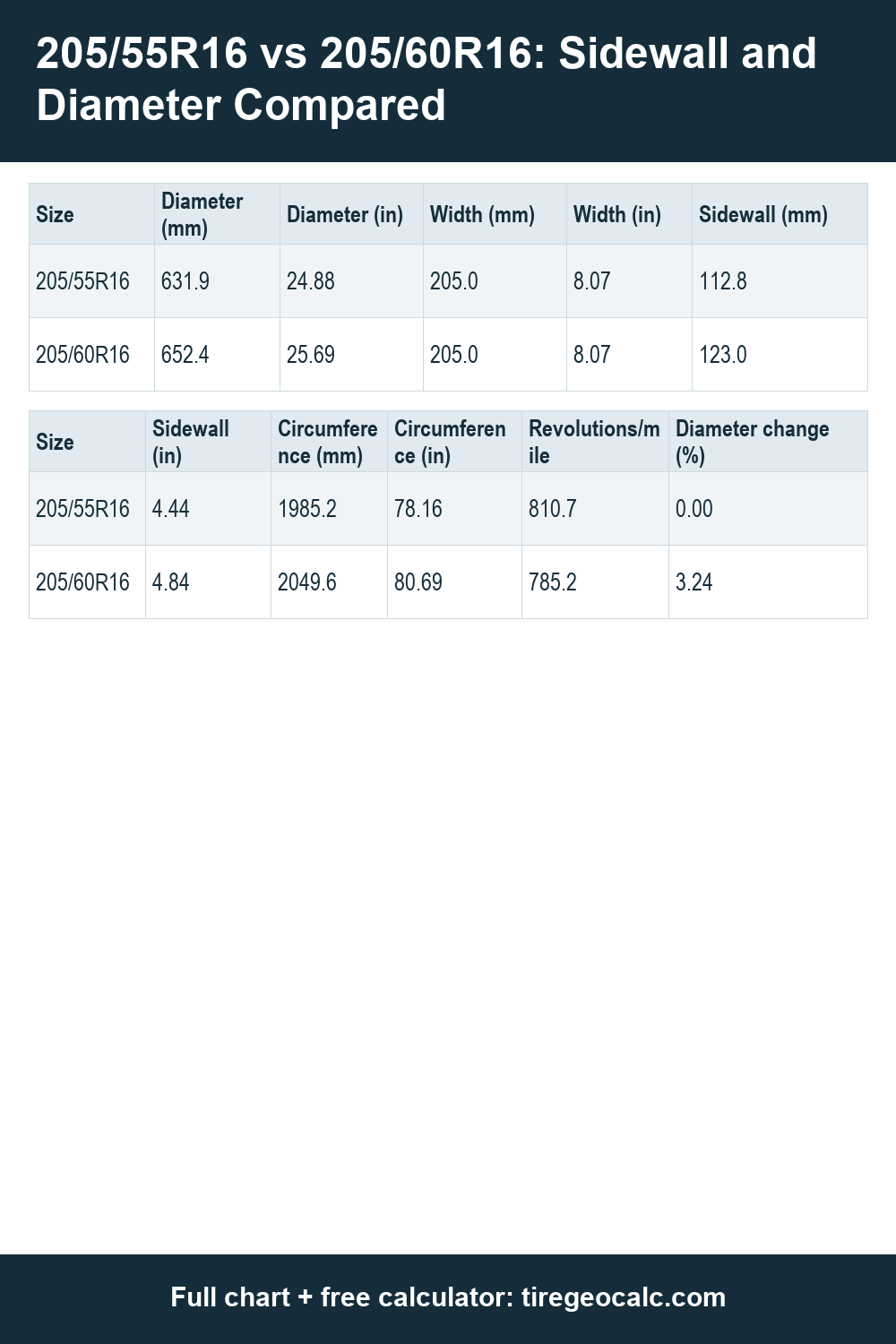
Five points of aspect ratio sounds like a tiny step. It is easy to picture it as five millimeters, but the ratio does not work that way. This page compares 205/55R16 with 205/60R16. Both are 205 mm wide and both sit on a 16 inch wheel, so the only change is the ratio, which rises from 55 to 60. We follow the result through the sidewall, the overall diameter, the circumference and the speedometer. The 205/55R16 size is the starting point, every figure comes from the table on this page, and every value is nominal geometry rather than a measurement from a vehicle.
Read these exact size markings
In both sizes, 205 is the nominal section width in millimeters and R16 means a radial tire for a 16 inch wheel. The middle number is the aspect ratio. It tells you the sidewall height as a percentage of the width. For 205/55R16 that is 55 percent, and for 205/60R16 it is 60 percent.
Because the width and wheel are the same, the rim figure stays at 406.4 mm in both rows of the table. That leaves the sidewall as the only moving part. The 205/55R16 sidewall is 112.8 mm and the 205/60R16 sidewall is 123 mm. Notice that the ratio steps are measured against the width, not against a fixed length, so five points means five percent of 205 mm on each side.
Work through this page's numerical example
Start with 205/55R16. Its overall diameter is 631.9 mm, or 24.88 inches. Its circumference is 1985.2 mm, or 78.16 inches, and it turns 810.7 times per mile and 503.7 times per kilometer. Its sidewall is 4.44 inches.
Now 205/60R16. Its overall diameter is 652.4 mm, or 25.69 inches. Its circumference is 2049.6 mm, or 80.69 inches, and it turns 785.2 times per mile and 487.9 times per kilometer. Its sidewall is 4.84 inches. The table lists the diameter change as 3.24 percent from the 205/55R16 baseline. The positive sign tells you the 205/60R16 tire is the taller one, and a taller tire turns fewer times over the same distance.
Explain the practical geometry difference
The overall diameter is the rim plus a sidewall on each side. When the ratio rises, both sidewalls grow, and the diameter feels the effect twice. This is why a small step in the ratio shows up as a larger step in the total height than the sidewall number alone suggests. The sidewall grows from 112.8 mm to 123 mm, and the full diameter moves from 631.9 mm to 652.4 mm.
Width plays no part in this change because it is identical. If you only looked at the width on the sidewall marking you would think nothing had changed. The ratio is the number that carries the height. When you compare two sizes, read all three numbers and not only the first one.
See what the speedometer would read
A speedometer counts turns of the wheel and assumes one tire size. A taller tire covers more road with each turn, so the real speed ends up above the dial. The table assumes 205/55R16 is the size the speedometer expects. With 205/60R16, a dial reading of 30 mph means 31 mph in real speed. A dial reading of 60 mph means 61.9 mph. A dial reading of 75 mph means 77.4 mph.
The gap grows with speed, which is simply what a percentage difference does. These values apply only if the original calibration was for the 205/55R16 size, and they come from nominal geometry, so they show direction and rough size and not a result measured on a vehicle.
Understand nominal dimensions and rounding
Every number here is nominal. It comes from the printed marking and from geometry, not from a tire carrying weight on the road. Real tires flex under load, change as they wear and differ a little by maker, so a measured rolling circumference can differ from the figures in the table.
Rounding is only a matter of display. The table works with full precision and rounds at the end. A hand calculation with rounded inputs can land a small step away from the table, and that gap is a rounding effect, not an error in the page.
Check what the calculation cannot decide
A similar or close diameter is not approval for any vehicle. This page does not say whether either size will mount on your wheel, clear the suspension and body, or match the sizes the maker lists. It also does not cover inflation pressure, load capacity, ride comfort or fuel use.
Use the table to understand how the ratio moves the height. Then check the vehicle placard, the owner manual and a qualified tire professional before you decide. The comparison answers a geometry question and stops there.