TireGeoCalc
Going up one wheel size often comes with a lower sidewall, and the two changes pull in opposite directions. This page compares 195/65R15 with 205/55R16. The second size has a wider tread, a bigger wheel and a lower aspect ratio all at once. That is three changes in one step, which makes it a good test of how they combine. We use 195/65R15 as the starting point and follow the numbers through the sidewall, the overall diameter, the circumference and the speedometer. All figures come from the table on this page, and all of them are nominal geometry and not measurements taken on a vehicle.
Read these exact size markings
In 195/65R15 the width is 195 mm, the aspect ratio is 65 and the wheel is 15 inches. In 205/55R16 the width is 205 mm, the aspect ratio is 55 and the wheel is 16 inches. Each number moves, so you have to read all three to see the result.
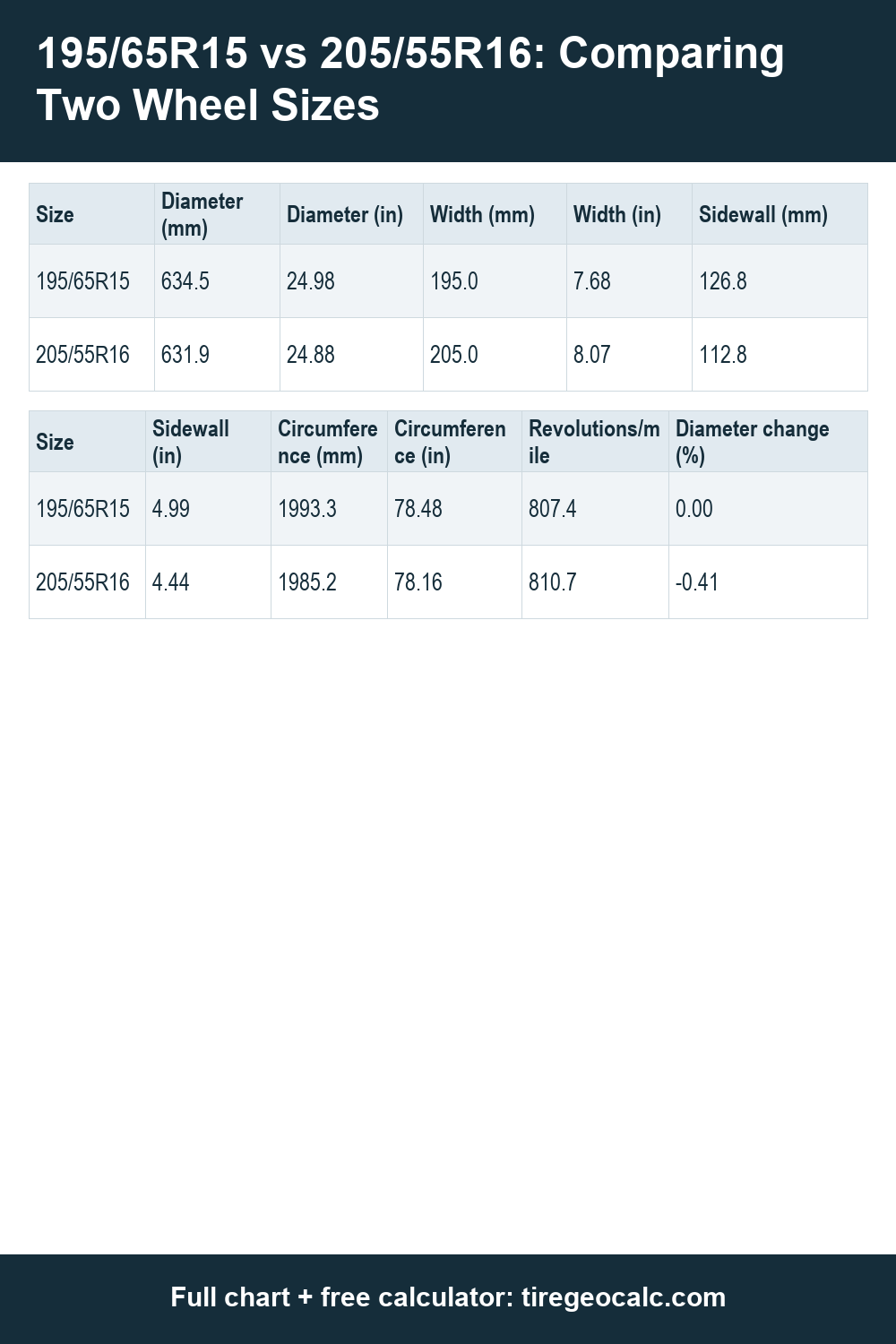
The table shows the wheel and the sidewall pulling against each other. The rim grows from 381 mm to 406.4 mm. The sidewall shrinks from 126.8 mm to 112.8 mm. The width grows from 195 mm to 205 mm, which in inches is 7.68 and 8.07. Width raises the sidewall a little through the ratio, but the lower ratio takes more than it gives.
Work through this page's numerical example
Start with 195/65R15. Its overall diameter is 634.5 mm, or 24.98 inches. Its circumference is 1993.3 mm, or 78.48 inches, and it turns 807.4 times per mile and 501.7 times per kilometer. Its sidewall is 4.99 inches.
Now 205/55R16. Its overall diameter is 631.9 mm, or 24.88 inches. Its circumference is 1985.2 mm, or 78.16 inches, and it turns 810.7 times per mile and 503.7 times per kilometer. Its sidewall is 4.44 inches. The table lists the diameter change as minus 0.41 percent from the 195/65R15 baseline. The minus sign means the new size is slightly smaller overall, even though the wheel is larger.
Explain the practical geometry difference
Overall diameter is the rim plus a sidewall on each side. A bigger rim adds height in the middle of the stack. A lower sidewall removes height at both ends. In this pair the two nearly cancel, and the diameters end up at 634.5 mm and 631.9 mm.
This is the main reason people compare total diameter and not wheel size. A wheel that is one inch larger does not make the tire one inch larger. What changes is how the height is shared between metal and rubber. The 16 inch wheel gets a bigger share, and the sidewall gets a smaller share. The tread is wider too, so the tire looks different from the front even though its overall height is so close.
See what the speedometer would read
A speedometer counts wheel turns and assumes a tire size. A slightly smaller tire covers a little less road per turn, so the real speed sits a little below the dial. The table assumes 195/65R15 is the size the speedometer expects. With 205/55R16, a dial reading of 30 mph means 29.9 mph in real speed. A dial reading of 60 mph means 59.8 mph. A dial reading of 75 mph means 74.7 mph.
The gap is small because the diameters are close. If the original calibration was for a different size, the starting point changes and so do the results.
Understand nominal dimensions and rounding
The numbers on this page are nominal, which means they come from the size marking and simple geometry. A tire on a vehicle flexes under load, changes with wear and varies a little by maker, so a measured rolling circumference can differ from the nominal figure.
Rounding is applied only to what you see. The sidewall of 126.8 mm in the table is a rounded display of a longer number inside the calculation. Redoing the math with rounded inputs can land a small step away from the table, and that is only rounding.
Check what the calculation cannot decide
A close diameter is not approval for a vehicle. This page does not say whether a 16 inch wheel with a wider tire will mount on your car, clear the brakes, suspension and body, or match what the maker allows. It also does not cover pressure, load capacity, comfort or fuel use.
Use the table to see how wheel size and sidewall trade against each other. Then check the vehicle placard, the owner manual and a qualified tire professional before you decide. The comparison answers a geometry question and nothing more.