 TireGeoCalc
Different Tire Widths with Similar Diameters: Worked Examples
Quick answer
Nominal geometryTable example: 195/65R15 → 205/60R15 · original-size calibration assumed
- 205/60R15 diameter
- 24.69in
- Diameter change
- -1.18%
- Actual at indicated 60 mph
- 59.29mph
Calculated from size markings. Not measured rolling dimensions or vehicle fitment approval.
Published
These examples show why a tire can become wider without becoming taller than the starting size. The fixed reference is 195/65R15. Against it, 205/60R15 is wider but shorter, while 215/60R15 is wider and taller in the nominal calculation. Each comparison returns to the reference rather than stepping through the rows in sequence. Nearby overall diameters should not be mistaken for equal widths, identical shapes or approval to exchange tires on a vehicle.
Nominal geometry for these tire sizes
The first size is the reference. Dimensions are nominal calculations, not measured rolling data or vehicle fitment approval.
| Tire size | Width (mm) | Width (in) | Sidewall (mm) | Sidewall (in) | Wheel (mm) | Wheel (in) | Diameter (mm) | Diameter (in) | Circumference (mm) | Circumference (in) | Revolutions / mile | Revolutions / km | Diameter change (%) |
|---|---|---|---|---|---|---|---|---|---|---|---|---|---|
| 195/65R15 | 195 | 7.68 | 126.8 | 4.99 | 381 | 15 | 634.5 | 24.98 | 1993.3 | 78.48 | 807.4 | 501.7 | 0 |
| 205/60R15 | 205 | 8.07 | 123 | 4.84 | 381 | 15 | 627 | 24.69 | 1969.8 | 77.55 | 817 | 507.7 | -1.18 |
| 215/60R15 | 215 | 8.46 | 129 | 5.08 | 381 | 15 | 639 | 25.16 | 2007.5 | 79.03 | 801.7 | 498.1 | 0.71 |
Nominal size-code geometry. Reference: 195/65R15. Display rounding only; not fitment approval.
- Tire size
- 195/65R15
- Width (mm)
- 195
- Width (in)
- 7.68
- Sidewall (mm)
- 126.8
- Sidewall (in)
- 4.99
- Wheel (mm)
- 381
- Wheel (in)
- 15
- Diameter (mm)
- 634.5
- Diameter (in)
- 24.98
- Circumference (mm)
- 1993.3
- Circumference (in)
- 78.48
- Revolutions / mile
- 807.4
- Revolutions / km
- 501.7
- Diameter change (%)
- 0
- Tire size
- 205/60R15
- Width (mm)
- 205
- Width (in)
- 8.07
- Sidewall (mm)
- 123
- Sidewall (in)
- 4.84
- Wheel (mm)
- 381
- Wheel (in)
- 15
- Diameter (mm)
- 627
- Diameter (in)
- 24.69
- Circumference (mm)
- 1969.8
- Circumference (in)
- 77.55
- Revolutions / mile
- 817
- Revolutions / km
- 507.7
- Diameter change (%)
- -1.18
- Tire size
- 215/60R15
- Width (mm)
- 215
- Width (in)
- 8.46
- Sidewall (mm)
- 129
- Sidewall (in)
- 5.08
- Wheel (mm)
- 381
- Wheel (in)
- 15
- Diameter (mm)
- 639
- Diameter (in)
- 25.16
- Circumference (mm)
- 2007.5
- Circumference (in)
- 79.03
- Revolutions / mile
- 801.7
- Revolutions / km
- 498.1
- Diameter change (%)
- 0.71
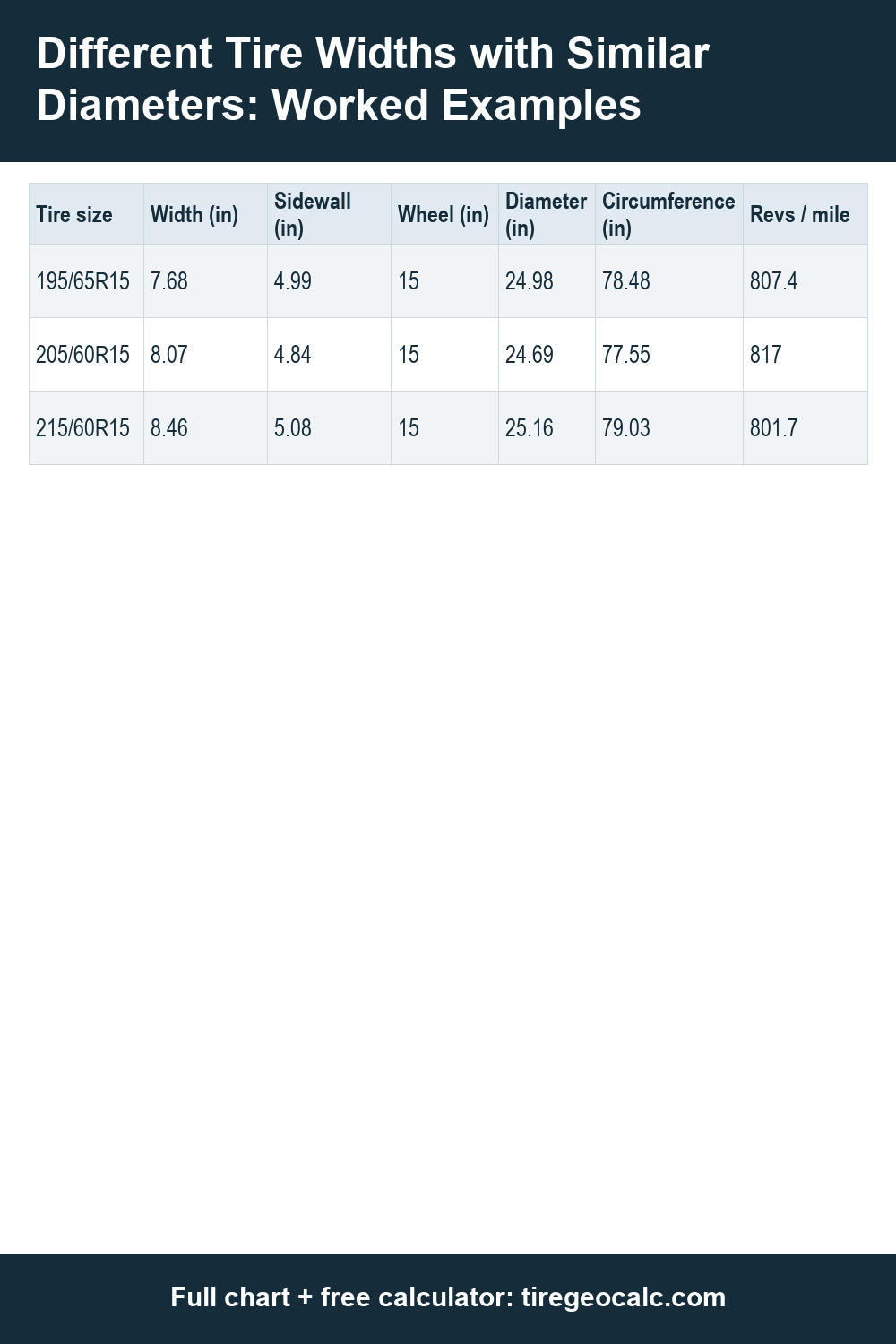
Calculated dimensions are nominal, not measured rolling dimensions or vehicle fitment approval.
Establish the reference before reading the alternatives
The 195/65R15 reference has a section width of 195 mm, a sidewall height of 126.8 mm and an overall diameter of 634.5 mm. In inches, those entries are 7.68, 4.99 and 24.98 respectively. The wheel diameter is 15 inches, also shown as 381 mm. This row supplies the baseline dimensions for every comparison on this page.
All the listed sizes use that wheel diameter, but the width and aspect-ratio inputs differ. The sidewall depends on the combination of those inputs rather than on either value alone. Keep the baseline row visible while reviewing a candidate. Otherwise it is easy to begin comparing the candidates with each other and lose the original question about changes from the reference.
Work through the wider but shorter candidate
For 205/60R15, width is 205 mm, or 8.07 inches. Its sidewall is 123 mm, or 4.84 inches, and its diameter is 627 mm, or 24.69 inches. Compare those entries directly with the reference diameter of 634.5 mm and width of 195 mm. This candidate increases nominal section width while its calculated overall height sits below the starting size.
This is the useful counterexample to the idea that a wider tire must always be taller. The aspect-ratio marking changes along with width, so the resulting sidewall is shorter here. The table illustrates the outcome for this specific combination. It does not create a general rule that increasing width reduces height, and it does not identify the candidate as an approved substitute.
Return to the baseline for the widest row
The 215/60R15 entry has a width of 215 mm, shown as 8.46 inches. Sidewall height is 129 mm, or 5.08 inches, and diameter is 639 mm, or 25.16 inches. Against 195/65R15 at 634.5 mm in diameter, this row is taller. Its width also exceeds the reference width, so the dimensional direction differs from the previous candidate.
Although the candidates share an aspect-ratio marking, their sidewall heights are not equal because their widths differ. That observation helps explain the group without changing the baseline. For a decision about either candidate, keep comparing with 195/65R15. Similar overall heights can coexist with different proportions between width and sidewall, which is precisely what a diameter-only shortlist would conceal.
Compare distance around each nominal circle
The reference circumference is 1993.3 mm, or 78.48 inches. For 205/60R15 it is 1969.8 mm, or 77.55 inches, below the reference. For 215/60R15 it is 2007.5 mm, or 79.03 inches, above the same reference. Circumference follows the direction of overall diameter here. These are calculated circle dimensions rather than measurements of a tire rolling under vehicle load.
The revolution counts reinforce the comparison: the reference gives 807.4 revolutions per mile, the shorter candidate gives 817, and the taller candidate gives 801.7. A smaller nominal circle needs more rotations for the same distance. Keep the size label beside each count when recording it; a list of unlabeled values would hide which side of the reference each candidate occupies.
Do not let a close height conceal the width check
A similar diameter does not authorize fitting any of these tires to a particular vehicle. Width and wheel details still matter, and nominal section width alone is not a clearance assessment. Check the exact tire specifications, the approved rim-width range, vehicle documentation, load and speed requirements and the space available around the assembly. The table cannot supply those missing checks.
The displayed figures are rounded descriptions of nominal geometry. They are useful for keeping the comparison consistent, but they should not be treated as measurements taken on your wheels. Preserve the full size codes when requesting exact product information. Neither the close heights nor the wider sections establish inflation pressure, carrying capacity, ride comfort or fuel consumption. Those questions require information beyond this dimensional exercise.
Frequently asked questions
Which row stays fixed throughout this group?
195/65R15 remains the reference. Both wider candidates are assessed against it, so the direction of each height and circumference change stays clear.
How can the middle row be wider but shorter?
Its width and aspect ratio change together. The resulting sidewall is 123 mm, below the reference sidewall of 126.8 mm, which produces a shorter overall diameter.
Do the candidates have equal sidewalls because their ratios match?
Their widths differ, so the same ratio is applied to different widths. Their displayed sidewall heights are 123 mm and 129 mm.
Does this group establish interchangeable tire sizes?
The group demonstrates nominal geometry only. Interchangeability requires the exact tire, wheel and vehicle specifications, not merely a nearby overall diameter.