 TireGeoCalc
285/75R16 vs 285/70R17: Similar Height, Different Sidewalls
Quick answer
Nominal geometry285/75R16 → 285/70R17 · original-size calibration assumed
- Diameter difference
- -0.12in
- Diameter change
- -0.37%
- Actual at indicated 60 mph
- 59.78mph
Calculated from size markings. Not measured rolling dimensions or vehicle fitment approval.
Published
Similar outside heights can hide a different balance between wheel and tire. In the comparison of 285/75R16 against 285/70R17, the larger wheel comes with a shorter nominal sidewall. The complete diameters remain close, even though the assemblies are not the same. Use 285/75R16 as the baseline throughout this page. The movement toward 285/70R17 is the direction being described. Keeping that direction clear makes it easier to separate the larger wheel from the slightly smaller overall tire diameter.
Nominal geometry for these tire sizes
The first size is the reference. Dimensions are nominal calculations, not measured rolling data or vehicle fitment approval.
| Tire size | Width (mm) | Width (in) | Sidewall (mm) | Sidewall (in) | Wheel (mm) | Wheel (in) | Diameter (mm) | Diameter (in) | Circumference (mm) | Circumference (in) | Revolutions / mile | Revolutions / km | Diameter change (%) | Actual at indicated 30 mph | Actual at indicated 60 mph | Actual at indicated 75 mph | Actual minus indicated at 60 mph |
|---|---|---|---|---|---|---|---|---|---|---|---|---|---|---|---|---|---|
| 285/75R16 | 285 | 11.22 | 213.8 | 8.42 | 406.4 | 16 | 833.9 | 32.83 | 2619.8 | 103.14 | 614.3 | 381.7 | 0 | 30 | 60 | 75 | 0 |
| 285/70R17 | 285 | 11.22 | 199.5 | 7.85 | 431.8 | 17 | 830.8 | 32.71 | 2610 | 102.76 | 616.6 | 383.1 | -0.37 | 29.9 | 59.8 | 74.7 | -0.2 |
Nominal size-code geometry. Reference: 285/75R16. Display rounding only; not fitment approval.
- Tire size
- 285/75R16
- Width (mm)
- 285
- Width (in)
- 11.22
- Sidewall (mm)
- 213.8
- Sidewall (in)
- 8.42
- Wheel (mm)
- 406.4
- Wheel (in)
- 16
- Diameter (mm)
- 833.9
- Diameter (in)
- 32.83
- Circumference (mm)
- 2619.8
- Circumference (in)
- 103.14
- Revolutions / mile
- 614.3
- Revolutions / km
- 381.7
- Diameter change (%)
- 0
- Actual at indicated 30 mph
- 30
- Actual at indicated 60 mph
- 60
- Actual at indicated 75 mph
- 75
- Actual minus indicated at 60 mph
- 0
- Tire size
- 285/70R17
- Width (mm)
- 285
- Width (in)
- 11.22
- Sidewall (mm)
- 199.5
- Sidewall (in)
- 7.85
- Wheel (mm)
- 431.8
- Wheel (in)
- 17
- Diameter (mm)
- 830.8
- Diameter (in)
- 32.71
- Circumference (mm)
- 2610
- Circumference (in)
- 102.76
- Revolutions / mile
- 616.6
- Revolutions / km
- 383.1
- Diameter change (%)
- -0.37
- Actual at indicated 30 mph
- 29.9
- Actual at indicated 60 mph
- 59.8
- Actual at indicated 75 mph
- 74.7
- Actual minus indicated at 60 mph
- -0.2
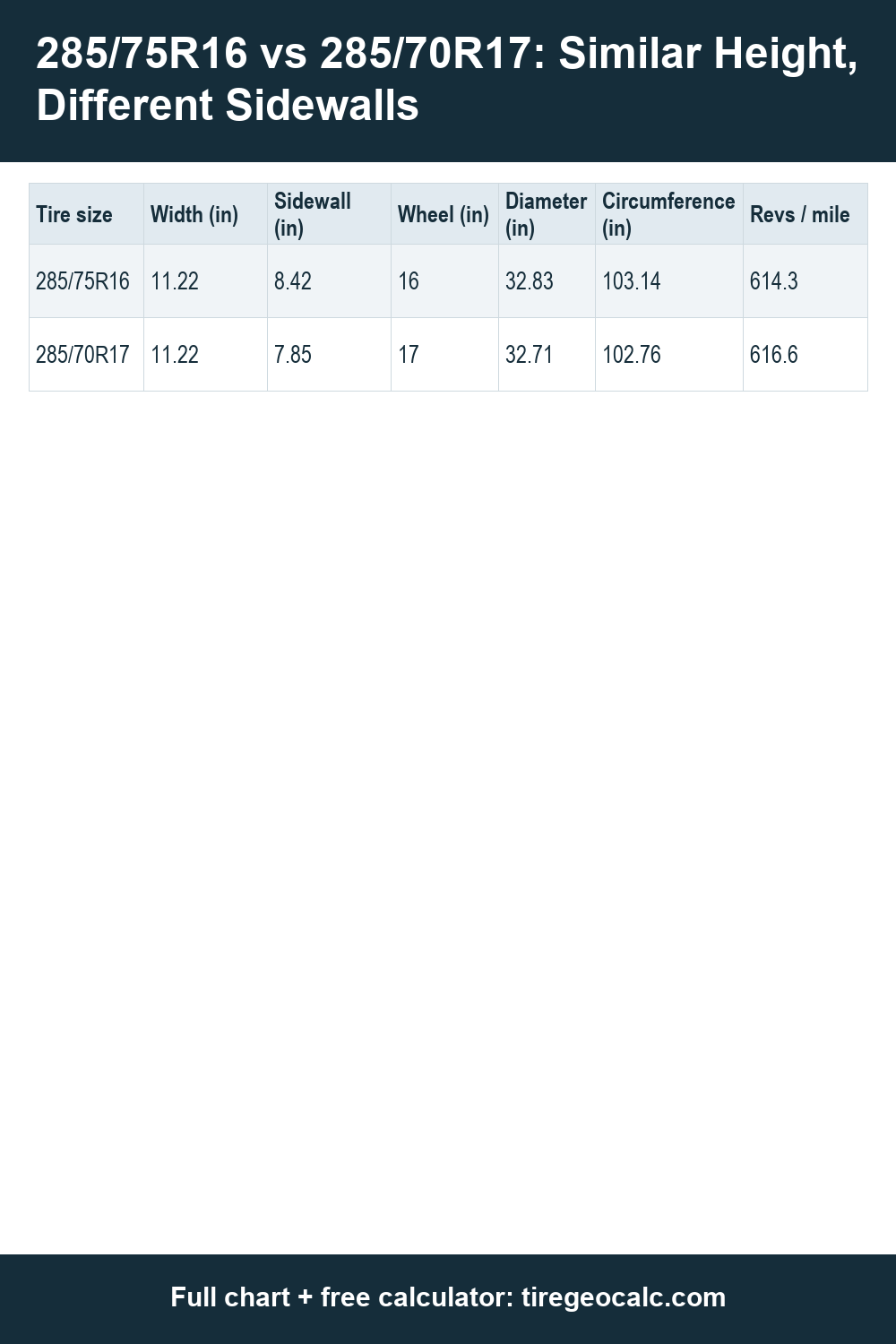
Calculated dimensions are nominal, not measured rolling dimensions or vehicle fitment approval.
Look inside the similar outer circles
Both rows list a nominal width of 285 mm, or 11.22 inches. Their wheel diameters differ: the baseline uses 16 inches, equivalent to 406.4 mm, and the candidate uses 17 inches, equivalent to 431.8 mm. Equal width therefore does not mean the same wheel opening or the same sidewall dimensions.
The aspect ratio is a proportion of the section width, not a sidewall measurement in inches. A lower proportion at the same width produces a shorter nominal sidewall. In this pair, that shorter sidewall accompanies the larger wheel. Reading the entire marking reveals that relationship, whereas looking at the wheel number alone leaves out the rubber surrounding it.
Compare the sidewalls before comparing outside height
Use the table for this worked example. The baseline sidewall is 213.8 mm, displayed as 8.42 inches. Its overall diameter is 833.9 mm, or 32.83 inches. The candidate sidewall is 199.5 mm, or 7.85 inches, and its overall diameter is 830.8 mm, or 32.71 inches. Read those entries beside the wheel diameters to see the change in proportions.
The candidate wheel is larger, yet the complete assembly is nominally a little shorter. The shorter sidewalls compensate for the wheel change and leave the outside diameters close. This does not make the sidewall figures interchangeable. They describe a different amount of radial height between the wheel and the tire's outside edge in each nominal assembly.
Avoid turning sidewall height into a ride prediction
A sidewall height value is a dimension. It is not a measurement of stiffness, impact behavior or comfort. This table supplies no construction data or driving evaluation that would let you rank how these tires feel. The visible difference in proportions is real within the model, but its meaning should stay within that model.
The same limit applies to load capacity and inflation pressure. Neither can be selected from sidewall height alone. If the reason for considering this pair is a change in ride behavior, the dimensional comparison answers only part of the question. The exact tire specifications and vehicle requirements remain necessary, and this page does not substitute a predicted driving result for that information.
Read the circumference entries without overstating precision
Circumference follows the slight difference in outside diameter. The baseline lists 2619.8 mm, or 103.14 inches, and the candidate lists 2610 mm, or 102.76 inches. Their revolutions per mile values are 614.3 and 616.6. The smaller nominal circumference corresponds to more theoretical turns over a mile.
These results come from the size codes, not from measuring the tires on a vehicle. Millimeters are abbreviated mm, while inches provide another way to express the length entries. Presentation rounding can make some entries look more precise than others, so use the supplied figures without extending their decimal places. They are not measurements of rolling circumference or loaded radius.
Treat the wheel change as a separate compatibility question
Close outside diameters do not provide vehicle fitment approval. The wheel diameter specified by each tire is different, so this comparison cannot justify fitting the candidate to the baseline wheel. It describes alternative nominal assemblies rather than a swap on an unchanged wheel.
An assessment of a complete replacement needs the vehicle documentation and the exact wheel and tire specifications. Wheel width, wheel position and clearance must be checked alongside the required ratings. The similar height is useful for understanding the geometry, but it cannot establish those other details. Keep the baseline and candidate labels on any notes you share, and describe the result as similar total height with different wheel and sidewall dimensions. That wording preserves the actual finding without implying identical construction or approved installation.
Frequently asked questions
Which assembly has the larger wheel?
The candidate 285/70R17 specifies a 17 inch wheel, while 285/75R16 specifies a 16 inch wheel.
Which row has more sidewall height?
The baseline shows 213.8 mm of nominal sidewall height, compared with 199.5 mm for the candidate.
Do the close diameters mean the tires use the same wheel?
They do not. Outside diameter and the wheel diameter named in the tire marking are different measurements.
Can the comparison predict ride comfort?
No comfort testing is included. Sidewall height describes geometry and does not establish how a particular tire behaves on the road.