 TireGeoCalc
255/85R16 vs 285/75R16: Narrow and Tall Compared with Wide
Quick answer
Nominal geometry255/85R16 → 285/75R16 · original-size calibration assumed
- Diameter difference
- -0.24in
- Diameter change
- -0.71%
- Actual at indicated 60 mph
- 59.57mph
Calculated from size markings. Not measured rolling dimensions or vehicle fitment approval.
Published
A narrow tire can stand taller than a wider tire when its sidewall proportion is higher. That is the pattern shown by 255/85R16 and 285/75R16. This comparison starts with 255/85R16 as the reference and reads 285/75R16 as the candidate. The candidate adds nominal width while reducing overall height slightly. The purpose is to explain that shape difference using the supplied dimensions. It is not a ranking for terrain, traction or driving conditions, none of which are tested by the size code.
Nominal geometry for these tire sizes
The first size is the reference. Dimensions are nominal calculations, not measured rolling data or vehicle fitment approval.
| Tire size | Width (mm) | Width (in) | Sidewall (mm) | Sidewall (in) | Wheel (mm) | Wheel (in) | Diameter (mm) | Diameter (in) | Circumference (mm) | Circumference (in) | Revolutions / mile | Revolutions / km | Diameter change (%) | Actual at indicated 30 mph | Actual at indicated 60 mph | Actual at indicated 75 mph | Actual minus indicated at 60 mph |
|---|---|---|---|---|---|---|---|---|---|---|---|---|---|---|---|---|---|
| 255/85R16 | 255 | 10.04 | 216.8 | 8.53 | 406.4 | 16 | 839.9 | 33.07 | 2638.6 | 103.88 | 609.9 | 379 | 0 | 30 | 60 | 75 | 0 |
| 285/75R16 | 285 | 11.22 | 213.8 | 8.42 | 406.4 | 16 | 833.9 | 32.83 | 2619.8 | 103.14 | 614.3 | 381.7 | -0.71 | 29.8 | 59.6 | 74.5 | -0.4 |
Nominal size-code geometry. Reference: 255/85R16. Display rounding only; not fitment approval.
- Tire size
- 255/85R16
- Width (mm)
- 255
- Width (in)
- 10.04
- Sidewall (mm)
- 216.8
- Sidewall (in)
- 8.53
- Wheel (mm)
- 406.4
- Wheel (in)
- 16
- Diameter (mm)
- 839.9
- Diameter (in)
- 33.07
- Circumference (mm)
- 2638.6
- Circumference (in)
- 103.88
- Revolutions / mile
- 609.9
- Revolutions / km
- 379
- Diameter change (%)
- 0
- Actual at indicated 30 mph
- 30
- Actual at indicated 60 mph
- 60
- Actual at indicated 75 mph
- 75
- Actual minus indicated at 60 mph
- 0
- Tire size
- 285/75R16
- Width (mm)
- 285
- Width (in)
- 11.22
- Sidewall (mm)
- 213.8
- Sidewall (in)
- 8.42
- Wheel (mm)
- 406.4
- Wheel (in)
- 16
- Diameter (mm)
- 833.9
- Diameter (in)
- 32.83
- Circumference (mm)
- 2619.8
- Circumference (in)
- 103.14
- Revolutions / mile
- 614.3
- Revolutions / km
- 381.7
- Diameter change (%)
- -0.71
- Actual at indicated 30 mph
- 29.8
- Actual at indicated 60 mph
- 59.6
- Actual at indicated 75 mph
- 74.5
- Actual minus indicated at 60 mph
- -0.4
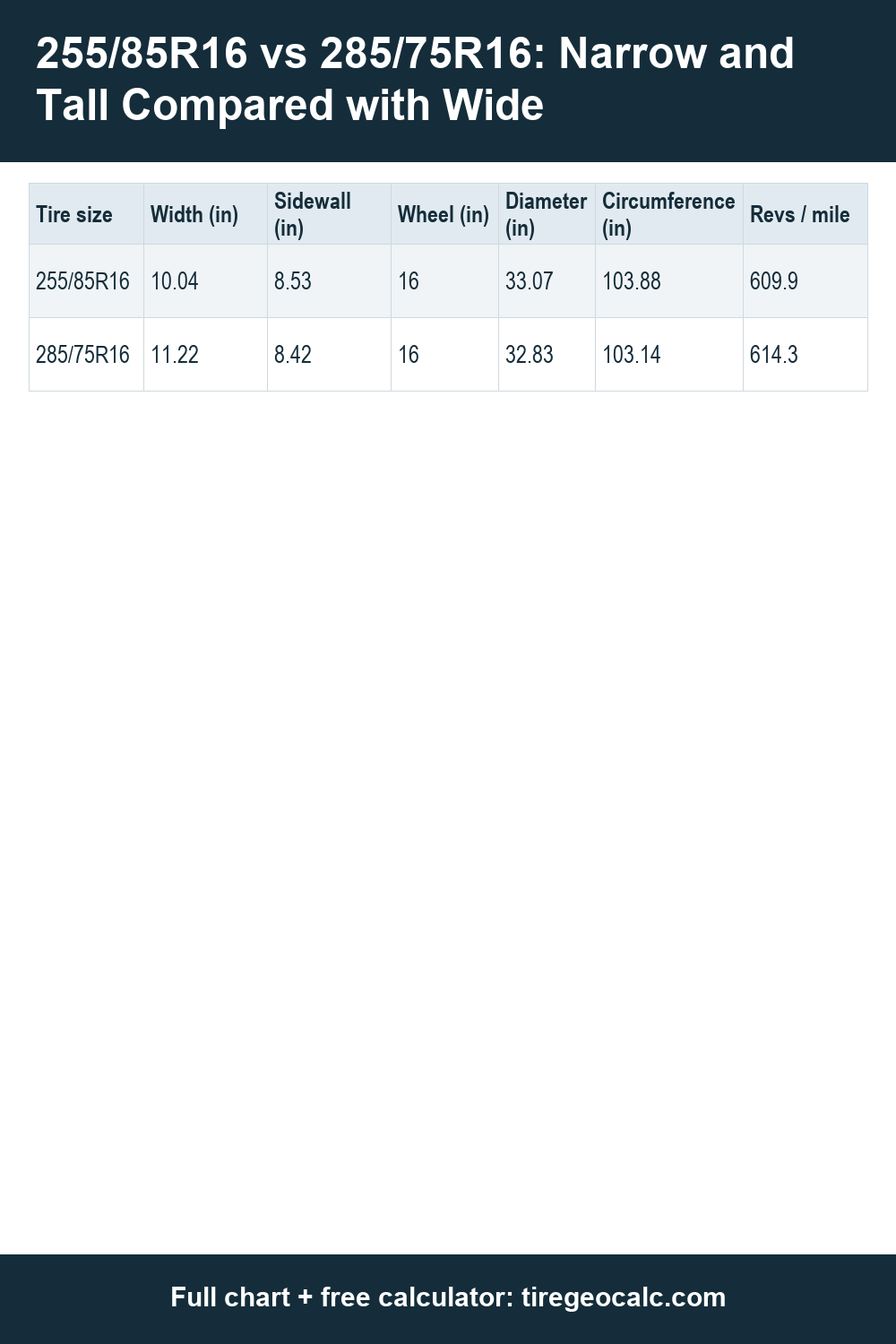
Calculated dimensions are nominal, not measured rolling dimensions or vehicle fitment approval.
Understand what narrow and tall describe here
The reference width is 255 mm, shown as 10.04 inches. The candidate width is 285 mm, or 11.22 inches. In this context, narrow and wide refer to nominal section width across the tire. They do not describe a measured tread width or specify the size and shape of the loaded contact patch.
Both tires name a wheel diameter of 16 inches, which the table expresses as 406.4 mm. The width and sidewall proportion are the parts of the marking that change. A larger aspect ratio means a taller sidewall relative to width, so the narrower reference can still have the taller sidewall. This pair demonstrates why width should not stand in for total size.
Follow the narrow reference through a worked comparison
Read the reference sidewall height of 216.8 mm, or 8.53 inches, alongside its diameter of 839.9 mm, or 33.07 inches. Next, read the candidate sidewall height of 213.8 mm, or 8.42 inches, and its diameter of 833.9 mm, or 32.83 inches. These figures show the narrower row retaining more nominal height.
The wheel diameter remains unchanged, so the outside height difference follows the sidewall difference. There is no need to derive another rounded figure to explain the result. The table already supplies the relevant lengths in metric and inch form. When copying them, keep width, sidewall and overall diameter on separate lines so that similar height is not confused with similar width.
Do not turn the shape comparison into a terrain verdict
Descriptions such as narrow and tall are often used as shorthand for an intended type of driving. This table cannot support that shortcut. It contains dimensions from size markings, not tests on sand, mud, rock or pavement. It also does not compare tread patterns, compounds or tire construction.
Consequently, the wider candidate is not shown to offer better traction, and the narrower reference is not shown to perform better in any particular conditions. Even the contact patch is outside the calculation because the page has no loaded footprint measurement. If terrain performance is your main question, keep it separate from this geometric result and look for evidence about the exact tire and intended use.
Relate the taller outline to circumference
The reference circumference is 2638.6 mm, equivalent to 103.88 inches. The candidate circumference is 2619.8 mm, or 103.14 inches. The nominal revolutions per mile values are 609.9 for the reference and 614.3 for the candidate. The taller reference therefore has the longer circumference and makes fewer theoretical turns over the same distance.
Those entries describe circular geometry, not measured rolling distance with a vehicle resting on the tires. The abbreviation mm means millimeters; inches express length in the other unit shown here. All quoted values retain the table's display rounding. Using the rounded values to create extra conversion digits would suggest precision that the display does not provide.
Use the dimensional result without assuming a replacement
The supported conclusion is that the reference is narrower and slightly taller, while the candidate is wider and slightly shorter. Similar overall diameter is not an approval to install either size on a vehicle. Nor does the common wheel diameter establish that an existing wheel has a suitable width for both exact tires.
Check the vehicle's requirements and the specifications for the actual wheel and tire before making an installation decision. Ratings, clearances and the permitted wheel dimensions are separate matters. The size comparison does not prescribe inflation pressure or prove load capacity, comfort or fuel consumption. Bring the full markings to any assessment so that a general description such as narrow and tall does not replace the exact equipment details. The value of this page is a clear account of shape, with the limits of that account kept visible.
Frequently asked questions
Is the narrower tire also shorter?
For this pair it is taller: 255/85R16 has a displayed diameter of 839.9 mm, while 285/75R16 has a diameter of 833.9 mm.
Does either shape prove better off-road performance?
No terrain testing appears in the calculation. Width and height cannot establish how an exact tire performs on a given surface.
What does the common R16 ending tell me?
It identifies radial construction and the same nominal wheel diameter. It does not confirm an acceptable wheel width or vehicle fit.
Which size makes fewer theoretical turns per mile?
The reference lists 609.9 revolutions per mile, below the candidate value of 614.3, consistent with its larger nominal circumference.