 TireGeoCalc
35x12.50R17 vs 315/70R17: Comparing Two Size Systems
Quick answer
Nominal geometry35X12.50R17 → 315/70R17 · original-size calibration assumed
- Diameter difference
- -0.64in
- Diameter change
- -1.82%
- Actual at indicated 60 mph
- 58.91mph
Calculated from size markings. Not measured rolling dimensions or vehicle fitment approval.
Published
A comparison between 35x12.50R17 and 315/70R17 needs more than a general description of a large tire. Their nominal widths are relatively close in the supplied table, yet their outside diameters are different. The distinction matters when interpreting height, circumference, and a speed calculation. This page uses the flotation entry as the original reference throughout, so the direction of each result stays clear. It does not identify either size as an approved replacement for the other.
Nominal geometry for these tire sizes
The first size is the reference. Dimensions are nominal calculations, not measured rolling data or vehicle fitment approval.
| Tire size | Width (mm) | Width (in) | Sidewall (mm) | Sidewall (in) | Wheel (mm) | Wheel (in) | Diameter (mm) | Diameter (in) | Circumference (mm) | Circumference (in) | Revolutions / mile | Revolutions / km | Diameter change (%) | Actual at indicated 30 mph | Actual at indicated 60 mph | Actual at indicated 75 mph | Actual minus indicated at 60 mph |
|---|---|---|---|---|---|---|---|---|---|---|---|---|---|---|---|---|---|
| 35x12.50R17 | 317.5 | 12.5 | 228.6 | 9 | 431.8 | 17 | 889 | 35 | 2792.9 | 109.96 | 576.2 | 358.1 | 0 | 30 | 60 | 75 | 0 |
| 315/70R17 | 315 | 12.4 | 220.5 | 8.68 | 431.8 | 17 | 872.8 | 34.36 | 2742 | 107.95 | 586.9 | 364.7 | -1.82 | 29.5 | 58.9 | 73.6 | -1.1 |
Nominal size-code geometry. Reference: 35x12.50R17. Display rounding only; not fitment approval.
- Tire size
- 35x12.50R17
- Width (mm)
- 317.5
- Width (in)
- 12.5
- Sidewall (mm)
- 228.6
- Sidewall (in)
- 9
- Wheel (mm)
- 431.8
- Wheel (in)
- 17
- Diameter (mm)
- 889
- Diameter (in)
- 35
- Circumference (mm)
- 2792.9
- Circumference (in)
- 109.96
- Revolutions / mile
- 576.2
- Revolutions / km
- 358.1
- Diameter change (%)
- 0
- Actual at indicated 30 mph
- 30
- Actual at indicated 60 mph
- 60
- Actual at indicated 75 mph
- 75
- Actual minus indicated at 60 mph
- 0
- Tire size
- 315/70R17
- Width (mm)
- 315
- Width (in)
- 12.4
- Sidewall (mm)
- 220.5
- Sidewall (in)
- 8.68
- Wheel (mm)
- 431.8
- Wheel (in)
- 17
- Diameter (mm)
- 872.8
- Diameter (in)
- 34.36
- Circumference (mm)
- 2742
- Circumference (in)
- 107.95
- Revolutions / mile
- 586.9
- Revolutions / km
- 364.7
- Diameter change (%)
- -1.82
- Actual at indicated 30 mph
- 29.5
- Actual at indicated 60 mph
- 58.9
- Actual at indicated 75 mph
- 73.6
- Actual minus indicated at 60 mph
- -1.1
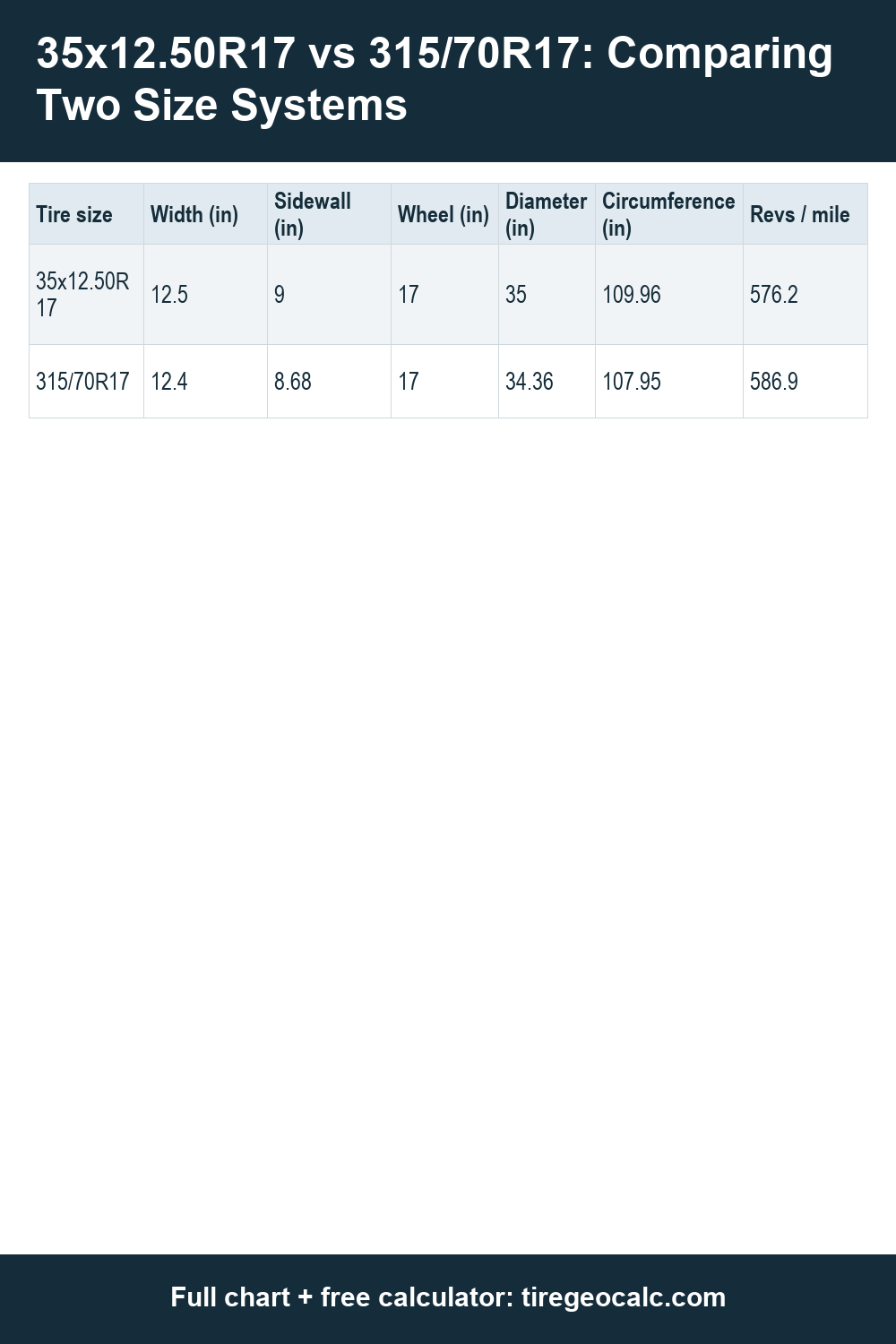
Calculated dimensions are nominal, not measured rolling dimensions or vehicle fitment approval.
Start with the meaning of the leading numbers
The 35 at the beginning of 35x12.50R17 is a nominal tire diameter in inches. The 12.50 is a nominal width in inches, followed by radial construction and a wheel diameter of 17 inches. This flotation system supplies the outside diameter directly as part of the designation.
By contrast, the leading 315 in 315/70R17 is a width in millimeters, not an outside diameter. The 70 expresses sidewall height relative to that width. Reading the leading values as though they measured the same thing would therefore compare diameter with width. Convert the completed geometry into common units before drawing a dimensional conclusion.
Build the metric picture without renaming the tire
The metric row displays a sidewall height of 220.5 mm and a wheel diameter of 431.8 mm. In words, its outside diameter comes from the wheel diameter plus twice the calculated sidewall height. The resulting table diameter is 872.8 mm, displayed in inches as 34.36.
That inch result does not change the designation into 35x12.50R17. It remains a calculation associated with 315/70R17. The flotation entry has a displayed outside diameter of 889 mm and a sidewall height of 228.6 mm. Keep the original labels attached to their values so that an approximate verbal description cannot erase the difference between them.
Check width independently of overall height
For width, the flotation row displays 317.5 mm, while the metric row displays 315 mm. In inches, the corresponding table entries are 12.5 and 12.4. These width figures are separate from the diameter figures and should be compared as their own dimension.
Nominal section width is not evidence of the space available around a tire on a vehicle. Nor does a close width comparison establish an approved wheel width. Product dimensions and wheel requirements are additional information. A useful comparison note should retain both dimensions rather than reducing the pair to a statement that the tires look roughly the same size.
Use the flotation reference to interpret speed
The reference circumference is displayed as 2792.9 mm for 35x12.50R17. The metric candidate has a displayed circumference of 2742 mm. With the instrument still calibrated to the flotation reference, the smaller candidate covers less modeled distance during a wheel revolution, so modeled actual speed is below indicated speed.
The speed rows show 29.5 mph at 30 indicated mph, 58.9 mph at 60 indicated mph, and 73.6 mph at 75 indicated mph. Each displayed result comes from the supplied table. These values describe a calculation with a stated original reference, not a finding that any vehicle's dashboard has those exact errors after a tire change.
Respect the nominal flotation warning
The flotation row carries a specific warning: its diameter is nominal, rather than derived from an aspect ratio. A nominal 35-inch label is not a substitute for the exact manufacturer's overall diameter specification. Product data must be read with its measuring conditions and relevant wheel information.
The metric row is also nominal geometry, even though it reaches diameter through a different calculation. Neither row supplies a measured loaded radius or measured rolling circumference. Retain full precision in underlying calculations and use the supplied rounded displays for presentation; do not rebuild a new comparison from already rounded inch entries and expect identical output.
Decide what evidence is still missing
Matching or nearby dimensions alone cannot give vehicle fitment approval. The table says nothing decisive about mounting clearance, wheel suitability, load capability, required inflation, comfort, or fuel use. Its role is to explain dimensions and the effect of choosing a calibration reference.
For an actual substitution, identify the exact tire products, the wheel specifications, and the vehicle requirements before treating either label as a candidate. Resolve any missing manufacturer information instead of assuming a size conversion completes the assessment. If the vehicle has already been recalibrated, establish that separately too; otherwise the nominal speed example could be applied to a reference the vehicle no longer uses.
Frequently asked questions
Why do close widths not establish equal diameter?
Width and diameter describe different dimensions. The metric aspect ratio determines how width contributes to sidewall height, while the flotation designation states nominal outside diameter directly.
Is the metric inch diameter a replacement flotation designation?
It is only another displayed unit for the calculated metric diameter. It does not rewrite the full size label or establish product equivalence.
Would reversing the original reference keep the speed example unchanged?
The supplied example assumes the flotation tire is original. Reversing the comparison changes the diameter ratio and requires a corresponding calculation.
Does the nominal warning apply only to the speed rows?
It concerns how flotation diameter is specified. That limitation also affects the nominal circumference and any derived comparison based on that diameter.