 TireGeoCalc
315/70R17 in Inches: Why the Size Code Is Not a Measurement
Quick answer
Nominal geometry315/70R17 · nominal size-code geometry
- Overall diameter
- 34.36in
- Section width
- 12.40in
- Sidewall height
- 8.68in
Calculated from size markings. Not measured rolling dimensions or vehicle fitment approval.
Published
The calculated diameter for 315/70R17 is 34.36 inches. The comparison row labeled 35x12.50R17 uses a nominal diameter of 35 inches. These labels belong to different ways of expressing tire size, and neither row proves a measured diameter on a vehicle. This page takes 315/70R17 as its reference and examines the flotation row only as a geometry illustration. A nearby nominal height does not make the labels equivalent or authorize a substitution.
Nominal geometry for these tire sizes
The first size is the reference. Dimensions are nominal calculations, not measured rolling data or vehicle fitment approval.
| Tire size | Width (mm) | Width (in) | Sidewall (mm) | Sidewall (in) | Wheel (mm) | Wheel (in) | Diameter (mm) | Diameter (in) | Circumference (mm) | Circumference (in) | Revolutions / mile | Revolutions / km | Diameter change (%) |
|---|---|---|---|---|---|---|---|---|---|---|---|---|---|
| 315/70R17 | 315 | 12.4 | 220.5 | 8.68 | 431.8 | 17 | 872.8 | 34.36 | 2742 | 107.95 | 586.9 | 364.7 | 0 |
| 35x12.50R17 | 317.5 | 12.5 | 228.6 | 9 | 431.8 | 17 | 889 | 35 | 2792.9 | 109.96 | 576.2 | 358.1 | 1.86 |
Nominal size-code geometry. Reference: 315/70R17. Display rounding only; not fitment approval.
- Tire size
- 315/70R17
- Width (mm)
- 315
- Width (in)
- 12.4
- Sidewall (mm)
- 220.5
- Sidewall (in)
- 8.68
- Wheel (mm)
- 431.8
- Wheel (in)
- 17
- Diameter (mm)
- 872.8
- Diameter (in)
- 34.36
- Circumference (mm)
- 2742
- Circumference (in)
- 107.95
- Revolutions / mile
- 586.9
- Revolutions / km
- 364.7
- Diameter change (%)
- 0
- Tire size
- 35x12.50R17
- Width (mm)
- 317.5
- Width (in)
- 12.5
- Sidewall (mm)
- 228.6
- Sidewall (in)
- 9
- Wheel (mm)
- 431.8
- Wheel (in)
- 17
- Diameter (mm)
- 889
- Diameter (in)
- 35
- Circumference (mm)
- 2792.9
- Circumference (in)
- 109.96
- Revolutions / mile
- 576.2
- Revolutions / km
- 358.1
- Diameter change (%)
- 1.86
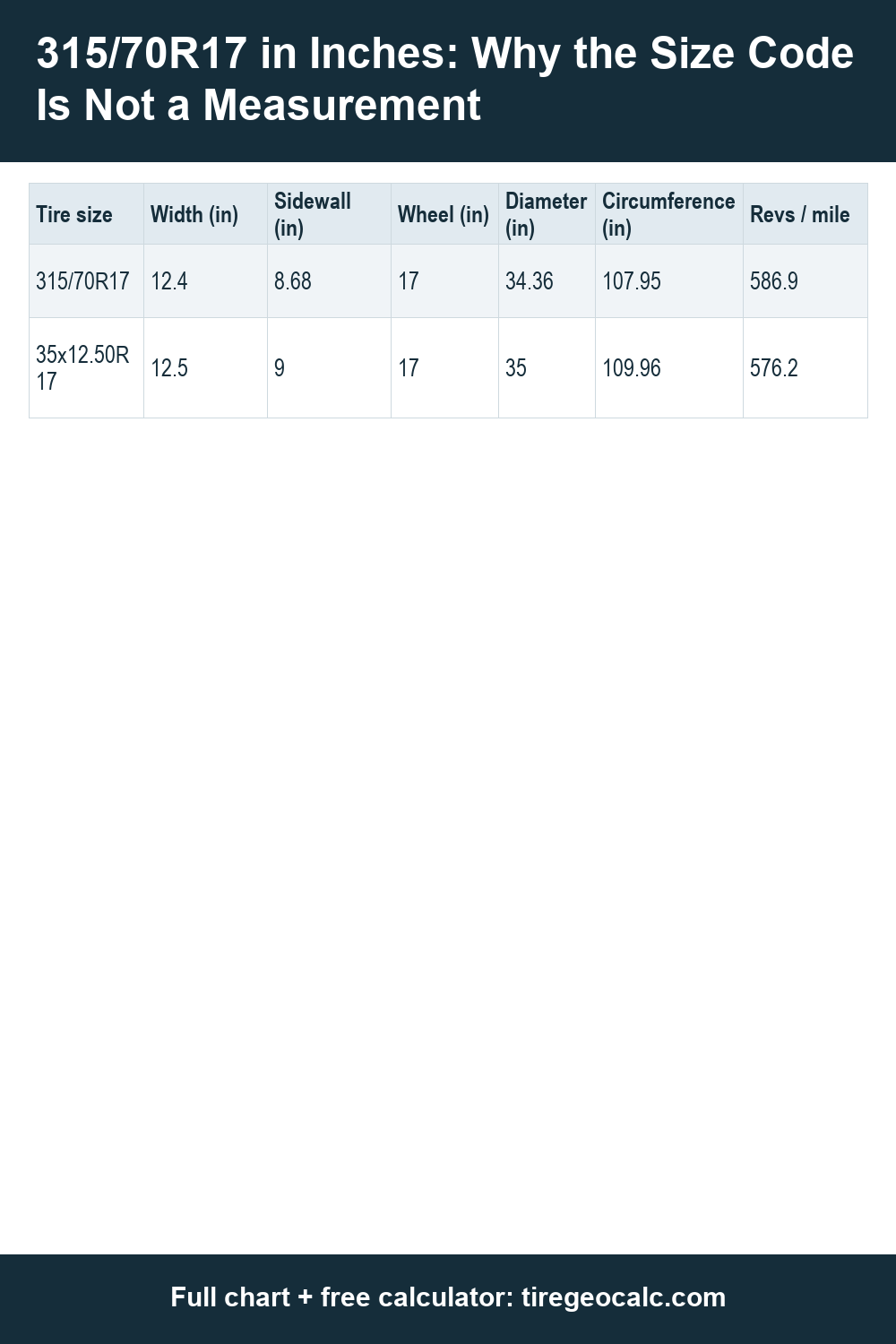
Calculated dimensions are nominal, not measured rolling dimensions or vehicle fitment approval.
Understand how the metric code describes a shape
In the metric row, nominal width is 315 mm, shown as 12.4 inches. The sidewall is calculated from the width and the aspect-ratio part of the code. The resulting height is 220.5 mm, or 8.68 inches. The wheel diameter is 17 inches, with its metric entry shown as 431.8 mm. Each value describes a specific dimension rather than a measured complete product.
The size marking supplies the inputs for this shape. It does not report a measuring session with a particular tire, rim and load. A useful note should therefore say calculated diameter or nominal width, not measured height or tested clearance. That language preserves the distinction between interpreting a code and verifying the dimensions of an exact tire.
Read the flotation label on its own terms
The flotation example, 35x12.50R17, gives its nominal diameter directly in the marking. The table lists 35 inches for diameter, 12.5 inches for width and 9 inches for sidewall height. Unlike the metric row, its nominal diameter is not derived from an aspect ratio. That is the specific caution attached to this row in the source table.
Treat the flotation label as a named size description rather than a promise that an actual tire measures precisely that height. The row is present to illustrate a different notation system. It does not establish that the products carrying either marking share a construction, load rating, approved rim range or vehicle application. Those details remain outside the nominal comparison.
Work through the comparison without inventing an equivalent
Begin with 315/70R17 at 872.8 mm overall diameter, or 34.36 inches. Then read the flotation row at 889 mm, or 35 inches. The flotation illustration is taller than the metric reference in this calculation. Its width is 317.5 mm rather than the reference width of 315 mm. Both rows use the same listed wheel diameter, but their other dimensions differ.
Follow the circumference entries in the same order. The metric reference is 2742 mm, displayed as 107.95 inches; the flotation illustration is 2792.9 mm, displayed as 109.96 inches. These are paths around nominal circles. The comparison shows the direction of the dimensional change without claiming that either row describes the exact rolling distance of a tire under load.
See what the revolution figures add
The reference geometry produces 586.9 revolutions per mile, compared with 576.2 for the flotation illustration. The taller nominal circle needs fewer turns for that distance. This relationship follows the circumference entries and gives another way to read the comparison. It is not a speedometer test and does not predict a measured vehicle result for either size.
Keep the reference fixed when discussing a change: the flotation row is being considered against the metric row. Reversing that order would describe a move toward a smaller calculated diameter. Use the exact displayed entries rather than rounding the metric result to the name of another nominal size. A rounded nickname can hide the distinction that this example is intended to reveal.
Move from nominal labels to a real specification
A tire with a similar calculated diameter is not thereby approved for a vehicle. For a real decision, check the vehicle documentation, exact tire dimensions, load and speed ratings, approved rim width and the wheel specification. Clearance also needs a separate assessment. The nominal comparison cannot decide whether the assembly has suitable space through the vehicle movements relevant to the installation.
When collecting product information, keep the full code and the source of each measurement together. Ask whether a dimension is nominal, published under specified conditions or measured for the actual setup. This page supplies only the nominal geometric category. It does not determine pressure, capacity, handling, comfort or fuel use, and the flotation illustration should never be presented as a confirmed replacement for the metric reference.
Frequently asked questions
Does 315/70R17 mean a measured diameter of 35 inches?
Its calculated diameter here is 34.36 inches. The nominal flotation diameter belongs to a separate example, and neither entry is a measurement of your tire.
What does the flotation warning mean?
The flotation diameter is supplied as a nominal part of the marking. It is not obtained from the metric width-and-aspect-ratio calculation.
Which size is the starting point for this comparison?
The starting point is 315/70R17. The 35x12.50R17 entry is considered against that reference solely to illustrate nominal geometry.
Are the rows interchangeable because the wheel diameter matches?
No interchangeability follows from that match. Exact tire and wheel specifications and the vehicle requirements must be checked separately.
Continue your comparison
Reference tables: Load index chart and Speed rating chart.