 TireGeoCalc
275/70R18 in Inches: Reading the Complete Size
Quick answer
Nominal geometry275/70R18 · nominal size-code geometry
- Overall diameter
- 33.16in
- Section width
- 10.83in
- Sidewall height
- 7.58in
Calculated from size markings. Not measured rolling dimensions or vehicle fitment approval.
Published
The quickest way to misread 275/70R18 is to assume that every number uses the same unit. The marking mixes a millimeter width, a sidewall proportion and an inch wheel diameter. This guide keeps those meanings attached as the calculation moves toward a complete tire outline. The table's outside diameter is 33.16 inches, while its width is 10.83 inches. Neither value replaces the complete marking when you need to identify a tire or discuss a possible application.
Nominal geometry for these tire sizes
The first size is the reference. Dimensions are nominal calculations, not measured rolling data or vehicle fitment approval.
| Tire size | Width (mm) | Width (in) | Sidewall (mm) | Sidewall (in) | Wheel (mm) | Wheel (in) | Diameter (mm) | Diameter (in) | Circumference (mm) | Circumference (in) | Revolutions / mile | Revolutions / km | Diameter change (%) |
|---|---|---|---|---|---|---|---|---|---|---|---|---|---|
| 275/70R18 | 275 | 10.83 | 192.5 | 7.58 | 457.2 | 18 | 842.2 | 33.16 | 2645.8 | 104.17 | 608.3 | 378 | 0 |
Nominal size-code geometry. Reference: 275/70R18. Display rounding only; not fitment approval.
- Tire size
- 275/70R18
- Width (mm)
- 275
- Width (in)
- 10.83
- Sidewall (mm)
- 192.5
- Sidewall (in)
- 7.58
- Wheel (mm)
- 457.2
- Wheel (in)
- 18
- Diameter (mm)
- 842.2
- Diameter (in)
- 33.16
- Circumference (mm)
- 2645.8
- Circumference (in)
- 104.17
- Revolutions / mile
- 608.3
- Revolutions / km
- 378
- Diameter change (%)
- 0
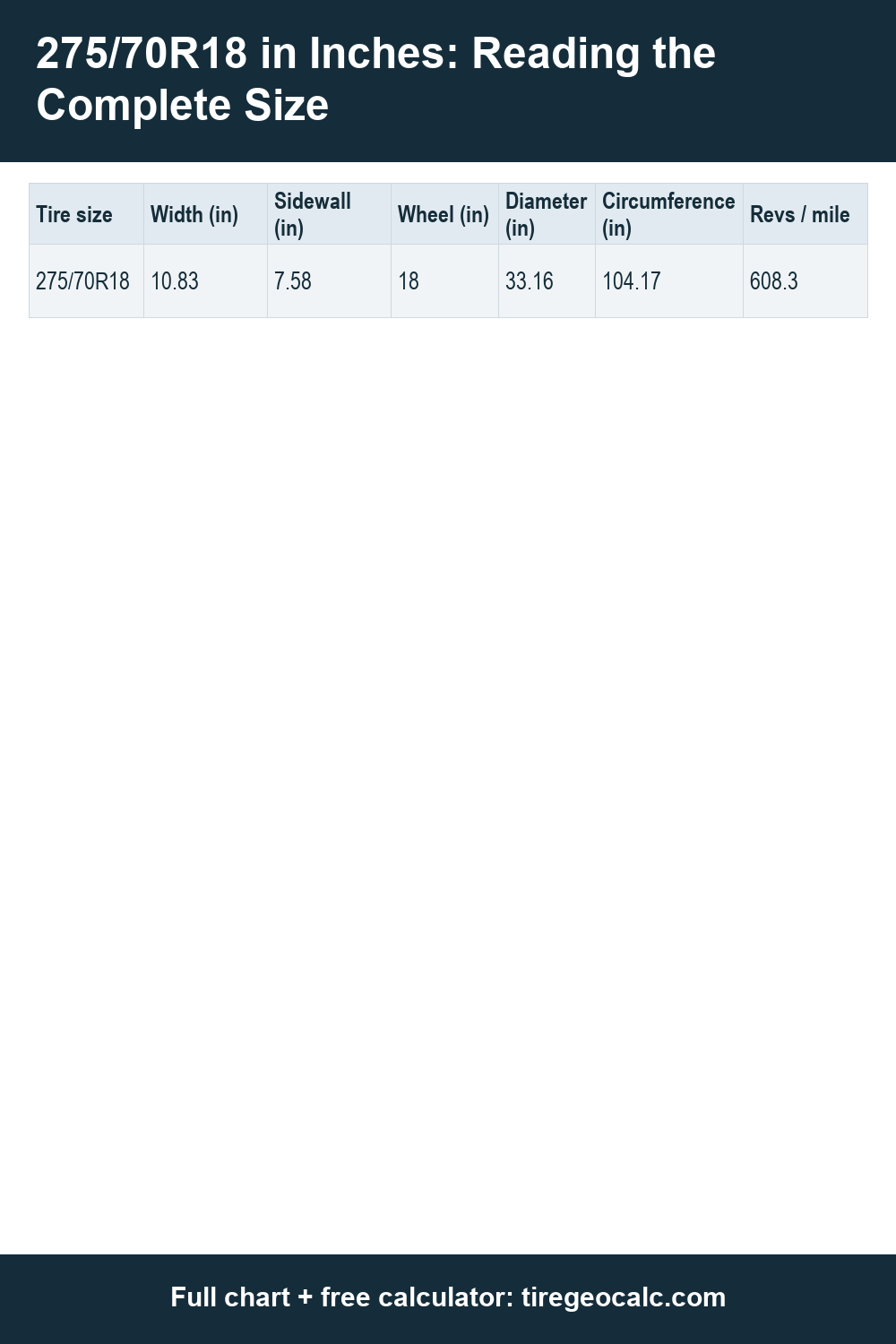
Calculated dimensions are nominal, not measured rolling dimensions or vehicle fitment approval.
Give every part of the code a job
Begin by reading 275/70R18 from left to right. Its first part identifies nominal section width in millimeters. The middle part expresses sidewall height relative to width, rather than naming a length in inches. The letter R indicates radial construction. At the end, the wheel diameter uses inches. The unit changes within the marking, which is why reading the digits without their meanings is misleading.
For the wheel, the table lists 18 inches and the corresponding 457.2 mm. That is the diameter at which the tire fits the wheel, not the outside diameter of the tire. Keep a separate place for wheel size in your notes. Writing every dimension under a general label such as height would hide the distinction that the conversion is meant to clarify.
Carry the units through the worked example
First follow section width: 275 mm is displayed as 10.83 inches. Then follow the sidewall derived from that width and the aspect ratio: 192.5 mm, or 7.58 inches. The wheel and opposing sidewalls form the complete nominal diameter. Its displayed value is 842.2 mm, equivalent in the inch column to 33.16 inches.
Continue with the outside path around the ideal circle, which is 2645.8 mm or 104.17 inches. Using mile distance and circumference in matching units yields 608.3 nominal revolutions per mile. The engine uses full precision before presenting these rounded values. Each step changes what is being described, from width to radial sidewall height, then diameter, circumference and finally a turn count.
Compare like dimensions in matching units
A width in millimeters and a diameter in inches cannot be compared as bare numbers. They describe different directions as well as different units. Use the width columns together when studying width, and the diameter columns together when studying overall height. Changing the unit of a measurement changes how it is written, not the physical direction it describes.
For a later comparison, identify the existing full size as the reference. Read the proposed candidate against that reference with the same units in both entries. Greater candidate diameter means a taller nominal circle, while smaller candidate diameter means a shorter one. Do not infer a difference from this page alone: the table describes this size without supplying an original vehicle tire to compare against it.
Understand the boundary between code and measurement
These values describe nominal geometry based on the size marking. They are not measurements of a tire under vehicle load, and the circumference is not measured rolling circumference. A manufacturer's sheet for an exact product may show different dimensions. Its stated measuring conditions matter when you compare that specification with a mathematical outline.
The visible decimal places serve presentation rather than replacing the engine's working precision. Converting a rounded inch result back into millimeters can lose the detail retained earlier in the calculation. When transferring the figures, take each value directly from its own table column. Avoid building a new chain of calculations from shortened numbers and then treating that chain as the source result.
Keep a unit conversion separate from an installation decision
A nearby or similar diameter does not provide vehicle fitment approval. The full tire and wheel specifications must meet the vehicle's requirements, including the relevant service description and clearance conditions. Consult the vehicle documentation and a qualified installer for that review. The size code offers a starting description, but it does not supply every condition needed for an installation.
No pressure setting or load capacity follows from converting these dimensions into inches. The same boundary applies to claims about comfort and fuel consumption. Use this page to keep your dimensional notes clear, then attach product-specific documentation when you need to evaluate an actual tire. This preserves the difference between a correctly labeled calculation and evidence about a particular vehicle setup.
Frequently asked questions
Does every part of 275/70R18 use millimeters?
The width uses millimeters, the aspect ratio is a proportion, and wheel diameter uses inches. Reading the complete code requires keeping those meanings separate.
What is the difference between 18 and 33.16 inches?
The former identifies wheel diameter; the latter is the calculated outside tire diameter including the sidewalls.
Is 104.17 inches a straight measurement across the tire?
It describes nominal circumference around the outside circle. The straight measurement through the center is diameter.
What should accompany a copied table value?
Retain its dimension name, unit and nominal status. That prevents a calculated width or height from being mistaken for a loaded measurement.