 TireGeoCalc
275/70R18 vs 285/65R18: Which Dimension Actually Changes
Quick answer
Nominal geometry275/70R18 → 285/65R18 · original-size calibration assumed
- Diameter difference
- -0.57in
- Diameter change
- -1.72%
- Actual at indicated 60 mph
- 58.97mph
Calculated from size markings. Not measured rolling dimensions or vehicle fitment approval.
Published
The wider tire in this pair is not the taller tire. Comparing 275/70R18 with 285/65R18 shows why width alone is a poor way to rank overall size. This page takes 275/70R18 as the base and treats 285/65R18 as the comparison size. The latter has more nominal section width but less sidewall height and a smaller outside diameter. That combination matters when describing the change: calling it simply bigger hides the fact that the dimensions move in different directions.
Nominal geometry for these tire sizes
The first size is the reference. Dimensions are nominal calculations, not measured rolling data or vehicle fitment approval.
| Tire size | Width (mm) | Width (in) | Sidewall (mm) | Sidewall (in) | Wheel (mm) | Wheel (in) | Diameter (mm) | Diameter (in) | Circumference (mm) | Circumference (in) | Revolutions / mile | Revolutions / km | Diameter change (%) | Actual at indicated 30 mph | Actual at indicated 60 mph | Actual at indicated 75 mph | Actual minus indicated at 60 mph |
|---|---|---|---|---|---|---|---|---|---|---|---|---|---|---|---|---|---|
| 275/70R18 | 275 | 10.83 | 192.5 | 7.58 | 457.2 | 18 | 842.2 | 33.16 | 2645.8 | 104.17 | 608.3 | 378 | 0 | 30 | 60 | 75 | 0 |
| 285/65R18 | 285 | 11.22 | 185.3 | 7.29 | 457.2 | 18 | 827.7 | 32.59 | 2600.3 | 102.37 | 618.9 | 384.6 | -1.72 | 29.5 | 59 | 73.7 | -1 |
Nominal size-code geometry. Reference: 275/70R18. Display rounding only; not fitment approval.
- Tire size
- 275/70R18
- Width (mm)
- 275
- Width (in)
- 10.83
- Sidewall (mm)
- 192.5
- Sidewall (in)
- 7.58
- Wheel (mm)
- 457.2
- Wheel (in)
- 18
- Diameter (mm)
- 842.2
- Diameter (in)
- 33.16
- Circumference (mm)
- 2645.8
- Circumference (in)
- 104.17
- Revolutions / mile
- 608.3
- Revolutions / km
- 378
- Diameter change (%)
- 0
- Actual at indicated 30 mph
- 30
- Actual at indicated 60 mph
- 60
- Actual at indicated 75 mph
- 75
- Actual minus indicated at 60 mph
- 0
- Tire size
- 285/65R18
- Width (mm)
- 285
- Width (in)
- 11.22
- Sidewall (mm)
- 185.3
- Sidewall (in)
- 7.29
- Wheel (mm)
- 457.2
- Wheel (in)
- 18
- Diameter (mm)
- 827.7
- Diameter (in)
- 32.59
- Circumference (mm)
- 2600.3
- Circumference (in)
- 102.37
- Revolutions / mile
- 618.9
- Revolutions / km
- 384.6
- Diameter change (%)
- -1.72
- Actual at indicated 30 mph
- 29.5
- Actual at indicated 60 mph
- 59
- Actual at indicated 75 mph
- 73.7
- Actual minus indicated at 60 mph
- -1
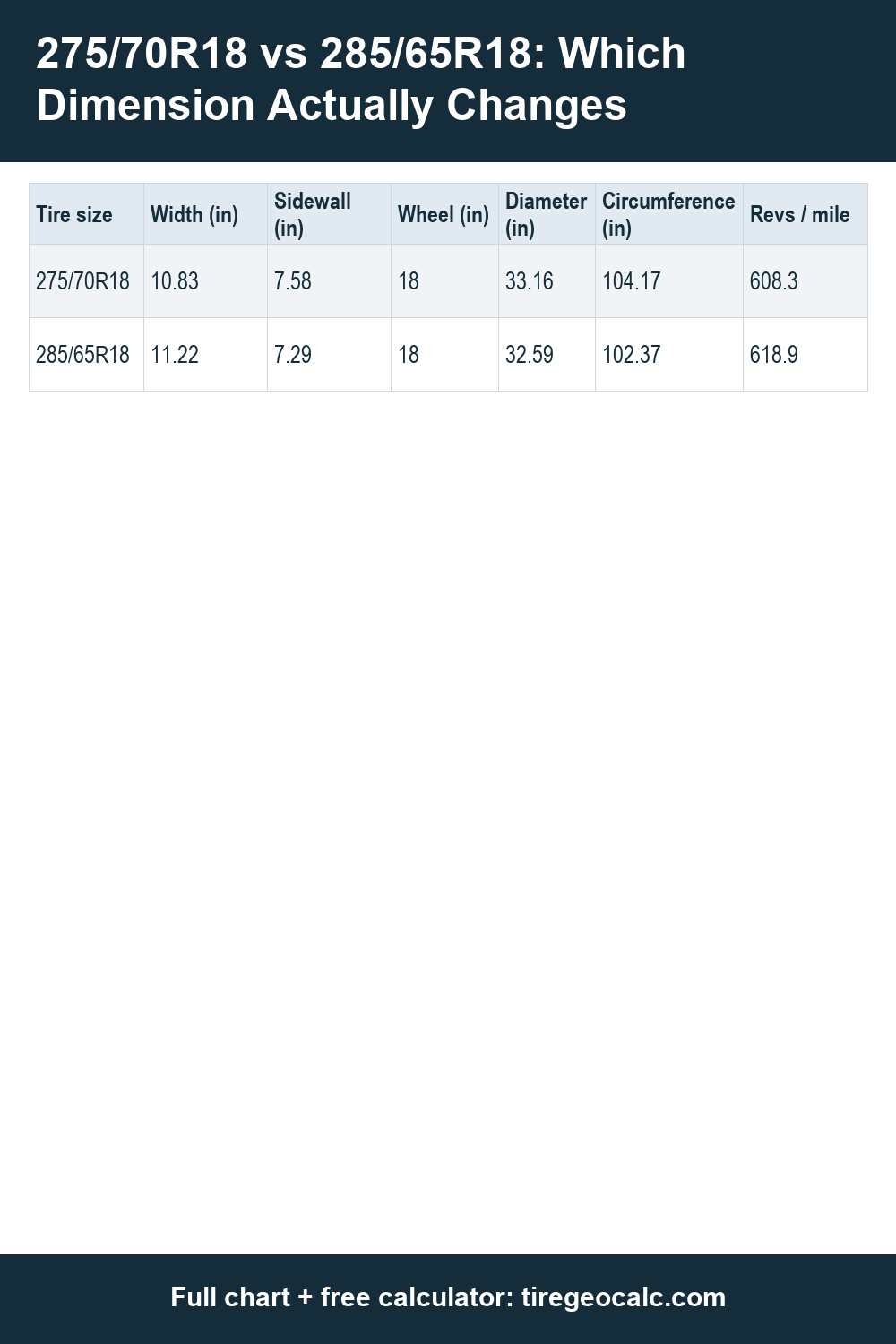
Calculated dimensions are nominal, not measured rolling dimensions or vehicle fitment approval.
Read the changing width and proportion together
A tire marking combines width, sidewall proportion and wheel diameter. Here the width rises from 275 mm to 285 mm. The inch entries are 10.83 and 11.22 respectively. Meanwhile, the sidewall proportion falls. Because the sidewall is based on a proportion of width, those changes must be considered together before making a claim about height.
Both sizes specify an 18 inch wheel diameter, shown as 457.2 mm. The shared wheel diameter makes this a useful example of how the width and aspect ratio interact without a wheel diameter change. It still says nothing about whether a particular wheel has an acceptable width for either exact tire.
Trace a wider but shorter candidate through the numbers
Start the worked example with the base sidewall of 192.5 mm, or 7.58 inches. Its diameter is 842.2 mm, equivalent to 33.16 inches. Move to the comparison row and the sidewall is 185.3 mm, or 7.29 inches, while diameter is 827.7 mm, or 32.59 inches. The increased width has not prevented a reduction in height.
The lower sidewall proportion more than offsets the width increase for this pair. This conclusion comes from the displayed sidewall and diameter entries, not from judging the appearance of the size codes. If you need a description for your notes, record wider section and shorter overall diameter as separate observations. Neither statement should be shortened into a claim that every dimension is larger.
Distinguish sideways space from radial space
Section width concerns the dimension across the tire. Diameter concerns the dimension through its center from one outer edge to the opposite edge. On a vehicle, those dimensions relate to different spaces around the assembly. A shorter outside diameter does not automatically resolve a question about clearance beside the tire.
The model also does not locate the inner and outer edges relative to the vehicle. Wheel position and the specifications of the actual tire are needed for that assessment. Even a useful geometric comparison cannot tell you what happens near suspension parts or through steering movement. Treat the table as a way to frame the questions, rather than as evidence that those checks have passed.
Check circumference when the height decreases
The base circumference is 2645.8 mm, or 104.17 inches, while the candidate circumference is 2600.3 mm, or 102.37 inches. The corresponding revolutions per mile entries are 608.3 and 618.9. A smaller nominal circle travels a shorter geometric distance per revolution and therefore makes more revolutions over the same distance.
This direction is consistent with the shorter diameter, despite the wider section. These are theoretical circular dimensions, not a measured rolling circumference. The mm label means millimeters; inch entries express the same type of length in another unit. Use the displayed values as supplied. Extra arithmetic based on already rounded entries would not add real measurement precision.
Keep the result focused on dimensions
For this comparison, the useful answer is specific: the candidate is nominally wider, its sidewall is shorter, and its complete diameter is smaller. A similar tire diameter does not establish compatibility with any vehicle. Nothing in those findings proves a suitable load rating, speed rating, inflation setting or mounting arrangement.
Check the vehicle requirements and the exact tire and wheel documentation before choosing an assembly. The table does not evaluate comfort or fuel use, and nominal width alone does not establish traction or a contact patch shape. It also contains no test of an installed tire under load. When discussing the pair with an installer, bring the complete markings and distinguish the dimensional comparison from the separate assessment of whether the equipment is appropriate.
Frequently asked questions
Is 285/65R18 taller because its width number is larger?
The wider candidate is shorter: its displayed diameter is 827.7 mm, below the 842.2 mm diameter of 275/70R18.
What stays the same in the wheel diameter row?
Both entries specify 18 inches, displayed as 457.2 mm. That shared diameter does not settle the required wheel width.
Does the shorter tire rotate more often over a mile?
In the nominal model, the candidate lists 618.9 revolutions per mile against 608.3 for the base.
Can the narrower row be used to predict grip?
This comparison supplies no grip test. Section width by itself cannot describe traction or the loaded contact patch.
Continue your comparison
Reference tables: Load index chart and Speed rating chart.