 TireGeoCalc
32x11.50R15 vs 265/75R15: Height and Width Calculations
Quick answer
Nominal geometry32X11.50R15 → 265/75R15 · original-size calibration assumed
- Diameter difference
- -1.35in
- Diameter change
- -4.22%
- Actual at indicated 60 mph
- 57.47mph
Calculated from size markings. Not measured rolling dimensions or vehicle fitment approval.
Published
When comparing 32x11.50R15 with 265/75R15, first separate width from height. The flotation marking gives both in inches, while the metric marking combines millimeter width with an aspect ratio. Sharing a wheel diameter does not make the remaining geometry match. This worked comparison keeps each designation intact and uses the table's existing conversions, so the differences can be read without inventing a new size label or assuming the tires serve the same vehicle application.
Nominal geometry for these tire sizes
The first size is the reference. Dimensions are nominal calculations, not measured rolling data or vehicle fitment approval.
| Tire size | Width (mm) | Width (in) | Sidewall (mm) | Sidewall (in) | Wheel (mm) | Wheel (in) | Diameter (mm) | Diameter (in) | Circumference (mm) | Circumference (in) | Revolutions / mile | Revolutions / km | Diameter change (%) | Actual at indicated 30 mph | Actual at indicated 60 mph | Actual at indicated 75 mph | Actual minus indicated at 60 mph |
|---|---|---|---|---|---|---|---|---|---|---|---|---|---|---|---|---|---|
| 32x11.50R15 | 292.1 | 11.5 | 215.9 | 8.5 | 381 | 15 | 812.8 | 32 | 2553.5 | 100.53 | 630.3 | 391.6 | 0 | 30 | 60 | 75 | 0 |
| 265/75R15 | 265 | 10.43 | 198.8 | 7.82 | 381 | 15 | 778.5 | 30.65 | 2445.7 | 96.29 | 658 | 408.9 | -4.22 | 28.7 | 57.5 | 71.8 | -2.5 |
Nominal size-code geometry. Reference: 32x11.50R15. Display rounding only; not fitment approval.
- Tire size
- 32x11.50R15
- Width (mm)
- 292.1
- Width (in)
- 11.5
- Sidewall (mm)
- 215.9
- Sidewall (in)
- 8.5
- Wheel (mm)
- 381
- Wheel (in)
- 15
- Diameter (mm)
- 812.8
- Diameter (in)
- 32
- Circumference (mm)
- 2553.5
- Circumference (in)
- 100.53
- Revolutions / mile
- 630.3
- Revolutions / km
- 391.6
- Diameter change (%)
- 0
- Actual at indicated 30 mph
- 30
- Actual at indicated 60 mph
- 60
- Actual at indicated 75 mph
- 75
- Actual minus indicated at 60 mph
- 0
- Tire size
- 265/75R15
- Width (mm)
- 265
- Width (in)
- 10.43
- Sidewall (mm)
- 198.8
- Sidewall (in)
- 7.82
- Wheel (mm)
- 381
- Wheel (in)
- 15
- Diameter (mm)
- 778.5
- Diameter (in)
- 30.65
- Circumference (mm)
- 2445.7
- Circumference (in)
- 96.29
- Revolutions / mile
- 658
- Revolutions / km
- 408.9
- Diameter change (%)
- -4.22
- Actual at indicated 30 mph
- 28.7
- Actual at indicated 60 mph
- 57.5
- Actual at indicated 75 mph
- 71.8
- Actual minus indicated at 60 mph
- -2.5
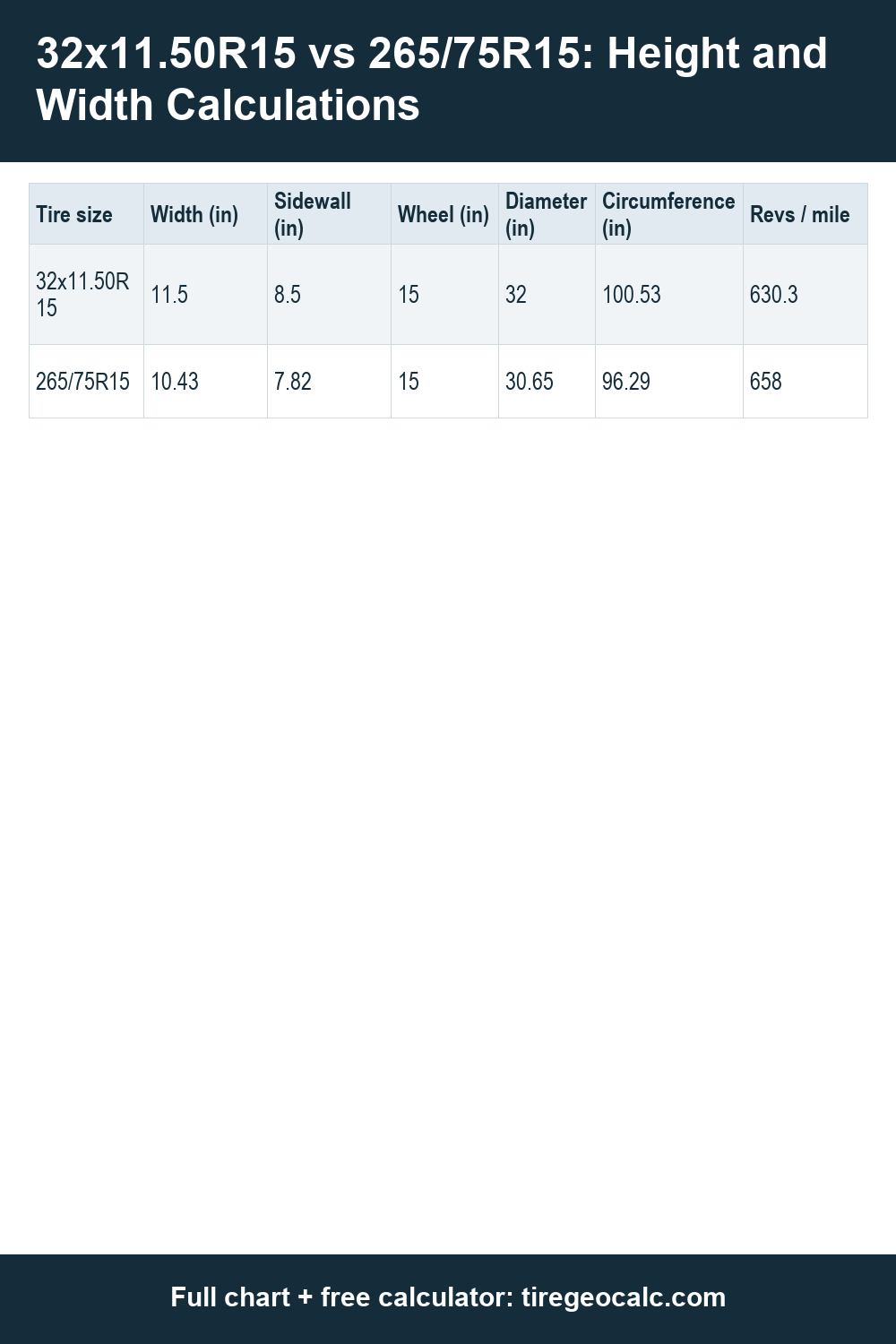
Calculated dimensions are nominal, not measured rolling dimensions or vehicle fitment approval.
Read the flotation width in its original units
The 11.50 in 32x11.50R15 is nominal width in inches. The corresponding supplied table width is 292.1 mm, with an inch display of 11.5. The trailing zero in the size marking does not describe a different width. It is the same nominal dimension written in the notation used by the label.
The 32 denotes nominal overall diameter in inches, and 15 is wheel diameter in inches. R identifies radial construction. None of those numbers is a metric aspect ratio. In particular, do not use the width entry as though it were a percentage or assume that the first number identifies the wheel rather than the tire's outside height.
Calculate the metric shape on its own terms
The metric designation 265/75R15 starts with 265 mm of nominal width. Its aspect ratio is 75, and its wheel diameter is 15 inches. Sidewall geometry follows from width and aspect ratio, then the outside diameter combines the wheel with the sidewall contribution above and below it.
The supplied row displays sidewall height as 198.8 mm, wheel diameter as 381 mm, and outside diameter as 778.5 mm. Its inch displays are 10.43 for width and 30.65 for diameter. Use the completed diameter from the table rather than calculating again with the rounded sidewall display; that avoids introducing a second rounding step into the comparison.
Put width beside width and height beside height
For the flotation size, the displayed diameter is 812.8 mm and the width is 292.1 mm. For the metric size, those entries are 778.5 mm and 265 mm. The flotation row is taller as well as wider. The shared wheel diameter is only the common wheel diameter stated by the codes, not a conclusion about the rest of the tire.
The flotation sidewall entry is displayed as 215.9 mm. It comes from the nominal flotation geometry rather than from a metric aspect ratio printed in the designation. This distinction prevents a common reading error: treating a converted flotation width as enough information to recreate a metric tire with the same outside dimensions.
Relate circumference to the stated direction of change
The circumference display is 2553.5 mm for 32x11.50R15 and 2445.7 mm for 265/75R15. These values describe ideal circles from the nominal dimensions. In the speed rows, the larger flotation entry is the original calibration reference and the smaller metric entry is the replacement being modeled.
The table gives modeled actual speeds of 28.7 mph at 30 indicated mph, 57.5 mph at 60 indicated mph, and 71.8 mph at 75 indicated mph. The direction follows from less modeled distance per revolution on the metric candidate. No vehicle was measured for this example, and an existing calibration change would need to be considered before using these results.
Understand what the flotation warning leaves unresolved
The warning attached to the flotation row says its diameter is nominal and is not derived from an aspect ratio. Therefore the nominal 32-inch height cannot replace the exact tire manufacturer's dimensions. The table also contains no measured rolling circumference under load.
An inch-to-millimeter presentation changes units, not the quality of the underlying evidence. Nominal width in a different unit is still nominal width. For product comparisons, obtain the manufacturer's stated dimensions and measurement conditions, including the relevant wheel information. Keep those specifications distinct from this calculation so that a unit conversion is not mistaken for a physical measurement.
Use the dimensional result without approving a swap
A nominal size resemblance does not constitute vehicle fitment approval. This comparison cannot specify inflation pressure, load capacity, clearance through suspension movement, or an acceptable wheel. It does not forecast ride comfort or fuel consumption either.
The next useful step is to compare complete product and vehicle requirements, not to shorten the metric label into a nearby flotation name. Retain both original codes when recording the candidate sizes. Note which size was used as the calibration reference and which figures came from nominal geometry. That gives a reviewer enough context to identify missing information before making any mounting or compatibility decision.
Frequently asked questions
Does converting width also determine overall height?
Width conversion changes the unit for width alone. Overall height must be taken from the flotation diameter designation or calculated from the complete metric geometry.
Why should the rounded sidewall value not be reused for arithmetic?
Rounding has already changed the displayed precision. The supplied completed diameter preserves the calculation workflow and avoids adding another display-rounding effect.
Does the shared wheel diameter establish interchangeability?
It establishes only the nominal wheel diameter stated in the markings. Wheel width, product requirements, vehicle clearance, and other specifications remain unresolved.
Can these speed estimates confirm dashboard accuracy?
They cannot. They illustrate nominal geometry with the flotation entry as the original reference; a vehicle's calibration and actual rolling behavior require separate evidence.