 TireGeoCalc
305/70R17 in Inches: Sidewall Height and Wheel Size
Quick answer
Nominal geometry305/70R17 · nominal size-code geometry
- Overall diameter
- 33.81in
- Section width
- 12.01in
- Sidewall height
- 8.41in
Calculated from size markings. Not measured rolling dimensions or vehicle fitment approval.
Published
For 305/70R17, the table gives 33.81 inches of overall diameter and 8.41 inches of sidewall height. Neither figure is the wheel diameter, which is 17 inches. Separating these measurements is the main task when reading this size. The table contains a single size, so this page explains its geometry rather than ranking alternatives. It also separates the dimensional marking from load and speed information that must come from the exact tire specification.
Nominal geometry for these tire sizes
The first size is the reference. Dimensions are nominal calculations, not measured rolling data or vehicle fitment approval.
| Tire size | Width (mm) | Width (in) | Sidewall (mm) | Sidewall (in) | Wheel (mm) | Wheel (in) | Diameter (mm) | Diameter (in) | Circumference (mm) | Circumference (in) | Revolutions / mile | Revolutions / km | Diameter change (%) |
|---|---|---|---|---|---|---|---|---|---|---|---|---|---|
| 305/70R17 | 305 | 12.01 | 213.5 | 8.41 | 431.8 | 17 | 858.8 | 33.81 | 2698 | 106.22 | 596.5 | 370.6 | 0 |
Nominal size-code geometry. Reference: 305/70R17. Display rounding only; not fitment approval.
- Tire size
- 305/70R17
- Width (mm)
- 305
- Width (in)
- 12.01
- Sidewall (mm)
- 213.5
- Sidewall (in)
- 8.41
- Wheel (mm)
- 431.8
- Wheel (in)
- 17
- Diameter (mm)
- 858.8
- Diameter (in)
- 33.81
- Circumference (mm)
- 2698
- Circumference (in)
- 106.22
- Revolutions / mile
- 596.5
- Revolutions / km
- 370.6
- Diameter change (%)
- 0
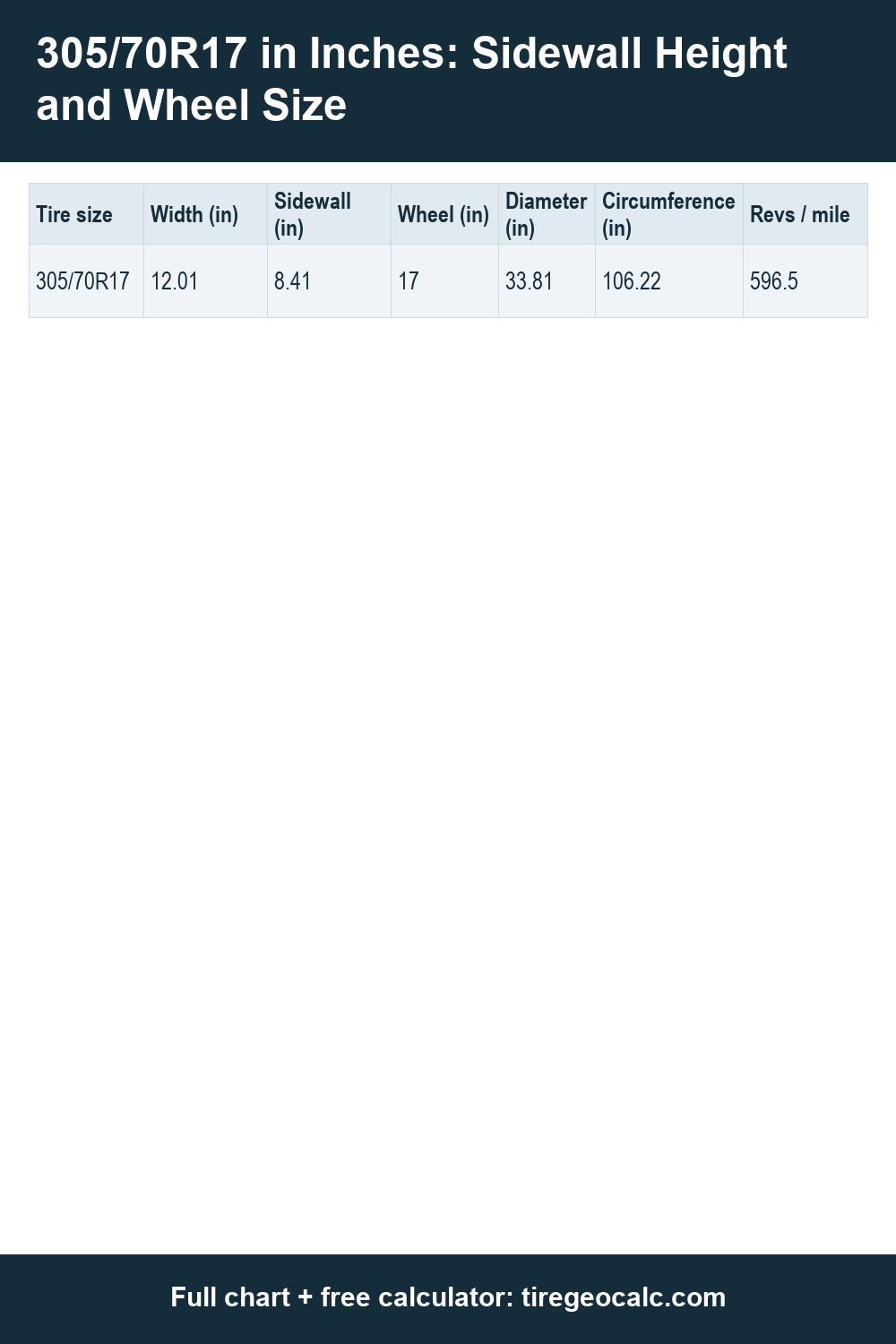
Calculated dimensions are nominal, not measured rolling dimensions or vehicle fitment approval.
Identify what each part of this marking describes
The nominal section width is 305 mm, equivalent to the displayed 12.01 inches. Width runs across the tire section, not around its circumference. The aspect-ratio portion describes sidewall height in relation to that width. It does not state the weight a tire can carry, and it is not a speed rating. R describes the radial construction indicated by the marking.
The final wheel figure identifies a diameter of 17 inches. A tire label may contain other characters beyond the size code, but they answer other questions. Keep a record of the complete product marking when investigating a real tire. A short size description can support a dimension calculation while leaving essential product and vehicle requirements unspecified.
Build a worked example from the supplied row
Start with the sidewall entry: 213.5 mm, or 8.41 inches. The wheel portion is 431.8 mm. The calculated overall diameter is 858.8 mm, displayed as 33.81 inches. The tire extends beyond the wheel on opposite sides, so overall diameter includes the sidewall above and below the wheel. Sidewall height is therefore a component of the total rather than another name for it.
Now read the width entry alongside that height. At 12.01 inches wide and 33.81 inches in calculated diameter, the row describes separate directions through a nominal shape. Writing those labels next to the numbers makes the example useful later. Copying only the values into a note would remove the distinction that the table is designed to explain.
Distinguish a trip around the tire from a trip across it
Circumference is listed as 2698 mm, or 106.22 inches. That is the geometric path around the outside of the circle. Diameter crosses the circle through its center. Both describe the same nominal geometry, but they are not interchangeable measurements. A question about assembly height calls for diameter; a question about distance per nominal revolution calls for circumference.
The same row gives 596.5 revolutions per mile and 370.6 revolutions per kilometer. These use different distance units, so their numerical values should not be compared as if they described different tires. They describe the turning count associated with the same calculated circumference. Neither value is evidence of an instrument reading, a road test or a loaded rolling measurement.
Keep dimensional data separate from service ratings
A load index and a speed symbol carry information that this size conversion does not provide. Do not infer them from the width, the sidewall height or the appearance of a tall tire. To answer a rating question, identify the exact product and read its relevant specifications alongside the requirements in the vehicle documentation. The dimensional row cannot fill that gap.
The same limit applies to inflation pressure. This page supplies no pressure setting and no load capacity. Its role is to clarify the size geometry so that separate specifications are easier to read. Keeping those tasks separate prevents a useful inch conversion from becoming an unsupported claim about what the tire can carry or how it should be used.
Use the inch conversion without treating it as a measurement
These figures are nominal geometric dimensions, not measurements taken with the vehicle resting on the tire. The displayed values are rounded for presentation. When comparing an exact product specification with this row, check what the specification actually measures and under what conditions. Do not assume that a difference between a nominal calculation and product data is a transcription mistake.
Even a closely matching diameter does not approve installation on a vehicle. The vehicle requirements, approved rim-width range, clearance and complete wheel details need their own checks. If you later compare another size, keep 305/70R17 as the stated reference and use the full new code. This single-size example makes no claims about compatibility, ride comfort or fuel consumption and does not select a replacement.
Frequently asked questions
Is the sidewall figure the full height of the tire?
The sidewall is 8.41 inches in the calculation, while total diameter is 33.81 inches. Overall height also includes the wheel and the opposite sidewall.
Where should I find the load and speed ratings?
Look at the complete marking and specification for the exact tire, then compare it with the vehicle requirements. The size conversion does not supply those ratings.
Why are there different revolution counts for a mile and a kilometer?
The distance units differ. Each count describes the nominal turns needed for its own distance unit using the same geometric circumference.
Can I choose an inflation pressure from this conversion?
No pressure is determined here. Use the relevant vehicle and tire documentation for that separate requirement rather than deriving it from the size.
Continue your comparison
Reference tables: Load index chart and Speed rating chart.