 TireGeoCalc
295/70R17 in Inches: Width, Sidewall and Diameter
Quick answer
Nominal geometry295/70R17 · nominal size-code geometry
- Overall diameter
- 33.26in
- Section width
- 11.61in
- Sidewall height
- 8.13in
Calculated from size markings. Not measured rolling dimensions or vehicle fitment approval.
Published
A 295/70R17 tire has a calculated diameter of 33.26 inches, a nominal width of 11.61 inches and a sidewall height of 8.13 inches. Those figures describe different parts of the same shape. They do not describe a tire measured on your vehicle. This guide starts with 295/70R17 as the reference and uses 285/70R17 for a focused comparison. Keep that direction in mind when reading the shorter comparison row; changing the reference changes the question being answered.
Nominal geometry for these tire sizes
The first size is the reference. Dimensions are nominal calculations, not measured rolling data or vehicle fitment approval.
| Tire size | Width (mm) | Width (in) | Sidewall (mm) | Sidewall (in) | Wheel (mm) | Wheel (in) | Diameter (mm) | Diameter (in) | Circumference (mm) | Circumference (in) | Revolutions / mile | Revolutions / km | Diameter change (%) |
|---|---|---|---|---|---|---|---|---|---|---|---|---|---|
| 295/70R17 | 295 | 11.61 | 206.5 | 8.13 | 431.8 | 17 | 844.8 | 33.26 | 2654 | 104.49 | 606.4 | 376.8 | 0 |
| 285/70R17 | 285 | 11.22 | 199.5 | 7.85 | 431.8 | 17 | 830.8 | 32.71 | 2610 | 102.76 | 616.6 | 383.1 | -1.66 |
Nominal size-code geometry. Reference: 295/70R17. Display rounding only; not fitment approval.
- Tire size
- 295/70R17
- Width (mm)
- 295
- Width (in)
- 11.61
- Sidewall (mm)
- 206.5
- Sidewall (in)
- 8.13
- Wheel (mm)
- 431.8
- Wheel (in)
- 17
- Diameter (mm)
- 844.8
- Diameter (in)
- 33.26
- Circumference (mm)
- 2654
- Circumference (in)
- 104.49
- Revolutions / mile
- 606.4
- Revolutions / km
- 376.8
- Diameter change (%)
- 0
- Tire size
- 285/70R17
- Width (mm)
- 285
- Width (in)
- 11.22
- Sidewall (mm)
- 199.5
- Sidewall (in)
- 7.85
- Wheel (mm)
- 431.8
- Wheel (in)
- 17
- Diameter (mm)
- 830.8
- Diameter (in)
- 32.71
- Circumference (mm)
- 2610
- Circumference (in)
- 102.76
- Revolutions / mile
- 616.6
- Revolutions / km
- 383.1
- Diameter change (%)
- -1.66
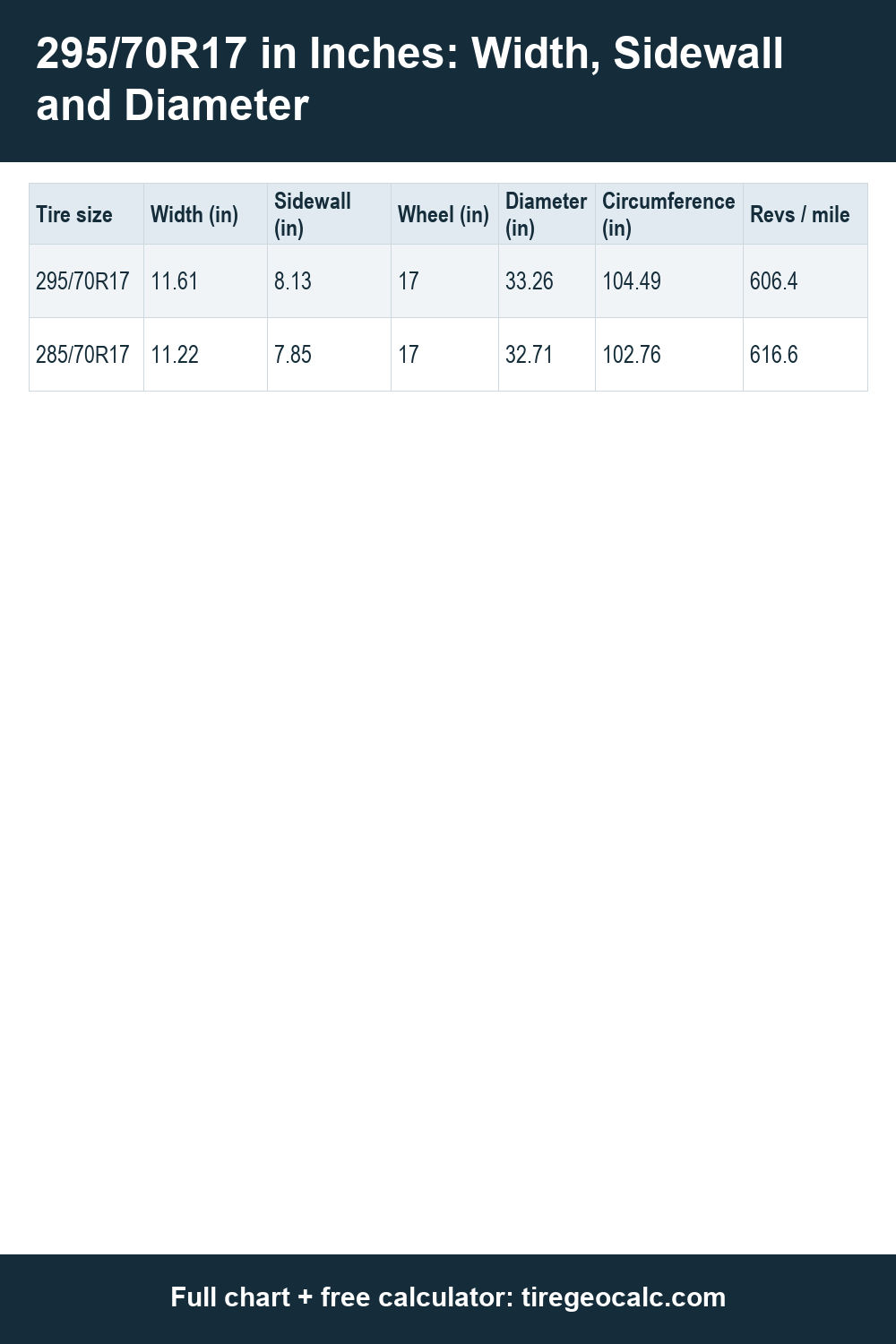
Calculated dimensions are nominal, not measured rolling dimensions or vehicle fitment approval.
Separate the width from the wheel opening
The opening in the tire is described by the wheel part of the marking, while the width describes its nominal section across the tire. In this example, the wheel diameter is 17 inches, also shown as 431.8 mm. The section width is 295 mm. Reading the wheel number as the overall tire height would leave the sidewalls out of the picture.
The middle part of the metric code expresses sidewall height as a percentage of section width. It is not a height in millimeters. R identifies radial construction. Read the full marking together rather than treating each part as an independent product description. The code gives the inputs for a geometric shape; it does not identify an exact tire model or its specifications.
Follow the calculated shape from sidewall to diameter
For a worked example, begin with the 295/70R17 row. Its sidewall is 206.5 mm, displayed in inches as 8.13. Overall diameter is 844.8 mm, or 33.26 inches. The overall dimension includes the wheel and the sidewall on either side of it. This is why the sidewall value alone cannot answer a question about total height.
Continue across the same row to circumference: 2654 mm, or 104.49 inches. This is the distance around the nominal circle, whereas diameter is the distance across it. Keep the column name attached when copying a value into your notes. An inch measurement without a label can easily be mistaken for width when it actually describes height or distance around the tire.
Compare the smaller row against the reference
The comparison tire, 285/70R17, has a width of 285 mm, or 11.22 inches. Its sidewall is 199.5 mm, or 7.85 inches, and its diameter is 830.8 mm, or 32.71 inches. Relative to the first row, it is narrower and shorter in this model. The matching wheel diameter does not cancel the effect of the different section widths.
Its circumference is 2610 mm, shown as 102.76 inches. Compare that with the reference circumference of 104.49 inches rather than confusing it with the reference diameter. This point comparison concerns only the listed sizes. It does not turn either size into a replacement recommendation, and it does not establish how either tire would behave on a particular axle.
Use revolutions as another view of the geometry
The reference row shows 606.4 revolutions per mile, while the narrower comparison shows 616.6. A smaller nominal circumference requires more turns to cover the same distance. These figures help explain the relationship between circumference and rotation without needing a claimed road test. They are calculated geometric revolutions, not manufacturer measurements of a loaded tire rolling along a surface.
Changing the units does not change that distinction. The table also provides metric dimensions for readers who want to compare them with a specification sheet. Use values from the same labeled column throughout a comparison. Do not reconstruct exact differences by subtracting already rounded inch figures, because the displayed precision is intended for reading rather than further calculation.
Take the comparison to the correct specification checks
A similar diameter is not approval to fit a tire to a vehicle. Check the vehicle documentation and the exact tire and wheel specifications, including permitted rim width, load and speed ratings, and clearance. Nominal width is not a complete description of the space available near suspension parts or bodywork. Geometry cannot supply missing approval information.
If your aim is to understand the neighboring size, retain both full codes alongside their dimensions. If your aim is to choose equipment, bring those notes to the specification check rather than treating this page as the decision. The calculations do not determine inflation pressure, carrying capacity, comfort or fuel use. They provide a consistent dimensional starting point and leave those separate questions open.
Frequently asked questions
Which number answers the overall height question?
Use the calculated diameter of 33.26 inches for 295/70R17. The 17-inch figure describes the wheel diameter, while 8.13 inches describes a sidewall.
Why is the comparison narrower and shorter?
The comparison keeps the wheel diameter and aspect-ratio marking while reducing section width. The resulting sidewall and overall diameter are both lower in the supplied geometry.
Can the circumference be used as loaded rolling data?
No. The circumference represents an ideal geometric circle. Obtain the exact product data when a task needs measured rolling information.
Does sharing a wheel diameter settle the fitment question?
Matching the wheel diameter is only part of the specification. The approved rim width, vehicle requirements and other tire and wheel details still need checking.
Continue your comparison
Reference tables: Load index chart and Speed rating chart.