 TireGeoCalc
245/75R16 in Inches: Sidewall and Overall Height Explained
Quick answer
Nominal geometry245/75R16 · nominal size-code geometry
- Overall diameter
- 30.47in
- Section width
- 9.65in
- Sidewall height
- 7.23in
Calculated from size markings. Not measured rolling dimensions or vehicle fitment approval.
Published
To understand the height of 245/75R16, imagine looking straight at the side of the tire and following a line through its center. The wheel fills the middle, while the tire extends beyond it above and below. The resulting calculated height is 30.47 inches. That is an outside diameter, not the wheel diameter and not a measurement of the vehicle above the road. Following the separate dimensions makes the table easier to use without confusing a sidewall measurement with a change in ground clearance.
Nominal geometry for these tire sizes
The first size is the reference. Dimensions are nominal calculations, not measured rolling data or vehicle fitment approval.
| Tire size | Width (mm) | Width (in) | Sidewall (mm) | Sidewall (in) | Wheel (mm) | Wheel (in) | Diameter (mm) | Diameter (in) | Circumference (mm) | Circumference (in) | Revolutions / mile | Revolutions / km | Diameter change (%) |
|---|---|---|---|---|---|---|---|---|---|---|---|---|---|
| 245/75R16 | 245 | 9.65 | 183.8 | 7.23 | 406.4 | 16 | 773.9 | 30.47 | 2431.3 | 95.72 | 661.9 | 411.3 | 0 |
Nominal size-code geometry. Reference: 245/75R16. Display rounding only; not fitment approval.
- Tire size
- 245/75R16
- Width (mm)
- 245
- Width (in)
- 9.65
- Sidewall (mm)
- 183.8
- Sidewall (in)
- 7.23
- Wheel (mm)
- 406.4
- Wheel (in)
- 16
- Diameter (mm)
- 773.9
- Diameter (in)
- 30.47
- Circumference (mm)
- 2431.3
- Circumference (in)
- 95.72
- Revolutions / mile
- 661.9
- Revolutions / km
- 411.3
- Diameter change (%)
- 0
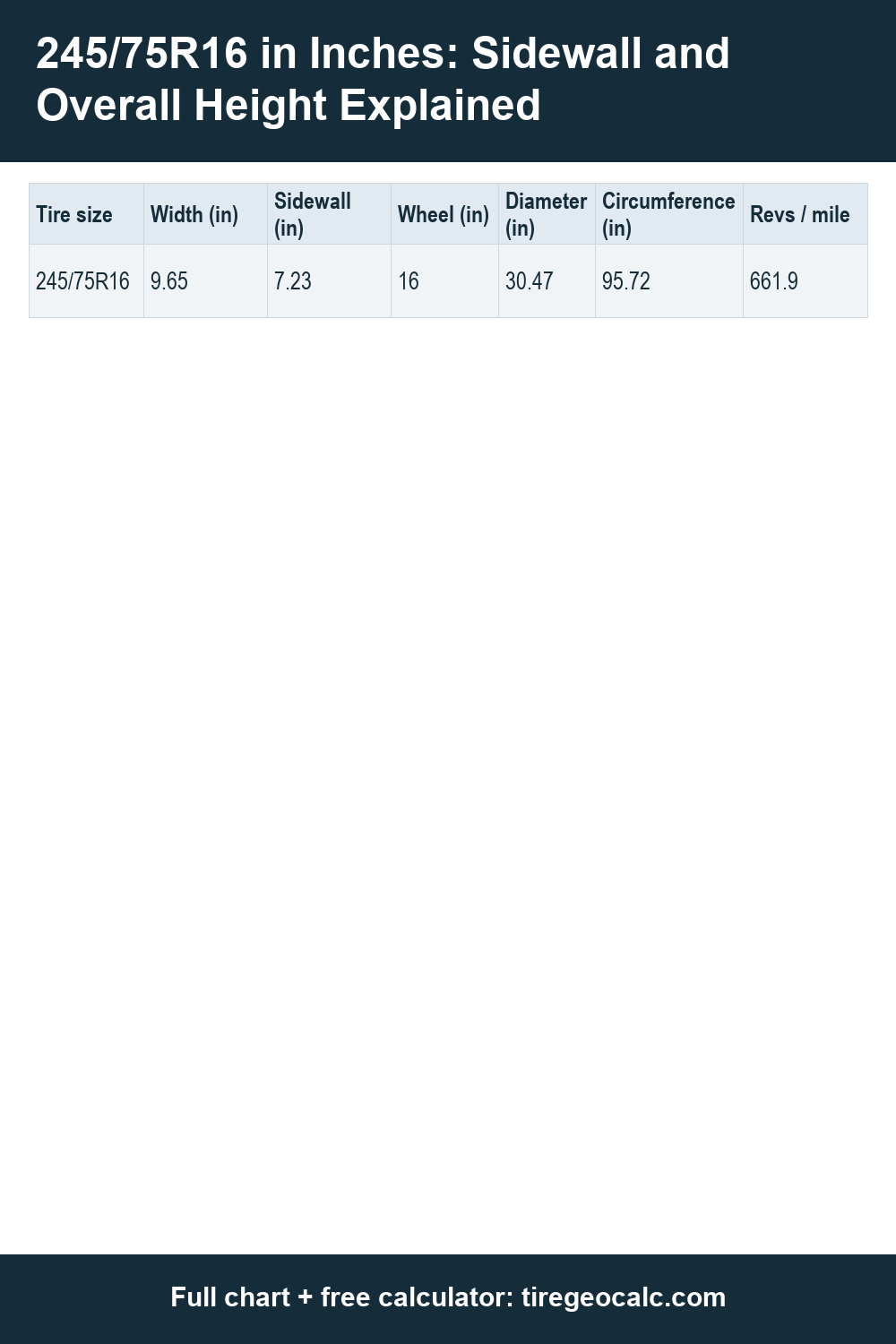
Calculated dimensions are nominal, not measured rolling dimensions or vehicle fitment approval.
Locate the sidewall within the marking
The full size 245/75R16 tells you how the nominal outline is built. Width comes first in millimeters, followed by an aspect ratio that relates sidewall height to width. R denotes radial construction, and the ending identifies the wheel diameter in inches. The aspect ratio is a proportion, not a sidewall length that can be read directly from a ruler.
For this outline, the wheel measures 16 inches across its diameter, or 406.4 mm. The tire extends outward from that wheel on opposing sides. Looking only at the ending of the marking therefore misses a substantial part of overall height. Looking only at width also misses the height calculation, because the relative sidewall proportion must be read with it.
Build the height and continue around the circle
Begin at the table width of 245 mm, equivalent in the display to 9.65 inches. Apply the size marking's aspect ratio to that width to obtain the sidewall entry: 183.8 mm, or 7.23 inches. The engine adds the opposing sidewalls to the wheel using full precision. Its resulting outside diameter is 773.9 mm, displayed as 30.47 inches.
From this diameter, the ideal circular outline gives a circumference of 2431.3 mm, or 95.72 inches. The final step divides mile distance by that circumference with consistent units and unrounded inputs. The table reports 661.9 nominal revolutions per mile. Follow that sequence from width through sidewall, diameter, circumference and turns; do not add the rounded inch entries and present the sum as a more accurate diameter.
Distinguish overall height from center height
Overall diameter spans the full outside outline through the wheel center. A distance from the wheel center toward the ground answers a different question. The table does not contain a measured loaded radius, so the diameter entry cannot be presented as a measurement of where a vehicle axle sits. A tire supporting a vehicle is not the unloaded ideal circle used here.
When comparing nominal heights, make the current size your reference and the proposed size your candidate. A candidate with greater diameter has a taller calculated outline; reversing the comparison reverses the direction. That observation alone does not establish a suspension clearance change or a vehicle height change. Keep the geometry comparison separate from measurements made on an actual installation.
Recognize what the rounded sidewall represents
The sidewall value describes nominal radial height derived from the size code. It is not the length of the curved rubber surface that you might follow with a flexible tape. The table's dimensions are calculated rather than measured under load, and its circumference does not represent measured rolling travel. These distinctions matter when a physical measurement appears to disagree with the page.
Published dimensions for an exact tire can differ because a specification sheet describes a manufactured product under its stated conditions. Use that sheet for product-specific questions and keep this calculation labeled as nominal. The engine rounds only its displayed output. Reusing a rounded sidewall as a new input discards precision before the rest of the calculation has finished.
Use the outline as preparation for a specification review
Having a similar diameter does not approve a tire for installation on a vehicle. The full application requires checks against vehicle guidance, the exact tire specification and the wheel specification. A shared wheel diameter does not settle permitted rim width, load and speed requirements, or clearance. Ask an installer to review those details together rather than relying on the height entry alone.
This sidewall calculation also provides no basis for a pressure setting, carrying capacity, comfort promise or fuel-use forecast. If your purpose is replacing an existing tire, record its complete marking before reviewing alternatives. Keep manufacturer measurements distinct from calculated dimensions in your notes. That makes it clear which values describe this geometric outline and which belong to a specific product or installation.
Frequently asked questions
What does the 7.23-inch figure measure?
It is calculated radial sidewall height. It is not the full tire height or the curved distance over the outside rubber.
Why is the tire taller than its 16-inch wheel?
The nominal overall outline includes the sidewalls on opposite sides of the wheel, giving the listed diameter of 30.47 inches.
Can this table predict axle height under load?
A loaded radius is not supplied. The nominal outside diameter cannot establish the position of an axle on a particular vehicle.
Should I add the displayed inch values myself?
Use the supplied diameter instead. Its calculation preserves precision before display rounding, whereas adding shortened values can change the last digits.