 TireGeoCalc
275/65R18 vs 285/65R18: Sidewall Size and Calculated Speed
Quick answer
Nominal geometry275/65R18 → 285/65R18 · original-size calibration assumed
- Diameter difference
- +0.51in
- Diameter change
- +1.60%
- Actual at indicated 60 mph
- 60.96mph
Calculated from size markings. Not measured rolling dimensions or vehicle fitment approval.
Published
A calculated speed change needs a starting tire size as well as a candidate. For this comparison, 275/65R18 is the original calibration reference and 285/65R18 is the size being evaluated against it. They share a wheel diameter and aspect ratio, but the candidate has a wider nominal section and a taller calculated sidewall. Following that change into the diameter ratio explains the speed examples. The numbers describe an ideal geometric relationship, not a dashboard test or a vehicle-specific installation decision.
Nominal geometry for these tire sizes
The first size is the reference. Dimensions are nominal calculations, not measured rolling data or vehicle fitment approval.
| Tire size | Width (mm) | Width (in) | Sidewall (mm) | Sidewall (in) | Wheel (mm) | Wheel (in) | Diameter (mm) | Diameter (in) | Circumference (mm) | Circumference (in) | Revolutions / mile | Revolutions / km | Diameter change (%) | Actual at indicated 30 mph | Actual at indicated 60 mph | Actual at indicated 75 mph | Actual minus indicated at 60 mph |
|---|---|---|---|---|---|---|---|---|---|---|---|---|---|---|---|---|---|
| 275/65R18 | 275 | 10.83 | 178.8 | 7.04 | 457.2 | 18 | 814.7 | 32.07 | 2559.5 | 100.77 | 628.8 | 390.7 | 0 | 30 | 60 | 75 | 0 |
| 285/65R18 | 285 | 11.22 | 185.3 | 7.29 | 457.2 | 18 | 827.7 | 32.59 | 2600.3 | 102.37 | 618.9 | 384.6 | 1.6 | 30.5 | 61 | 76.2 | 1 |
Nominal size-code geometry. Reference: 275/65R18. Display rounding only; not fitment approval.
- Tire size
- 275/65R18
- Width (mm)
- 275
- Width (in)
- 10.83
- Sidewall (mm)
- 178.8
- Sidewall (in)
- 7.04
- Wheel (mm)
- 457.2
- Wheel (in)
- 18
- Diameter (mm)
- 814.7
- Diameter (in)
- 32.07
- Circumference (mm)
- 2559.5
- Circumference (in)
- 100.77
- Revolutions / mile
- 628.8
- Revolutions / km
- 390.7
- Diameter change (%)
- 0
- Actual at indicated 30 mph
- 30
- Actual at indicated 60 mph
- 60
- Actual at indicated 75 mph
- 75
- Actual minus indicated at 60 mph
- 0
- Tire size
- 285/65R18
- Width (mm)
- 285
- Width (in)
- 11.22
- Sidewall (mm)
- 185.3
- Sidewall (in)
- 7.29
- Wheel (mm)
- 457.2
- Wheel (in)
- 18
- Diameter (mm)
- 827.7
- Diameter (in)
- 32.59
- Circumference (mm)
- 2600.3
- Circumference (in)
- 102.37
- Revolutions / mile
- 618.9
- Revolutions / km
- 384.6
- Diameter change (%)
- 1.6
- Actual at indicated 30 mph
- 30.5
- Actual at indicated 60 mph
- 61
- Actual at indicated 75 mph
- 76.2
- Actual minus indicated at 60 mph
- 1
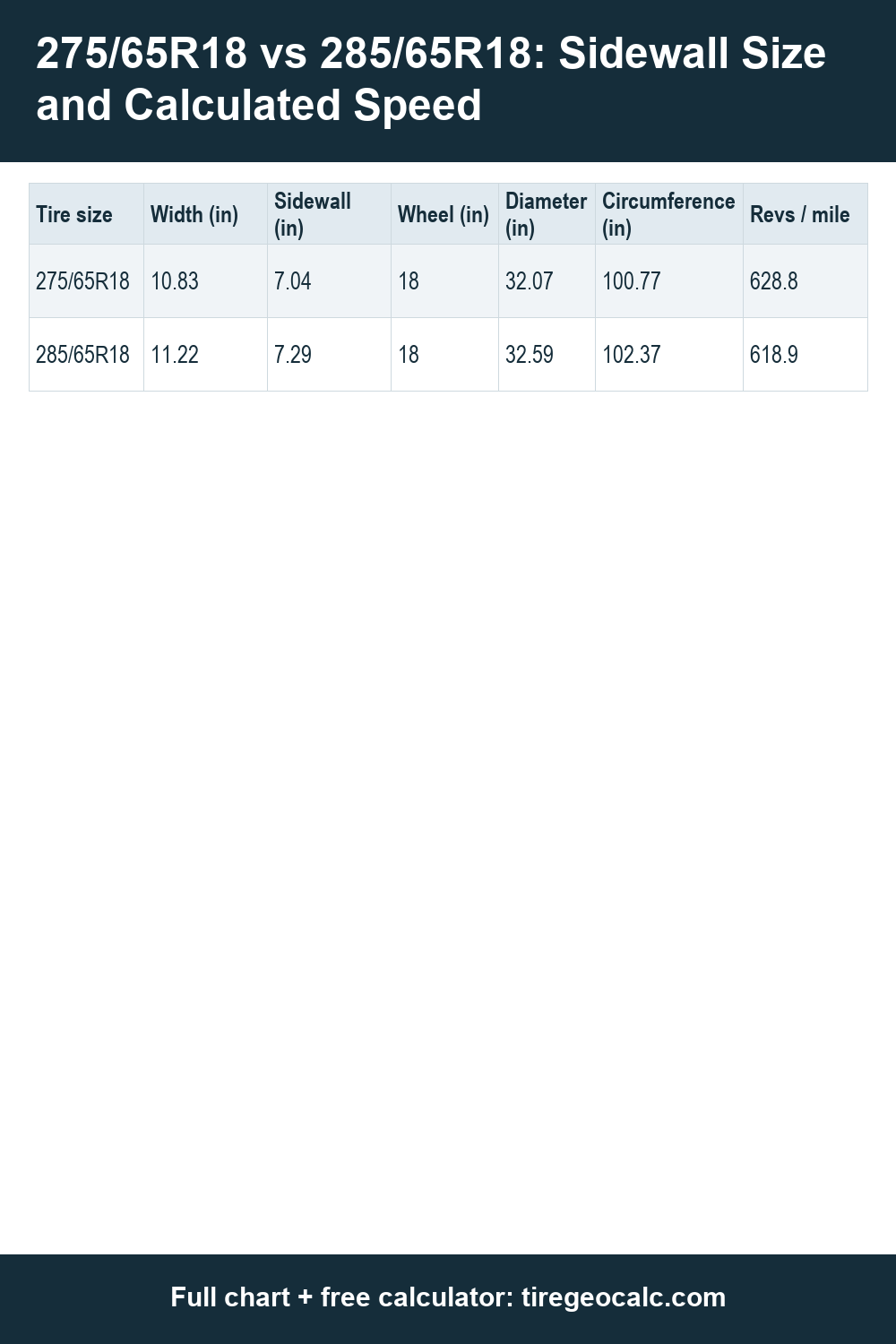
Calculated dimensions are nominal, not measured rolling dimensions or vehicle fitment approval.
Name the reference before reading any result
The original diameter is 814.7 mm, and the candidate diameter is 827.7 mm. Every speed example on this page uses the original as the denominator of the comparison. Writing down the starting size matters because a table can contain the right dimensions yet answer the wrong question if the intended direction is reversed.
If your vehicle's original specification differs from 275/65R18, these speed examples do not describe its size ratio. Enter that actual reference in a new comparison. The fact that another size also uses an 18-inch wheel does not give it the same outside diameter, because the sidewalls contribute to the complete assembly.
See how the candidate gains sidewall height
In the original marking, 275 is nominal section width in millimeters and 65 is the aspect ratio. The candidate changes width to 285 mm while retaining that same ratio. Sidewall height is width multiplied by aspect ratio and divided by one hundred. Applying the ratio separately gives displayed sidewall heights of 178.8 mm and 185.3 mm.
The 18-inch wheel contributes 457.2 mm to each overall diameter. The complete height formula adds twice the sidewall height to the wheel diameter, using the unrounded sidewall internally. The displayed totals are therefore 814.7 mm and 827.7 mm. Do not rebuild them from rounded sidewall displays when you need to match the engine's reported result.
Work the speed formula in the forward direction
Assume the speedometer was calibrated to the original size and has no independent error. Calculated actual speed equals indicated speed multiplied by new diameter divided by original diameter. At an indicated 60 mph, using the 827.7 mm candidate over the 814.7 mm reference gives a displayed actual-speed estimate of 61 mph. The taller candidate increases distance per modeled turn.
The same ratio produces 30.5 mph at an indicated 30 mph and 76.2 mph at an indicated 75 mph. These rows show how the proportional relationship applies at different inputs. They do not provide a correction based on an actual instrument measurement, and they do not include errors already present before any size change.
Check the direction using circumference and rotations
Multiplying the complete diameter by pi yields circumference. The original displays 2559.5 mm, whereas the candidate displays 2600.3 mm. This longer circumference is another way of seeing why calculated speed rises at a fixed indicated reading. It is the same geometric change expressed around the circle instead of across its center.
Geometric revolutions per mile move from 628.8 in the original row to 618.9 in the candidate row. Dividing a fixed distance by a larger circumference produces a smaller rotation count. These figures describe nominal circles without loading; they are not measured rolling circumference or the recorded turns of a specific tire traveling on a road.
Use the inch columns for dimensions, not new labels
The original's calculated diameter is 32.07 inches and the candidate's is 32.59 inches. Their nominal widths convert to 10.83 and 11.22 inches. These values let you read the same geometry in another unit system. They do not change the original metric markings or supply a different tire specification that can be substituted for them.
When comparing a manufacturer's dimension sheet with this table, note which value is calculated and which is specified for an actual product. A converted height is not a measurement of a selected tire. Preserve the complete metric size and the product's measuring conditions beside the numbers so the distinction remains visible throughout your comparison.
Leave the installation decision to the missing specifications
Similar overall dimensions provide no approval to install 285/65R18 on a particular vehicle in place of 275/65R18. The vehicle's required specification, tire service ratings, permitted rim dimensions and physical clearance must be considered separately. Neither the upward speed estimate nor the shared wheel diameter answers those requirements on its own.
Before using the comparison in a discussion about a replacement, record the reference size, candidate size and wheel details together. That prevents a theoretical speed example from being mistaken for evidence about a completed installation. The table explains the sidewall and diameter relationship clearly; the exact vehicle, tire and wheel documentation supplies the remaining information.
Frequently asked questions
What is the calibration reference in these speed examples?
The reference is 275/65R18. The calculation treats 285/65R18 as the candidate and assumes the instrument still interprets wheel rotations using the original size.
Why does a matching wheel diameter not keep speed unchanged?
Outside diameter includes the sidewalls as well as the wheel. In this pair, increasing width while keeping the aspect ratio raises sidewall height and changes the diameter ratio.
Can I quote 32.59 inches as a measured product height?
The 32.59-inch value is the candidate's calculated nominal diameter after unit conversion. A specific product's measured or published height must come from that product's dimensional information.
Will swapping the sizes back give the same calculation in reverse?
Reversing the swap changes which diameter is the denominator. Keep the new original and candidate roles explicit and calculate that direction separately rather than reusing these forward outputs.
Continue your comparison
Verified against manufacturer data
Published specifications for the named models, checked on the dates below. Differences mean published minus calculated, divided by calculated. These are examples, not specifications for every tire of this size. P, LT and XL designations remain in the source row; matching nominal dimensions does not make their load capacities interchangeable.
| Size / model | Calculated diameter | Published diameter | Difference | Revolutions per mile: calculated / published (difference) | Source / checked |
|---|---|---|---|---|---|
| 275/65R18116T ToyoCelsius II (243940) | 32.07 in | 32.10 in | +0.08% | 628.8 / not recorded in rev/mile | Toyo specifications |
| LT 275/65 R 18123S E General TireGrabber HTS60 (4490700000) | 32.07 in | 32.10 in | +0.08% | 628.8 / 648 (+3.06%) | General Tire specifications |
How we calculate: nominal geometry and measured rolling data can differ. This comparison is not vehicle fitment approval.