 TireGeoCalc
Tire Circumference Chart and Revolutions per Mile
Quick answer
Nominal geometryTable example: 205/55R16 → 205/55R16 · original-size calibration assumed
- 205/55R16 diameter
- 24.88in
- Diameter change
- 0.00%
- Actual at indicated 60 mph
- 60.00mph
Calculated from size markings. Not measured rolling dimensions or vehicle fitment approval.
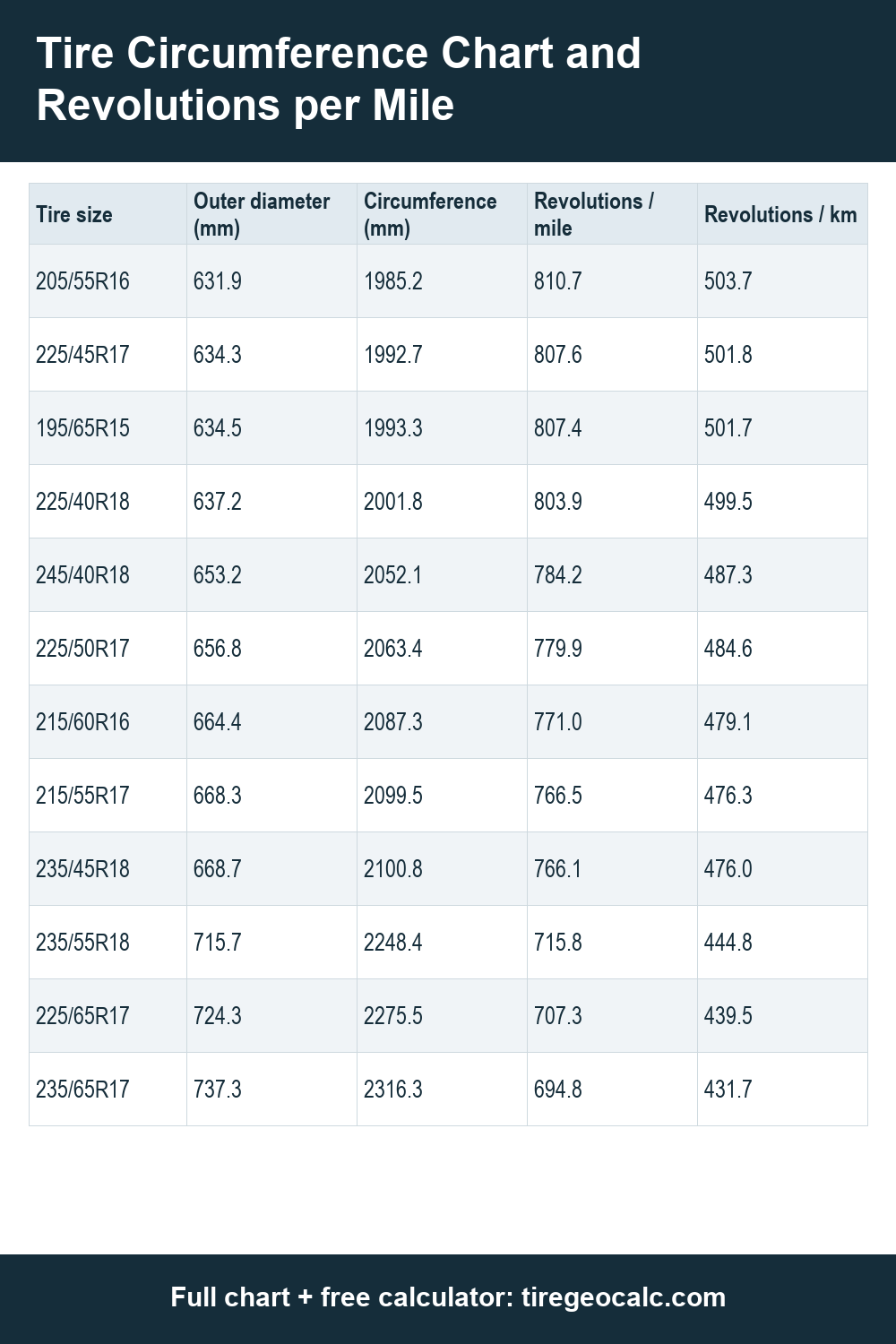
Tire circumference describes the distance around the outside of a tire. This chart connects familiar size markings to nominal outer diameter, circumference and the number of rotations needed to cover a mile or kilometer. Use it to compare distances per revolution before investigating a size change, instrument calibration or an axle mismatch. Every measurement is calculated from the complete size code using the same tire engine as the calculator. These are nominal geometric calculations, not vehicle fitment approval. Check the vehicle manual and exact tire and wheel specifications, including load and speed ratings, approved rim width and clearance; consult the manual for any diameter change exceeding 3%.
Circumference and revolutions for 18 common tire sizes
Rows are ordered by nominal outer diameter. Revolutions per mile and revolutions per kilometer use full-precision circumference; displayed measurements are rounded to one decimal place. The flotation example uses its stated overall diameter rather than a metric aspect ratio.
| Tire size | Outer diameter (mm) | Circumference (mm) | Revolutions / mile | Revolutions / km |
|---|---|---|---|---|
| 205/55R16 | 631.9 | 1985.2 | 810.7 | 503.7 |
| 225/45R17 | 634.3 | 1992.7 | 807.6 | 501.8 |
| 195/65R15 | 634.5 | 1993.3 | 807.4 | 501.7 |
| 225/40R18 | 637.2 | 2001.8 | 803.9 | 499.5 |
| 245/40R18 | 653.2 | 2052.1 | 784.2 | 487.3 |
| 225/50R17 | 656.8 | 2063.4 | 779.9 | 484.6 |
| 215/60R16 | 664.4 | 2087.3 | 771.0 | 479.1 |
| 215/55R17 | 668.3 | 2099.5 | 766.5 | 476.3 |
| 235/45R18 | 668.7 | 2100.8 | 766.1 | 476.0 |
| 235/55R18 | 715.7 | 2248.4 | 715.8 | 444.8 |
| 225/65R17 | 724.3 | 2275.5 | 707.3 | 439.5 |
| 235/65R17 | 737.3 | 2316.3 | 694.8 | 431.7 |
| 245/65R17 | 750.3 | 2357.1 | 682.8 | 424.2 |
| 31x10.50R15 | 787.4 | 2473.7 | 650.6 | 404.3 |
| 255/55R20 | 788.5 | 2477.1 | 649.7 | 403.7 |
| 265/65R18 | 801.7 | 2518.6 | 639.0 | 397.0 |
| 265/70R17 | 802.8 | 2522.1 | 638.1 | 396.5 |
| 275/55R20 | 810.5 | 2546.3 | 632.0 | 392.7 |
Nominal geometric circumference and revolutions; not measured rolling data.
- Tire size
- 205/55R16
- Outer diameter (mm)
- 631.9
- Circumference (mm)
- 1985.2
- Revolutions / mile
- 810.7
- Revolutions / km
- 503.7
- Tire size
- 225/45R17
- Outer diameter (mm)
- 634.3
- Circumference (mm)
- 1992.7
- Revolutions / mile
- 807.6
- Revolutions / km
- 501.8
- Tire size
- 195/65R15
- Outer diameter (mm)
- 634.5
- Circumference (mm)
- 1993.3
- Revolutions / mile
- 807.4
- Revolutions / km
- 501.7
- Tire size
- 225/40R18
- Outer diameter (mm)
- 637.2
- Circumference (mm)
- 2001.8
- Revolutions / mile
- 803.9
- Revolutions / km
- 499.5
- Tire size
- 245/40R18
- Outer diameter (mm)
- 653.2
- Circumference (mm)
- 2052.1
- Revolutions / mile
- 784.2
- Revolutions / km
- 487.3
- Tire size
- 225/50R17
- Outer diameter (mm)
- 656.8
- Circumference (mm)
- 2063.4
- Revolutions / mile
- 779.9
- Revolutions / km
- 484.6
- Tire size
- 215/60R16
- Outer diameter (mm)
- 664.4
- Circumference (mm)
- 2087.3
- Revolutions / mile
- 771.0
- Revolutions / km
- 479.1
- Tire size
- 215/55R17
- Outer diameter (mm)
- 668.3
- Circumference (mm)
- 2099.5
- Revolutions / mile
- 766.5
- Revolutions / km
- 476.3
- Tire size
- 235/45R18
- Outer diameter (mm)
- 668.7
- Circumference (mm)
- 2100.8
- Revolutions / mile
- 766.1
- Revolutions / km
- 476.0
- Tire size
- 235/55R18
- Outer diameter (mm)
- 715.7
- Circumference (mm)
- 2248.4
- Revolutions / mile
- 715.8
- Revolutions / km
- 444.8
- Tire size
- 225/65R17
- Outer diameter (mm)
- 724.3
- Circumference (mm)
- 2275.5
- Revolutions / mile
- 707.3
- Revolutions / km
- 439.5
- Tire size
- 235/65R17
- Outer diameter (mm)
- 737.3
- Circumference (mm)
- 2316.3
- Revolutions / mile
- 694.8
- Revolutions / km
- 431.7
- Tire size
- 245/65R17
- Outer diameter (mm)
- 750.3
- Circumference (mm)
- 2357.1
- Revolutions / mile
- 682.8
- Revolutions / km
- 424.2
- Tire size
- 31x10.50R15
- Outer diameter (mm)
- 787.4
- Circumference (mm)
- 2473.7
- Revolutions / mile
- 650.6
- Revolutions / km
- 404.3
- Tire size
- 255/55R20
- Outer diameter (mm)
- 788.5
- Circumference (mm)
- 2477.1
- Revolutions / mile
- 649.7
- Revolutions / km
- 403.7
- Tire size
- 265/65R18
- Outer diameter (mm)
- 801.7
- Circumference (mm)
- 2518.6
- Revolutions / mile
- 639.0
- Revolutions / km
- 397.0
- Tire size
- 265/70R17
- Outer diameter (mm)
- 802.8
- Circumference (mm)
- 2522.1
- Revolutions / mile
- 638.1
- Revolutions / km
- 396.5
- Tire size
- 275/55R20
- Outer diameter (mm)
- 810.5
- Circumference (mm)
- 2546.3
- Revolutions / mile
- 632.0
- Revolutions / km
- 392.7
Calculate outer diameter before circumference
For a metric size, one sidewall equals section width multiplied by aspect ratio divided by 100. Convert wheel diameter from inches to millimeters using 25.4, then add two sidewalls. Outer diameter therefore equals wheel diameter in millimeters plus twice the calculated sidewall height. The R indicates radial construction; it is not a radius measurement.
Circumference in millimeters equals outer diameter in millimeters multiplied by pi. Keep the full value of pi and the unrounded diameter during calculation. Round the result only when displaying it. The 31x10.50R15 flotation marking instead supplies a nominal overall diameter of 31 inches, which the engine converts directly to millimeters before calculating circumference.
Convert circumference into revolutions per mile or kilometer
One mile contains 1,609,344 millimeters. Revolutions per mile therefore equal 1,609,344 divided by circumference in millimeters. One kilometer contains 1,000,000 millimeters, so revolutions per kilometer equal 1,000,000 divided by that same circumference. These are rotations of the complete tire, not engine revolutions or a gearbox ratio.
A larger circumference produces fewer revolutions over a fixed distance. A smaller circumference produces more. Compare the two rotation columns using the same distance unit; the mile value is larger because a mile is longer than a kilometer. Do not divide by a circumference expressed in inches while leaving the distance expressed in millimeters. Unit consistency matters more than the number of decimal places shown.
Understand the speedometer and odometer relationship
If an instrument assumes the original circumference, changing the distance traveled per wheel turn changes its geometric speed relationship. Under an original-size calibration assumption, actual speed equals indicated speed multiplied by new circumference divided by original circumference. A taller replacement therefore increases calculated actual speed at the same indicated reading; a shorter replacement decreases it.
The odometer relationship follows the same distance-per-turn principle. This chart does not measure existing factory calibration, sensor processing or an individual instrument error. Enter both complete sizes in the calculator and read the linked speedometer guide to follow the direction of the change. Similar rounded revolutions figures can hide a small difference, so use full-precision comparisons when examining close candidates.
Compare axles before assuming a drivetrain match
Wheel-speed sensors provide inputs to systems such as ABS. Different rolling circumferences can create different rotational speeds even when tires cover the same road distance. The vehicle determines how those signals are interpreted; this nominal chart cannot predict an ABS warning, control-system response or a permitted mismatch. Check the approved axle arrangement and the instructions for your exact vehicle.
On a 4x4 or AWD vehicle, a persistent front-to-rear rolling mismatch can also impose a speed difference across coupled drivetrain components, including a transfer case where fitted. Do not apply a general diameter percentage as a universal drivetrain tolerance. Factory staggered sizes may be intentionally matched as a pair. Replacement tread depth and product differences also matter, so check the manufacturer requirements before mixing tires between axles.
Distinguish nominal geometry from loaded rolling data
The circumference here describes an ideal circle based on the size marking. It is not a road measurement. Tire construction, tread, pressure, load and the measuring rim can affect published or measured dimensions. Loaded radius describes the axle height under load; multiplying that radius by two pi does not automatically reproduce a manufacturer rolling-circumference test.
For product-specific rolling revolutions, compare manufacturer specifications obtained under comparable conditions. For an initial nominal comparison, record the original size, locate each candidate in this chart and use the alternatives tool to investigate nearby dimensions. Keep geometry, measured rolling data and vehicle approval distinct so that an accurate arithmetic result is not mistaken for an installation decision.
Frequently asked questions
How do I calculate tire circumference?
Multiply nominal outer diameter by pi, keeping both in consistent units. For a metric tire, first calculate two sidewalls and add the wheel diameter converted to millimeters. The table performs those steps with the tire engine.
Why does a bigger tire have fewer revolutions per mile?
Each rotation covers a longer nominal distance. Dividing the fixed length of a mile by a larger circumference produces a smaller rotation count. This relationship concerns tire rotations, independently of engine speed.
Are calculated revolutions the same as manufacturer rolling data?
Not necessarily. These numbers come from ideal nominal geometry. Manufacturer rolling data may reflect load, pressure, construction and a defined test method. Compare like measurements when checking two exact products.
Can I use equal circumference to approve an AWD tire combination?
Equal nominal circumference alone cannot establish approval. Check the vehicle axle arrangement, product specifications and permitted rolling mismatch, including tread-depth requirements. The chart cannot certify compatibility with a transfer case or wheel-speed control system.
Continue your comparison
These are nominal geometric calculations, not vehicle fitment approval. Check the vehicle manual and exact tire and wheel specifications, including load and speed ratings, approved rim width and clearance; consult the manual for any diameter change exceeding 3%.
Reference tables: Load index chart and Speed rating chart.