 TireGeoCalc
Tire Measurements Explained: Width, Height and Revs
Quick answer
Nominal geometryTable example: 205/55R16 → 205/55R16 · original-size calibration assumed
- 205/55R16 diameter
- 24.88in
- Diameter change
- 0.00%
- Actual at indicated 60 mph
- 60.00mph
Calculated from size markings. Not measured rolling dimensions or vehicle fitment approval.
Understand section width, sidewall height, overall diameter, circumference and revolutions per mile. These measurements answer different questions even though they come from the same tire size marking. The example table keeps several related sizes together, while the worked example below follows one size through the calculation. Use the sidewall-reading guide for the other codes printed on a real tire. These are nominal geometric calculations, not vehicle fitment approval. Check the vehicle manual and exact tire and wheel specifications, including load and speed ratings, approved rim width and clearance; consult the manual for any diameter change exceeding 3%.
Measurement examples from complete metric sizes
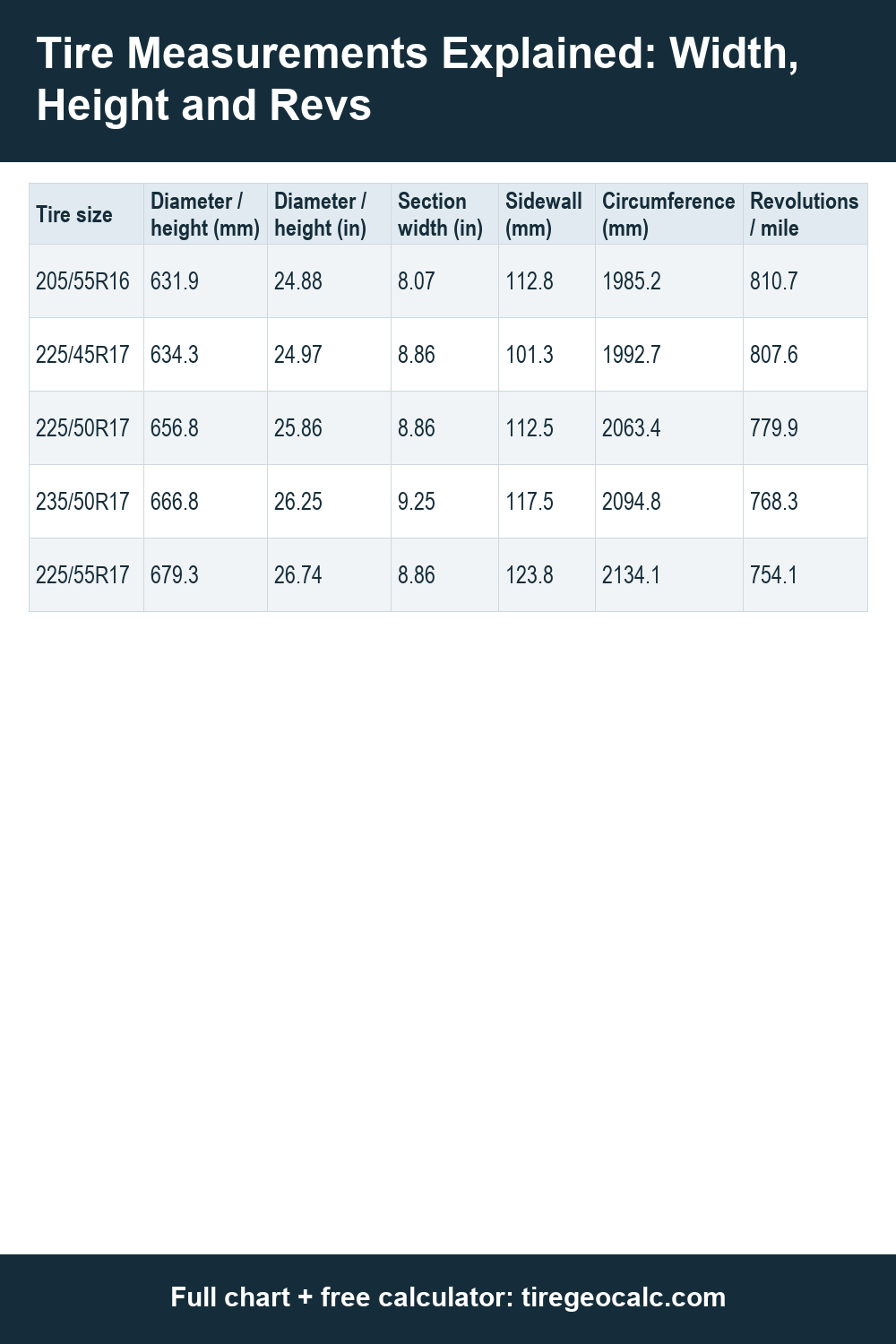
These rows are independent measurement examples, each using itself as the reference. Width is nominal section width rather than tread width. Revolutions per mile use ideal circumference rather than a loaded rolling measurement.
| Tire size | Diameter / height (mm) | Diameter / height (in) | Section width (in) | Sidewall (mm) | Circumference (mm) | Revolutions / mile |
|---|---|---|---|---|---|---|
| 205/55R16 | 631.9 | 24.88 | 8.07 | 112.8 | 1985.2 | 810.7 |
| 225/45R17 | 634.3 | 24.97 | 8.86 | 101.3 | 1992.7 | 807.6 |
| 225/50R17 | 656.8 | 25.86 | 8.86 | 112.5 | 2063.4 | 779.9 |
| 235/50R17 | 666.8 | 26.25 | 9.25 | 117.5 | 2094.8 | 768.3 |
| 225/55R17 | 679.3 | 26.74 | 8.86 | 123.8 | 2134.1 | 754.1 |
Nominal dimensions calculated from tire size markings; rounding is for display only.
- Tire size
- 205/55R16
- Diameter / height (mm)
- 631.9
- Diameter / height (in)
- 24.88
- Section width (in)
- 8.07
- Sidewall (mm)
- 112.8
- Circumference (mm)
- 1985.2
- Revolutions / mile
- 810.7
- Tire size
- 225/45R17
- Diameter / height (mm)
- 634.3
- Diameter / height (in)
- 24.97
- Section width (in)
- 8.86
- Sidewall (mm)
- 101.3
- Circumference (mm)
- 1992.7
- Revolutions / mile
- 807.6
- Tire size
- 225/50R17
- Diameter / height (mm)
- 656.8
- Diameter / height (in)
- 25.86
- Section width (in)
- 8.86
- Sidewall (mm)
- 112.5
- Circumference (mm)
- 2063.4
- Revolutions / mile
- 779.9
- Tire size
- 235/50R17
- Diameter / height (mm)
- 666.8
- Diameter / height (in)
- 26.25
- Section width (in)
- 9.25
- Sidewall (mm)
- 117.5
- Circumference (mm)
- 2094.8
- Revolutions / mile
- 768.3
- Tire size
- 225/55R17
- Diameter / height (mm)
- 679.3
- Diameter / height (in)
- 26.74
- Section width (in)
- 8.86
- Sidewall (mm)
- 123.8
- Circumference (mm)
- 2134.1
- Revolutions / mile
- 754.1
Calculated example: 225/50R17
Section width is 225.0 mm. One sidewall is width times 50 / 100 = 112.5 mm. Wheel diameter is 17 times 25.4 = 431.8 mm. Adding two sidewalls gives 656.8 mm overall diameter. Multiplying by pi gives 2063.4 mm circumference. Dividing 1,609,344 mm per mile by that unrounded circumference gives 779.9 geometric revolutions per mile.
Section width and sidewall height describe different axes
Section width is the nominal distance across the sidewalls, expressed in millimeters by the first number of a metric code. It is not the width of rubber touching the road and does not state a wheel width. The actual published section width depends partly on the measuring rim used for that product specification.
Sidewall height runs radially between the wheel and tread. In a metric code, aspect ratio expresses that height as a percentage of section width. Keeping the same ratio while increasing width increases sidewall height as well. That is why a profile number without its width cannot tell you how tall the sidewall is.
Follow a worked measurement example
For 225/50R17, multiply the section width by the aspect ratio divided by one hundred to obtain one sidewall. Convert the wheel diameter to millimeters, then add one sidewall above the wheel and another below it. The row for this size displays the resulting sidewall and overall diameter, calculated the same way as the other rows.
Next multiply that unrounded overall diameter by pi to obtain circumference. Divide the number of millimeters in a mile by the unrounded circumference to obtain geometric revolutions per mile. Follow the row from left to right to see those results. Performing the calculation before rounding avoids accumulating errors from each displayed intermediate value.
Distinguish unloaded geometry from rolling behavior
Overall diameter describes the ideal circle across the full assembly. Circumference describes distance around that circle. Loaded radius instead measures the distance from the axle center to the ground under specified conditions. A real contact patch deforms, so substituting one of these measurements for another can create a misleading comparison.
Geometric revolutions per mile are a useful consistent reference, but manufacturer rolling data may differ. Tire construction, pressure, load and test method affect the real rolling result. When comparing published specifications, check that both products use the same kind of measurement rather than assuming all circumference or revolutions figures were obtained in the same way.
Connect measurements to the question you need answered
Use section width to understand the nominal lateral dimension, sidewall height to understand the rubber contribution to diameter, and diameter to begin a height comparison. Use circumference or revolutions per mile when the question concerns travel per rotation. None of these columns supplies the complete service description; read load and speed markings separately.
Frequently asked questions
Is sidewall height printed directly in millimeters?
Not in the usual metric width/aspect-ratio code. You calculate it from section width multiplied by the aspect ratio as a fraction. The table shows the result for each complete example.
Does circumference equal distance traveled in actual use?
Here it is the ideal unloaded circumference derived from nominal diameter. Actual rolling behavior requires product-specific data under defined conditions, so do not treat this geometric number as a measured road result.
Where do I find load index and speed rating?
Read the full tire sidewall marking and the vehicle specification. Those service codes are separate from width, aspect ratio and wheel diameter; the linked sidewall guide explains how to locate and interpret them.
Continue your comparison
These are nominal geometric calculations, not vehicle fitment approval. Check the vehicle manual and exact tire and wheel specifications, including load and speed ratings, approved rim width and clearance; consult the manual for any diameter change exceeding 3%.
Reference tables: Load index chart and Speed rating chart.