 TireGeoCalc
275/60R20 in Inches: Calculated Height Versus Measured Height
Quick answer
Nominal geometry275/60R20 · nominal size-code geometry
- Overall diameter
- 32.99in
- Section width
- 10.83in
- Sidewall height
- 6.50in
Calculated from size markings. Not measured rolling dimensions or vehicle fitment approval.
Published
A calculation and a tape measure can describe different things even when both refer to 275/60R20. The table gives a nominal diameter of 32.99 inches from the size code. It does not report a measurement taken with a tire supporting a vehicle. Before using that height, decide whether your question concerns the geometric outline, the dimensions of an exact product, or the position of the wheel center above the road. Those questions require different evidence, and the table answers only the geometric one.
Nominal geometry for these tire sizes
The first size is the reference. Dimensions are nominal calculations, not measured rolling data or vehicle fitment approval.
| Tire size | Width (mm) | Width (in) | Sidewall (mm) | Sidewall (in) | Wheel (mm) | Wheel (in) | Diameter (mm) | Diameter (in) | Circumference (mm) | Circumference (in) | Revolutions / mile | Revolutions / km | Diameter change (%) |
|---|---|---|---|---|---|---|---|---|---|---|---|---|---|
| 275/60R20 | 275 | 10.83 | 165 | 6.5 | 508 | 20 | 838 | 32.99 | 2632.7 | 103.65 | 611.3 | 379.8 | 0 |
Nominal size-code geometry. Reference: 275/60R20. Display rounding only; not fitment approval.
- Tire size
- 275/60R20
- Width (mm)
- 275
- Width (in)
- 10.83
- Sidewall (mm)
- 165
- Sidewall (in)
- 6.5
- Wheel (mm)
- 508
- Wheel (in)
- 20
- Diameter (mm)
- 838
- Diameter (in)
- 32.99
- Circumference (mm)
- 2632.7
- Circumference (in)
- 103.65
- Revolutions / mile
- 611.3
- Revolutions / km
- 379.8
- Diameter change (%)
- 0
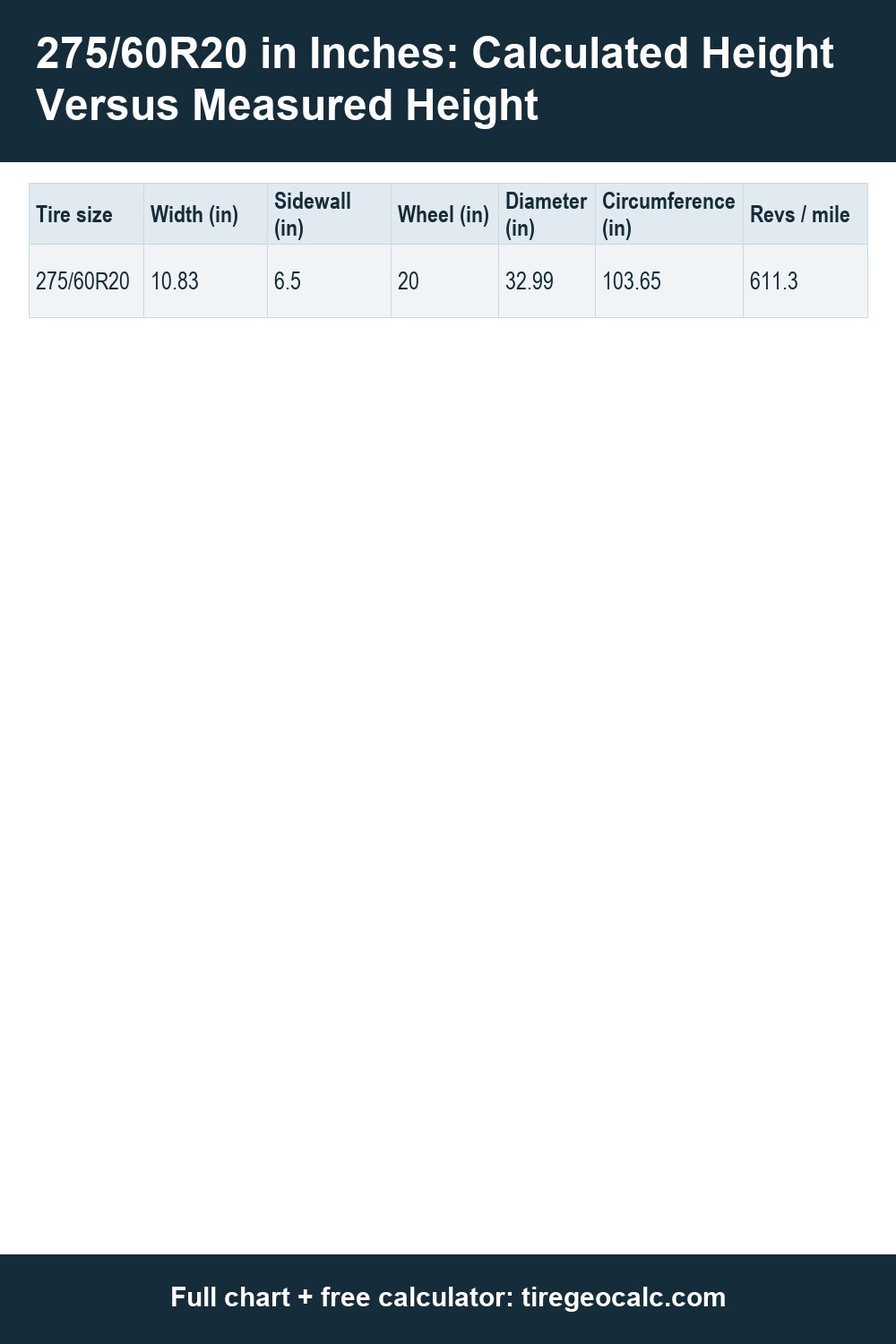
Calculated dimensions are nominal, not measured rolling dimensions or vehicle fitment approval.
Identify the inputs behind the calculated outline
The marking 275/60R20 supplies nominal width, an aspect ratio and wheel diameter. Width is expressed in millimeters; the aspect ratio relates sidewall height to width; wheel diameter is expressed in inches. R identifies radial construction. The calculation combines these pieces to describe an ideal circle without needing to inspect a physical tire.
The wheel diameter is 20 inches, or 508 mm. Sidewall height fills the radial space between that wheel and the tread outline. The overall diameter therefore includes both opposing sidewalls as well as the wheel. This structure explains why the outside height is different from the final number in the size marking and why width by itself cannot supply the height.
Work through the nominal measurements in order
The width entry starts the example at 275 mm, shown as 10.83 inches. Applying the aspect ratio gives the listed sidewall height of 165 mm, or 6.5 inches. With the wheel included between the opposing sidewalls, the overall diameter becomes 838 mm, displayed as 32.99 inches. These entries trace the outline from its size inputs.
The diameter then defines a circular circumference of 2632.7 mm, or 103.65 inches. Dividing mile distance by the unrounded circumference in consistent units produces 611.3 nominal revolutions per mile. The engine retains precision throughout and rounds for display at the end. None of these stages introduces a load measurement or observes how far an installed tire travels during an actual turn.
Ask what a physical height measurement describes
A tire specification can describe dimensions measured under stated conditions, while this page describes dimensions inferred from a code. The manufacturer sheet for an exact product may therefore differ from the nominal result. Before deciding that the figures disagree, check whether the source describes overall diameter, a loaded radius or a rolling measurement. A shared word such as height can conceal those distinctions.
Loaded radius concerns the wheel center's distance from the supporting surface. It is not interchangeable with a full outside diameter. This table provides no measured loaded radius, and a nominal size alone is insufficient to predict it. Do not turn the listed diameter into a claim about actual vehicle clearance or axle position without the appropriate application-specific evidence.
Avoid replacing rolling evidence with a perfect circle
The circumference entry follows the geometry of an ideal circle. It is not a measured rolling circumference under load. A real rolling measurement addresses behavior in stated conditions, while the nominal calculation addresses the outline encoded by the size. Keeping those descriptions separate prevents the revolutions entry from being presented as a verified vehicle result.
If you compare another nominal size, use the current size as the reference and name the proposed size as the candidate. A larger candidate diameter implies a larger ideal circumference and fewer nominal turns over the same distance; a smaller diameter implies the reverse. That directional comparison does not supply an exact loaded rolling change. It also does not establish a speedometer correction without the relevant reference and calibration information.
Use specifications to resolve the practical question
A similar calculated diameter is not approval for vehicle fitment. Review the vehicle's requirements and the exact tire and wheel documentation before selecting an application. Wheel diameter alone cannot establish permitted rim width, service ratings or sufficient clearance. A qualified installer can assess those requirements together with the details of the actual vehicle.
Calculated height cannot set inflation pressure, establish carrying capacity, or promise a particular ride or fuel consumption. If your concern is a physical clearance, state that concern explicitly instead of substituting a nominal diameter for a measurement. Record whether each figure in your notes is calculated, manufacturer-published or measured under identified conditions. That simple distinction makes follow-up questions much more precise.
Frequently asked questions
Is 32.99 inches a measurement made on a vehicle?
It is a nominal diameter calculated from the size code. No vehicle load or physical tire measurement is represented by that value.
Can I infer loaded radius from the size alone?
The size does not provide the evidence needed to predict loaded rolling radius. Use the relevant product and application data for that question.
Why might a manufacturer list another height?
An exact product has dimensions established under its stated measuring conditions. A code-based geometric outline is a different kind of information.
Does 611.3 prove the real rolling count?
It is a geometric revolutions-per-mile result derived from nominal circumference. A measured rolling count requires separate evidence about the actual tire and conditions.