 TireGeoCalc
265/65R17 vs 275/65R17: Height and Wheel Rotation Compared
Quick answer
Nominal geometry265/65R17 → 275/65R17 · original-size calibration assumed
- Diameter difference
- +0.51in
- Diameter change
- +1.67%
- Actual at indicated 60 mph
- 61.00mph
Calculated from size markings. Not measured rolling dimensions or vehicle fitment approval.
Published
Height and wheel rotations describe the same nominal tire circle in different ways. Between 265/65R17 and 275/65R17, the wider size creates a taller circle and a longer distance around it. The number of geometric rotations needed to cover a mile moves in the opposite direction. This page connects those ideas while keeping 265/65R17 as the starting reference. Its purpose is to explain the calculation, including its rounding, before any separate assessment of a specific tire and vehicle.
Nominal geometry for these tire sizes
The first size is the reference. Dimensions are nominal calculations, not measured rolling data or vehicle fitment approval.
| Tire size | Width (mm) | Width (in) | Sidewall (mm) | Sidewall (in) | Wheel (mm) | Wheel (in) | Diameter (mm) | Diameter (in) | Circumference (mm) | Circumference (in) | Revolutions / mile | Revolutions / km | Diameter change (%) | Actual at indicated 30 mph | Actual at indicated 60 mph | Actual at indicated 75 mph | Actual minus indicated at 60 mph |
|---|---|---|---|---|---|---|---|---|---|---|---|---|---|---|---|---|---|
| 265/65R17 | 265 | 10.43 | 172.3 | 6.78 | 431.8 | 17 | 776.3 | 30.56 | 2438.8 | 96.02 | 659.9 | 410 | 0 | 30 | 60 | 75 | 0 |
| 275/65R17 | 275 | 10.83 | 178.8 | 7.04 | 431.8 | 17 | 789.3 | 31.07 | 2479.7 | 97.62 | 649 | 403.3 | 1.67 | 30.5 | 61 | 76.3 | 1 |
Nominal size-code geometry. Reference: 265/65R17. Display rounding only; not fitment approval.
- Tire size
- 265/65R17
- Width (mm)
- 265
- Width (in)
- 10.43
- Sidewall (mm)
- 172.3
- Sidewall (in)
- 6.78
- Wheel (mm)
- 431.8
- Wheel (in)
- 17
- Diameter (mm)
- 776.3
- Diameter (in)
- 30.56
- Circumference (mm)
- 2438.8
- Circumference (in)
- 96.02
- Revolutions / mile
- 659.9
- Revolutions / km
- 410
- Diameter change (%)
- 0
- Actual at indicated 30 mph
- 30
- Actual at indicated 60 mph
- 60
- Actual at indicated 75 mph
- 75
- Actual minus indicated at 60 mph
- 0
- Tire size
- 275/65R17
- Width (mm)
- 275
- Width (in)
- 10.83
- Sidewall (mm)
- 178.8
- Sidewall (in)
- 7.04
- Wheel (mm)
- 431.8
- Wheel (in)
- 17
- Diameter (mm)
- 789.3
- Diameter (in)
- 31.07
- Circumference (mm)
- 2479.7
- Circumference (in)
- 97.62
- Revolutions / mile
- 649
- Revolutions / km
- 403.3
- Diameter change (%)
- 1.67
- Actual at indicated 30 mph
- 30.5
- Actual at indicated 60 mph
- 61
- Actual at indicated 75 mph
- 76.3
- Actual minus indicated at 60 mph
- 1
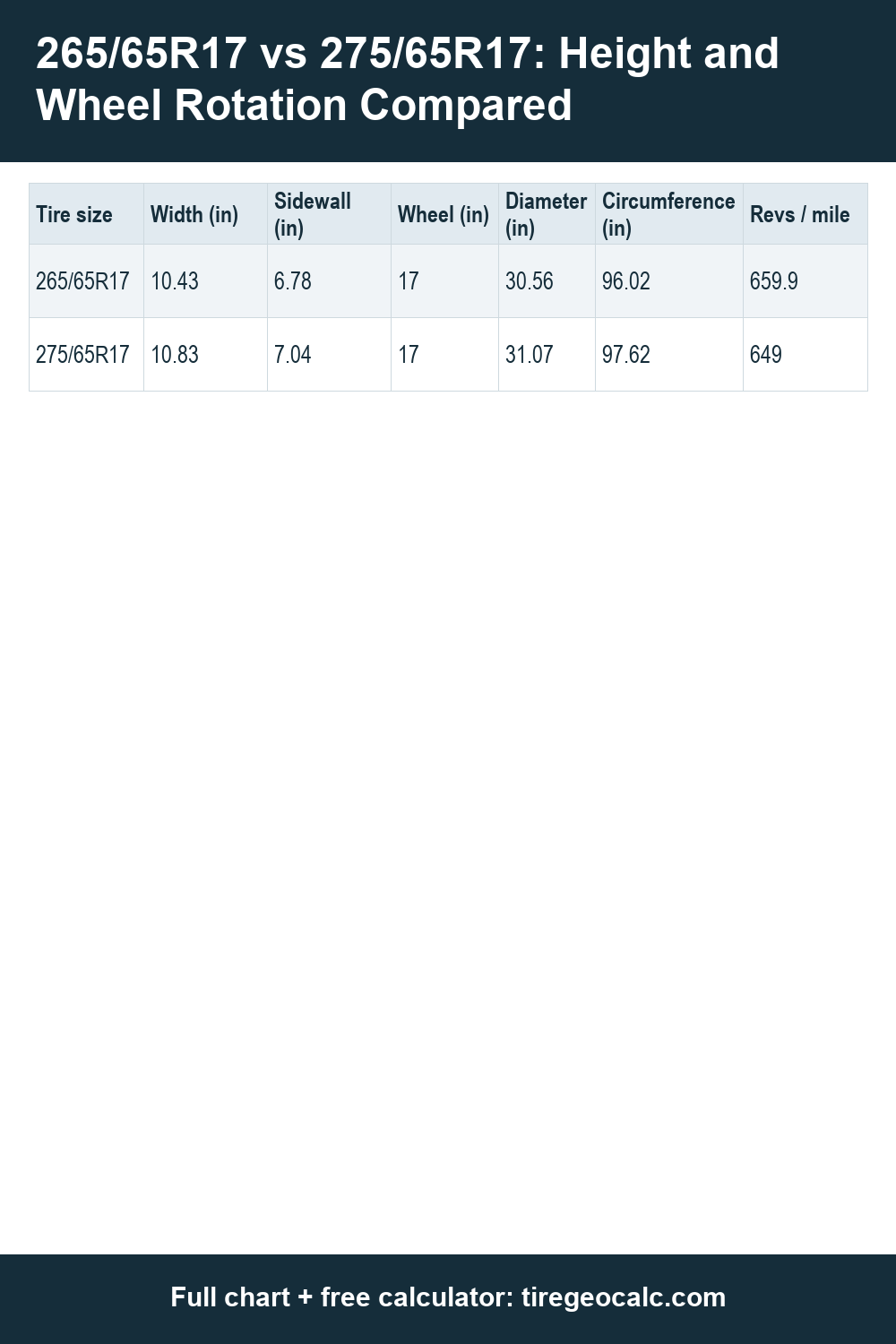
Calculated dimensions are nominal, not measured rolling dimensions or vehicle fitment approval.
Read what the shared profile does to unequal widths
The nominal widths are 265 mm and 275 mm. Both use a 65 aspect ratio, which expresses sidewall height as a percentage of the width in its own row. A shared aspect ratio is therefore a shared proportion, not a shared sidewall height. Changing width alters the result even when the remaining marking stays unchanged.
Both tires use an R17 marking, so this comparison retains the same 17-inch wheel diameter and radial construction notation. The wheel diameter converts to 431.8 mm in the table. It forms the central part of each calculated circle, while the sidewall above and below the wheel supplies the rest of the outside height.
Build height while respecting presentation precision
The sidewall formula is width times aspect ratio divided by one hundred. For these rows, the displayed sidewall heights are 172.3 mm and 178.8 mm. Overall diameter then adds twice the full-precision sidewall result to the wheel diameter. The engine reports diameters of 776.3 mm for 265/65R17 and 789.3 mm for 275/65R17.
A useful detail here is that the displayed sidewall has already been rounded. Reusing that shortened number in the diameter formula can give a slightly different displayed total. The diameter column comes from the underlying calculation, so use that column when quoting height. This distinction explains a rounding mismatch without treating either row as a physical measurement.
Move from a straight diameter to the circular path
Circumference is found by multiplying diameter by pi. The original row displays 2438.8 mm, and the candidate displays 2479.7 mm. These values represent distance around each ideal outside circle. The larger diameter must produce the longer circumference because the formula applies the same circular relationship to both sizes.
For an inch-based reading, the diameters are 30.56 and 31.07 inches, with circumferences of 96.02 and 97.62 inches. Keep the units attached when copying values into a comparison. A diameter is a straight distance through the center, while a circumference follows the entire circle; switching between those quantities without changing the label leads to misleading conclusions.
Explain why the rotation count falls
To calculate revolutions per mile, divide the length of a mile by the circumference expressed in matching units. The table gives 659.9 for the original and 649 for the candidate. A longer circle covers more nominal distance with each revolution, so fewer revolutions are needed to cover the same route in this geometric model.
These counts are not observations from a moving vehicle. A tire carrying weight has a contact patch, and measured rolling data answers a different question from an unloaded ideal circle. If you need an actual rolling specification, use information for the exact product and its stated conditions rather than presenting this calculated count as a measured result.
Apply the diameter ratio to the dashboard example
Assuming calibration to 265/65R17 without additional instrument error, calculated actual speed is indicated speed multiplied by candidate diameter and divided by original diameter. Use 789.3 mm over 776.3 mm for this pair. The displayed result at an indicated 60 mph is 61 mph, consistent with the candidate covering more distance during each modeled revolution.
The table also shows 30.5 mph for an indicated 30 mph and 76.3 mph for an indicated 75 mph. All use the same original-to-candidate direction. They explain a proportional size effect; they do not verify the instrument or reveal the complete error of a real speed reading after a tire change.
Keep the geometric conclusion within its limits
The justified conclusion is that 275/65R17 is nominally taller and requires fewer geometric revolutions per mile than 265/65R17. Similar dimensions do not establish permission to fit that candidate to a particular vehicle. Vehicle documentation and the specifications of the actual tire and wheel remain necessary before evaluating a replacement.
Check the original axle size rather than assuming the currently installed tire is the intended reference. Also keep service ratings, permitted rim width and clearance questions separate from the calculation. With the baseline and units recorded, this table becomes a useful explanation of dimensions while leaving installation decisions to the information it does not contain.
Frequently asked questions
Which row has the greater nominal height?
The 275/65R17 diameter is 789.3 mm, compared with 776.3 mm for 265/65R17. Its larger width feeds a taller sidewall at the same aspect ratio.
Why might arithmetic using 172.3 mm miss the listed diameter?
The sidewall display is rounded, whereas the diameter is calculated from the unrounded sidewall. Reusing the shortened display changes the precision available to the next calculation.
Do 649 revolutions per mile describe a loaded tire test?
The candidate's 649 figure is derived from its nominal geometric circumference. It is not a counted result from a tire carrying vehicle weight.
Does the smaller rotation count identify a suitable replacement?
A rotation count only expresses distance per turn in the model. Suitability requires the vehicle's requirements together with exact tire and wheel information beyond the size pair.