 TireGeoCalc
265/60R20 in Inches: Reading Width and Sidewall Separately
Quick answer
Nominal geometry265/60R20 · nominal size-code geometry
- Overall diameter
- 32.52in
- Section width
- 10.43in
- Sidewall height
- 6.26in
Calculated from size markings. Not measured rolling dimensions or vehicle fitment approval.
Published
For 265/60R20, the converted section width is 10.43 inches and the sidewall height is 6.26 inches. These describe different directions through the tire and answer different questions. Neither figure tells you which wheel width is approved for a particular product. Keeping them separate is especially useful when an inch-based wheel listing sits beside a metric tire marking. This guide explains the width and sidewall first, works through the complete diameter, and then identifies what the geometric results can contribute to a comparison before the vehicle and product checks begin.
Nominal geometry for these tire sizes
The first size is the reference. Dimensions are nominal calculations, not measured rolling data or vehicle fitment approval.
| Tire size | Width (mm) | Width (in) | Sidewall (mm) | Sidewall (in) | Wheel (mm) | Wheel (in) | Diameter (mm) | Diameter (in) | Circumference (mm) | Circumference (in) | Revolutions / mile | Revolutions / km | Diameter change (%) |
|---|---|---|---|---|---|---|---|---|---|---|---|---|---|
| 265/60R20 | 265 | 10.43 | 159 | 6.26 | 508 | 20 | 826 | 32.52 | 2595 | 102.16 | 620.2 | 385.4 | 0 |
Nominal size-code geometry. Reference: 265/60R20. Display rounding only; not fitment approval.
- Tire size
- 265/60R20
- Width (mm)
- 265
- Width (in)
- 10.43
- Sidewall (mm)
- 159
- Sidewall (in)
- 6.26
- Wheel (mm)
- 508
- Wheel (in)
- 20
- Diameter (mm)
- 826
- Diameter (in)
- 32.52
- Circumference (mm)
- 2595
- Circumference (in)
- 102.16
- Revolutions / mile
- 620.2
- Revolutions / km
- 385.4
- Diameter change (%)
- 0
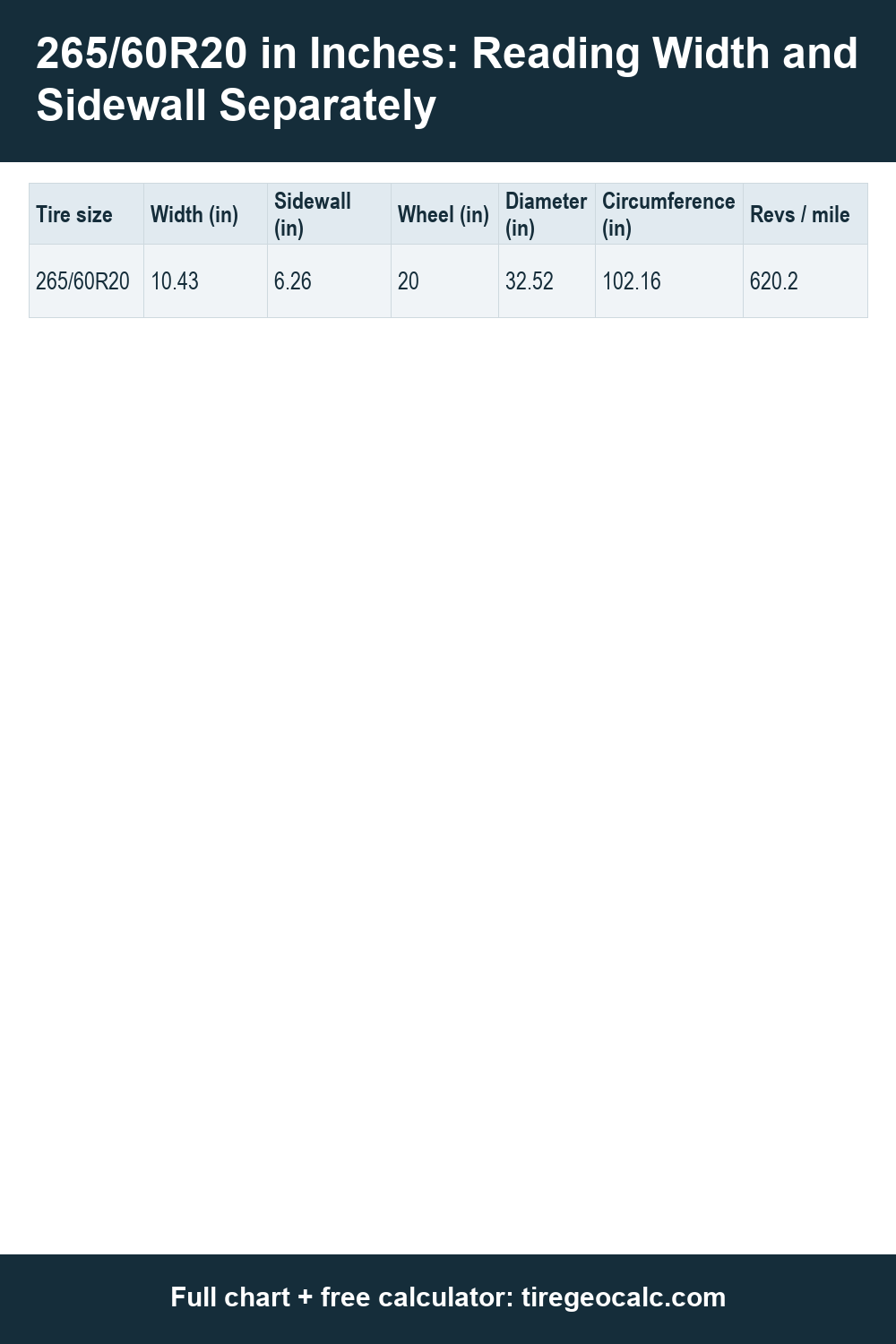
Calculated dimensions are nominal, not measured rolling dimensions or vehicle fitment approval.
Give width and sidewall different labels
Section width runs across the tire section, whereas sidewall height describes a radial contribution between the wheel and the outside tire circle. The marking starts with a nominal width of 265 mm. Its aspect ratio is 60 percent, which makes sidewall height dependent on that width rather than a separate fixed number. R denotes radial construction, and 20 is the wheel diameter in inches. This mix of units is normal for the marking, but it means you cannot assign inches to every printed number. Write the dimension name next to each converted result so that width never becomes a stand-in for height or wheel width.
Use the aspect ratio to calculate the radial contribution
The sidewall formula multiplies nominal width by the aspect ratio as a fraction of the whole. With the 265/60R20 inputs, the result is 159 mm, which appears as 6.26 inches after conversion and rounding. That calculation explains the relationship between the width and the sidewall without suggesting they are interchangeable measurements. The converted section width of 10.43 inches remains a transverse dimension. The sidewall value is not a tread-depth figure, a material-thickness measurement or a specification for suspension travel. These distinctions matter when the reason for converting is to sketch an assembly or discuss its dimensions with someone using inch measurements.
Combine the wheel with both sidewalls for overall height
To complete the worked example, convert the wheel diameter to millimeters, giving 508 mm. Add the calculated sidewall height twice, once for each side of the wheel along a line through the center. The total nominal diameter is 826 mm, displayed as 32.52 inches. This is the tire's full calculated height, rather than its wheel diameter or sidewall height alone. The engine performs that addition with the original values and then rounds the unit conversions for presentation. Doubling a rounded inch sidewall and adding the wheel marking can introduce a rounding difference, so preserve the input code when checking the arithmetic yourself.
Read circumference as another geometric dimension
Multiplying the unrounded overall diameter by pi gives the circumference of the ideal tire circle. The displayed result for this size is 2595 mm or 102.16 inches. Circumference represents a path around the outline and should not be confused with either of the width or height figures. Dividing a mile by the circumference in matching units gives 620.2 geometric revolutions per mile. These relationships help you understand why a different overall diameter changes the distance represented by a wheel revolution. However, this page supplies no second size or original calibration baseline, so the conversion alone cannot state a speedometer or odometer change.
Avoid treating section width as a wheel instruction
A nominal section width of 10.43 inches does not select a wheel of that width. Obtain the permitted wheel-width range for the exact tire from its manufacturer and check the wheel details required by the vehicle. Diameter is only part of the wheel specification; width, offset and clearance also need their own attention. Likewise, a similar tire diameter does not establish approval to fit that tire to your particular vehicle. Use the inch conversion to communicate dimensions, then keep the fitting decision tied to the applicable vehicle and product documentation. A simple unit conversion cannot supply information absent from the original size marking.
Carry the calculation into a properly labeled comparison
The values here represent nominal geometry rather than measurements under load or measured rolling circumference. If a manufacturer's sheet provides measured dimensions, record them separately instead of silently replacing them with these calculated figures. For a size comparison, identify the original specification for the relevant axle, calculate the candidate using the same method and compare matching dimensions in matching units. Keeping the reference visible prevents a wide tire and a tall tire from being described as equivalent simply because one rounded figure looks close. The result of this page is a clear set of labeled lengths, ready to support that comparison while leaving product suitability and physical clearance to their own checks.
Frequently asked questions
Which measurement is 10.43 inches on 265/60R20?
It is the converted nominal section width. The sidewall is a different dimension, displayed as 6.26 inches in this calculation.
Does the 20-inch wheel marking include the sidewalls?
The marking identifies wheel diameter only. Adding the sidewall contributions gives the complete nominal tire diameter of 32.52 inches.
Can the sidewall figure be used as a tread-depth measurement?
Sidewall height follows from the size code's width and aspect ratio. Tread depth is a separate product characteristic and cannot be read from that calculated height.
What should I record before comparing a replacement size?
Record the original axle size and the complete candidate marking, then calculate each with the same method. Keep vehicle requirements and exact tire and wheel specifications beside the geometric comparison.