 TireGeoCalc
255/60R19 in Inches: Diameter and Geometric Revolutions
Quick answer
Nominal geometry255/60R19 · nominal size-code geometry
- Overall diameter
- 31.05in
- Section width
- 10.04in
- Sidewall height
- 6.02in
Calculated from size markings. Not measured rolling dimensions or vehicle fitment approval.
Published
A search for 255/60R19 in inches often starts with overall height, but the same calculation can explain circumference and rotation count as well. The nominal diameter here is 31.05 inches and the circumference is 97.54 inches. Those dimensions describe an ideal tire circle derived from the size marking. Following the relationship between them makes the revolutions figure easier to interpret and helps avoid confusing a mathematical result with measured rolling data. Begin with the code, keep the units visible, and treat each later result as a different view of the same calculated geometry.
Nominal geometry for these tire sizes
The first size is the reference. Dimensions are nominal calculations, not measured rolling data or vehicle fitment approval.
| Tire size | Width (mm) | Width (in) | Sidewall (mm) | Sidewall (in) | Wheel (mm) | Wheel (in) | Diameter (mm) | Diameter (in) | Circumference (mm) | Circumference (in) | Revolutions / mile | Revolutions / km | Diameter change (%) |
|---|---|---|---|---|---|---|---|---|---|---|---|---|---|
| 255/60R19 | 255 | 10.04 | 153 | 6.02 | 482.6 | 19 | 788.6 | 31.05 | 2477.5 | 97.54 | 649.6 | 403.6 | 0 |
Nominal size-code geometry. Reference: 255/60R19. Display rounding only; not fitment approval.
- Tire size
- 255/60R19
- Width (mm)
- 255
- Width (in)
- 10.04
- Sidewall (mm)
- 153
- Sidewall (in)
- 6.02
- Wheel (mm)
- 482.6
- Wheel (in)
- 19
- Diameter (mm)
- 788.6
- Diameter (in)
- 31.05
- Circumference (mm)
- 2477.5
- Circumference (in)
- 97.54
- Revolutions / mile
- 649.6
- Revolutions / km
- 403.6
- Diameter change (%)
- 0
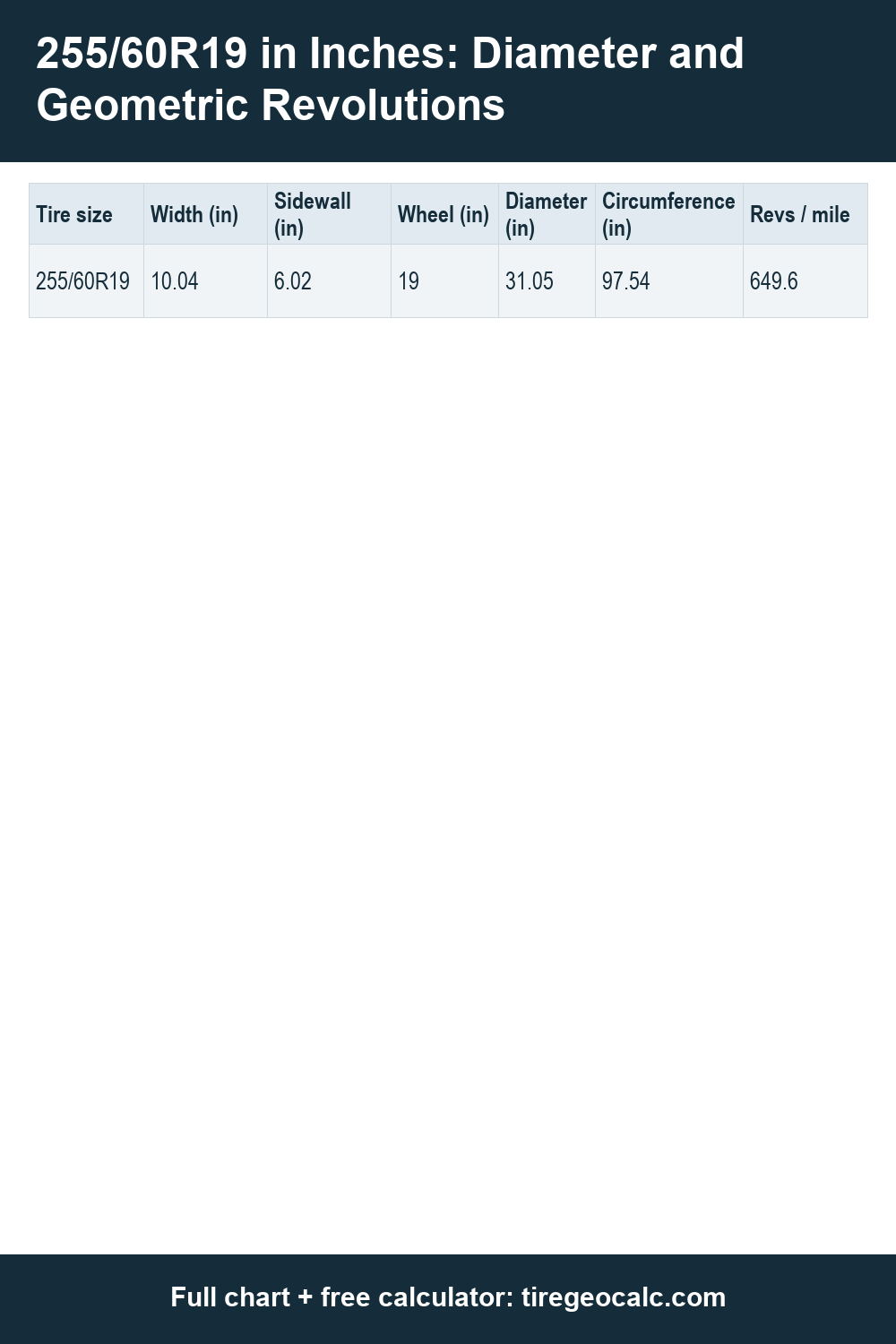
Calculated dimensions are nominal, not measured rolling dimensions or vehicle fitment approval.
Read the width and aspect ratio as a pair
The 255 in the marking is nominal section width in millimeters, which the conversion table shows as 10.04 inches. The 60 is a percentage relating sidewall height to that width. It is not an independent sidewall length, and it should not be converted directly into inches. The wheel portion is 19 inches, with R identifying radial construction. Assigning a role to each part allows the calculation to proceed without mixing wheel diameter and tire width. It also shows why section width alone is insufficient to determine overall height: the sidewall proportion and the wheel diameter both contribute to the completed assembly.
Assemble the nominal diameter step by step
For the numerical example, multiply width by the aspect ratio expressed as a fraction. The resulting sidewall is 153 mm, displayed as 6.02 inches. Convert the wheel diameter into millimeters to obtain 482.6 mm, then add both sidewalls to that wheel measurement. The calculated overall diameter is 788.6 mm, or 31.05 inches in the inch column. Both sidewalls matter because a line through the center crosses the rubber on opposite sides of the wheel. Use the original size inputs for this calculation; the displayed inch sidewall is already rounded and should not become an intermediate input when reproducing the full diameter.
Turn the diameter into a distance around the circle
Multiply the complete, unrounded tire diameter by pi to calculate circumference. For 255/60R19 the displayed circumference is 2477.5 mm, with the inch version shown as 97.54. This length traces the outside of the ideal circle instead of cutting across it. Labeling the dimension matters when copying it into a worksheet: a circumference value cannot be compared directly with another tire's diameter. Compare circumference with circumference or diameter with diameter, using consistent units. The table rounds each result only after calculation, so converting a rounded value backward may not reproduce every final digit shown in the other unit column.
Divide travel distance by circumference to count turns
The geometric count is 649.6 revolutions per mile. Its formula divides the length of a mile by the circumference, after putting both distances in the same unit. The kilometer version is 403.6 revolutions per kilometer and uses the same tire circle with a different travel distance. This relationship is inverse: a longer circumference needs fewer turns to cover a fixed distance, while a shorter one needs more. The count is not the number of revolutions per minute at a particular speed. A time-based rotation rate would require additional information, which this conversion page does not assume or calculate.
Do not substitute geometric turns for measured rolling data
These rotation counts come from nominal dimensions, not measurements under load or measured rolling circumference. An ideal circle does not model the contact patch as a tire carries a vehicle. Consequently, a geometric revolutions figure should keep its label when it appears beside manufacturer data. Check whether the manufacturer's value is measured or calculated and what conditions accompany it before treating the figures as equivalent. This page cannot establish instrument calibration or a measured travel distance from a road test. It explains the size-code geometry so you can identify the correct kind of information when a later task calls for actual rolling behavior.
Keep the fitting decision outside the conversion
A comparable inch diameter or rotation count does not confer approval to mount a tire on a specific vehicle. Confirm the vehicle's requirements and the exact tire and wheel specifications before making that decision. The converted section width is also not an approved wheel-width recommendation, and neither circumference nor diameter establishes clearance around the assembly. If you want to study a size change next, retain the original tire marking as the reference and calculate the proposed candidate separately. Comparing labeled results from the same method makes the dimensional difference understandable without implying that either the dimensions or the rotation count settle every requirement for installation.
Frequently asked questions
How tall is 255/60R19 according to the size-code calculation?
Its nominal overall diameter displays as 31.05 inches. That is the complete tire circle, while the wheel portion is 19 inches.
Does 649.6 revolutions per mile mean a measured road result?
Here it means a geometric count calculated from nominal circumference. It has not been obtained by measuring a tire rolling under vehicle load.
Why does a larger circumference require fewer turns?
Each ideal rotation covers a longer distance around the circle. Dividing the same travel distance by that longer circumference therefore produces a lower rotation count.
Is the 10.04-inch width the width of the tread?
The figure converts the marking's nominal section width. It does not specify tread contact width or provide the manufacturer's permitted wheel-width range.