 TireGeoCalc
245/60R18 vs 255/60R18: What the Extra Width Also Changes
Quick answer
Nominal geometry245/60R18 → 255/60R18 · original-size calibration assumed
- Diameter difference
- +0.47in
- Diameter change
- +1.60%
- Actual at indicated 60 mph
- 60.96mph
Calculated from size markings. Not measured rolling dimensions or vehicle fitment approval.
Published
The first numbers in 245/60R18 and 255/60R18 draw attention to width, but they also influence the height calculation. With the aspect ratio held at 60, the wider section produces a taller sidewall. Keeping the wheel diameter unchanged does not keep the outside diameter unchanged. This comparison explains each dimension separately, using 245/60R18 as the original and 255/60R18 as the candidate. It describes the shape implied by the markings, not the position of a tire inside a wheel opening.
Nominal geometry for these tire sizes
The first size is the reference. Dimensions are nominal calculations, not measured rolling data or vehicle fitment approval.
| Tire size | Width (mm) | Width (in) | Sidewall (mm) | Sidewall (in) | Wheel (mm) | Wheel (in) | Diameter (mm) | Diameter (in) | Circumference (mm) | Circumference (in) | Revolutions / mile | Revolutions / km | Diameter change (%) | Actual at indicated 30 mph | Actual at indicated 60 mph | Actual at indicated 75 mph | Actual minus indicated at 60 mph |
|---|---|---|---|---|---|---|---|---|---|---|---|---|---|---|---|---|---|
| 245/60R18 | 245 | 9.65 | 147 | 5.79 | 457.2 | 18 | 751.2 | 29.57 | 2360 | 92.91 | 681.9 | 423.7 | 0 | 30 | 60 | 75 | 0 |
| 255/60R18 | 255 | 10.04 | 153 | 6.02 | 457.2 | 18 | 763.2 | 30.05 | 2397.7 | 94.4 | 671.2 | 417.1 | 1.6 | 30.5 | 61 | 76.2 | 1 |
Nominal size-code geometry. Reference: 245/60R18. Display rounding only; not fitment approval.
- Tire size
- 245/60R18
- Width (mm)
- 245
- Width (in)
- 9.65
- Sidewall (mm)
- 147
- Sidewall (in)
- 5.79
- Wheel (mm)
- 457.2
- Wheel (in)
- 18
- Diameter (mm)
- 751.2
- Diameter (in)
- 29.57
- Circumference (mm)
- 2360
- Circumference (in)
- 92.91
- Revolutions / mile
- 681.9
- Revolutions / km
- 423.7
- Diameter change (%)
- 0
- Actual at indicated 30 mph
- 30
- Actual at indicated 60 mph
- 60
- Actual at indicated 75 mph
- 75
- Actual minus indicated at 60 mph
- 0
- Tire size
- 255/60R18
- Width (mm)
- 255
- Width (in)
- 10.04
- Sidewall (mm)
- 153
- Sidewall (in)
- 6.02
- Wheel (mm)
- 457.2
- Wheel (in)
- 18
- Diameter (mm)
- 763.2
- Diameter (in)
- 30.05
- Circumference (mm)
- 2397.7
- Circumference (in)
- 94.4
- Revolutions / mile
- 671.2
- Revolutions / km
- 417.1
- Diameter change (%)
- 1.6
- Actual at indicated 30 mph
- 30.5
- Actual at indicated 60 mph
- 61
- Actual at indicated 75 mph
- 76.2
- Actual minus indicated at 60 mph
- 1
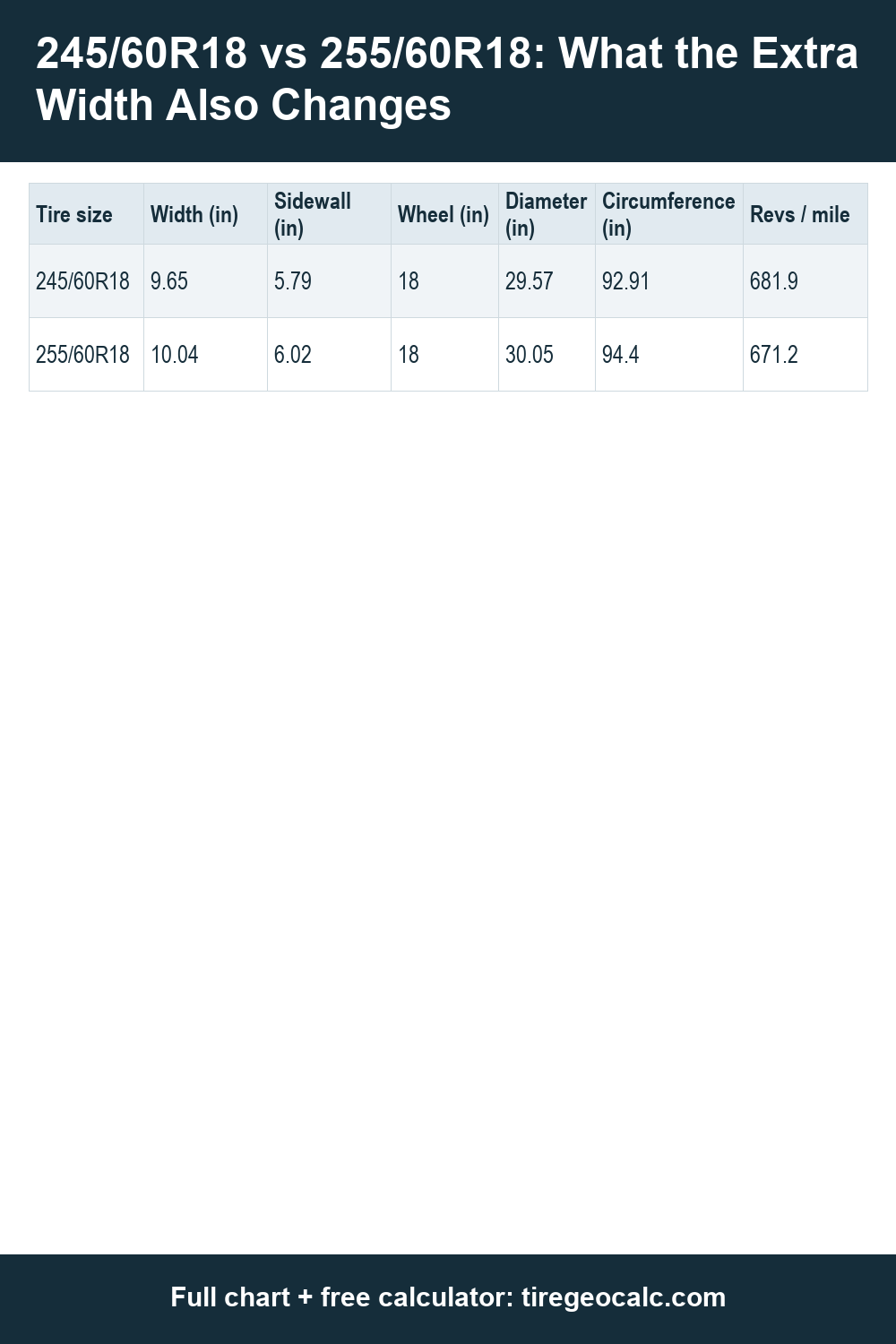
Calculated dimensions are nominal, not measured rolling dimensions or vehicle fitment approval.
Separate the outline from its position on the vehicle
Section width is 245 mm in the original row and 255 mm in the candidate row. These values describe a nominal width across the tire. They do not locate its centerline relative to the vehicle. A tire-size calculator can compare dimensions while still lacking the wheel information needed to determine where those dimensions sit.
Wheel width and offset are separate from the R18 part of the size code. R identifies radial construction, while 18 supplies the wheel diameter in inches. Reading that ending as a complete wheel specification would leave out information relevant to the placement of the assembly and the space around it.
Trace width into the sidewall calculation
For each metric size, multiply width by the aspect ratio and divide by one hundred to calculate a sidewall. The 245/60R18 sidewall displays 147 mm, and the 255/60R18 sidewall displays 153 mm. Because the aspect ratio acts on width, it cannot be interpreted as a sidewall measurement on its own.
The complete diameter is the wheel diameter plus twice the sidewall height, with all terms expressed in matching units. Both rows use a 457.2 mm wheel diameter. Combining it with the respective sidewalls gives 751.2 mm for the original assembly and 763.2 mm for the candidate. The width change therefore appears in both the horizontal and vertical descriptions.
Read the inch values without rounding a second time
The original width converts to 9.65 inches and its sidewall to 5.79 inches. For the candidate, those displayed figures are 10.04 and 6.02 inches. Overall diameters are 29.57 and 30.05 inches respectively. Use the complete labels when discussing these values so a sidewall dimension is not mistaken for an outside diameter.
The calculator converts its full-precision geometry before formatting the inch columns. Avoid rebuilding the diameter by adding already rounded inch values, because that creates another rounding step. Read the diameter column directly when you need the presented height. The different units provide another way to express the calculation, not a second source of product dimensions.
Connect the taller outline to distance per turn
The circumference formula multiplies overall diameter by pi. It produces a displayed 2360 mm for the original and 2397.7 mm for the candidate. A complete turn of the candidate's ideal circle therefore represents a longer distance. This geometric relationship explains the rotation figures without making any claim about the tire's behavior on a particular surface.
Revolutions per mile are 681.9 for 245/60R18 and 671.2 for 255/60R18. These numbers divide the same distance by different circumferences, so the larger circumference needs fewer rotations. Neither row is a measured rolling result under vehicle load. Keep manufacturer rolling specifications separate if you later compare an actual tire with the nominal calculation.
Interpret the speed estimate with a named baseline
The speed example treats 245/60R18 as the original calibration size and assumes no other instrument error. Multiply indicated speed by the 763.2 mm candidate diameter and divide by the 751.2 mm original diameter. At an indicated 60 mph, the engine presents the calculated actual speed as 61 mph. This is a consequence of the taller candidate circle.
An indicated 75 mph produces a displayed calculation of 76.2 mph in the same direction. Do not reuse this result if your original tire has a different marking, even if its wheel diameter matches. A different original diameter changes the ratio, and an existing speedometer error is outside the simplified example.
Check the actual package beyond its nominal dimensions
Dimensional similarity between these rows does not authorize installing either size on a specific vehicle. Check the vehicle's tire specification and the exact tire's wheel requirements, then evaluate the complete assembly. The code alone does not provide service ratings, permitted rim widths, wheel position or clearance throughout steering and suspension travel.
Bring the original and candidate markings together with the wheel specification when asking about an installation. That makes the unresolved questions concrete: where the assembly sits, what dimensions the selected product actually has, and which requirements apply to the vehicle. The comparison supports those questions by keeping width, sidewall and diameter distinct rather than treating them as one interchangeable measurement.
Frequently asked questions
Does the wider candidate keep the same overall height?
The candidate has a calculated diameter of 763.2 mm, while the original is 751.2 mm. The shared aspect ratio makes the wider candidate's sidewall taller too.
Can the table tell me how much inner clearance remains?
Remaining clearance needs the wheel position, actual product dimensions and the vehicle's available space. Those details are not encoded by the nominal tire markings used in this table.
Why should I read diameter directly from its column?
That column is generated before presentation rounding. Adding rounded inch sidewalls to a rounded wheel value can produce a slightly different total because it introduces extra rounding.
Is the candidate's width 10.04 inches also its tread width?
The 10.04-inch value is a conversion of nominal section width. It does not supply the width of a particular product's tread, which requires its own specification.