 TireGeoCalc
235/75R15 in Inches: Diameter, Width and Circumference
Quick answer
Nominal geometry235/75R15 · nominal size-code geometry
- Overall diameter
- 28.88in
- Section width
- 9.25in
- Sidewall height
- 6.94in
Calculated from size markings. Not measured rolling dimensions or vehicle fitment approval.
Published
The marking 235/75R15 combines measurements that describe different parts of a tire. Converting the complete size into inches helps separate the wheel inside the tire from the outside edge of the tread. The table gives a nominal width of 9.25 inches and an overall diameter of 28.88 inches. Those figures answer different questions, so keep their labels attached when recording them. This guide follows the size from its width through to its calculated travel around an ideal circle, without treating that circle as a tested tire on a vehicle.
Nominal geometry for these tire sizes
The first size is the reference. Dimensions are nominal calculations, not measured rolling data or vehicle fitment approval.
| Tire size | Width (mm) | Width (in) | Sidewall (mm) | Sidewall (in) | Wheel (mm) | Wheel (in) | Diameter (mm) | Diameter (in) | Circumference (mm) | Circumference (in) | Revolutions / mile | Revolutions / km | Diameter change (%) |
|---|---|---|---|---|---|---|---|---|---|---|---|---|---|
| 235/75R15 | 235 | 9.25 | 176.3 | 6.94 | 381 | 15 | 733.5 | 28.88 | 2304.4 | 90.72 | 698.4 | 434 | 0 |
Nominal size-code geometry. Reference: 235/75R15. Display rounding only; not fitment approval.
- Tire size
- 235/75R15
- Width (mm)
- 235
- Width (in)
- 9.25
- Sidewall (mm)
- 176.3
- Sidewall (in)
- 6.94
- Wheel (mm)
- 381
- Wheel (in)
- 15
- Diameter (mm)
- 733.5
- Diameter (in)
- 28.88
- Circumference (mm)
- 2304.4
- Circumference (in)
- 90.72
- Revolutions / mile
- 698.4
- Revolutions / km
- 434
- Diameter change (%)
- 0
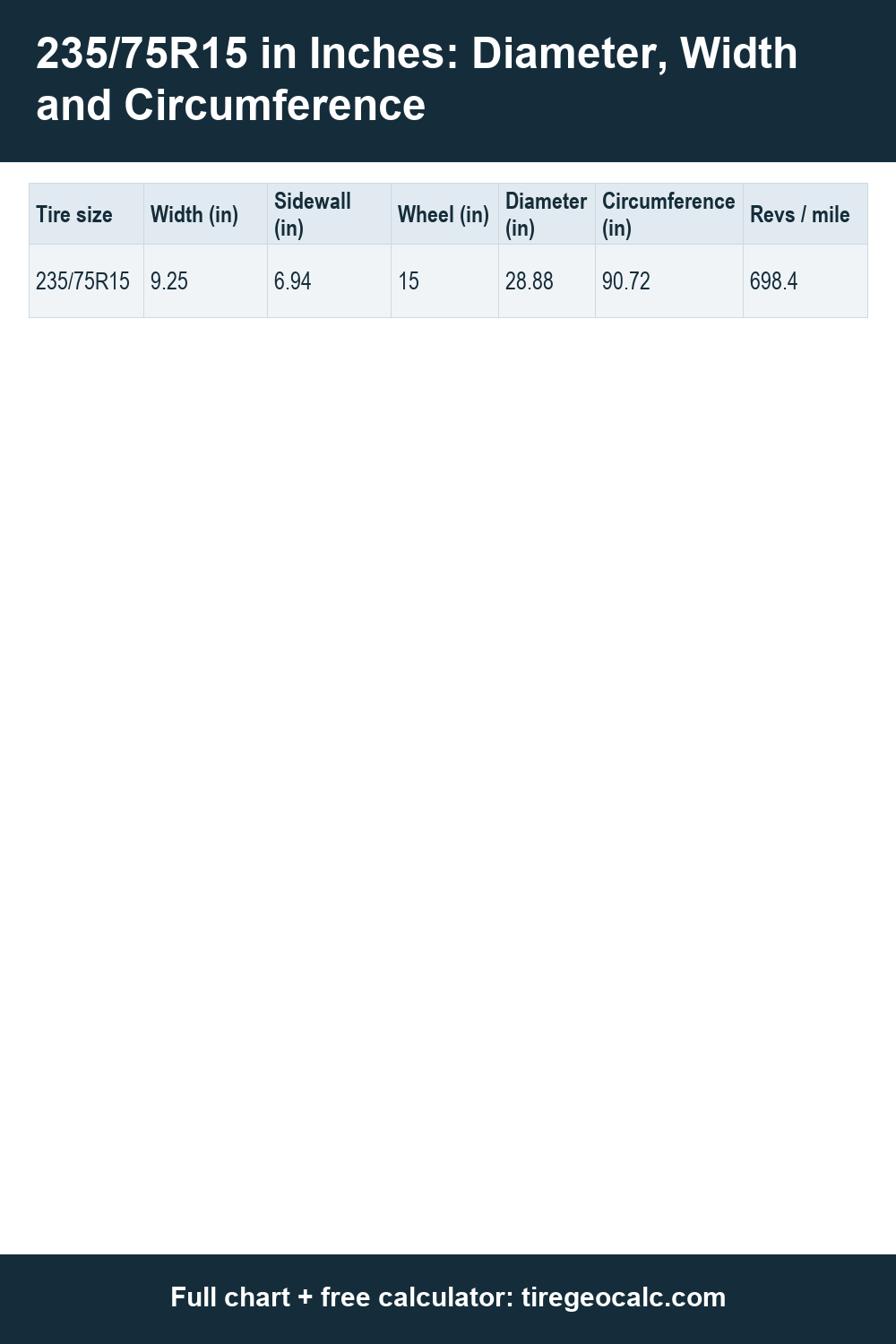
Calculated dimensions are nominal, not measured rolling dimensions or vehicle fitment approval.
Separate the wheel from the whole tire
Read 235/75R15 as a complete label before looking for an inch equivalent. Its opening number describes nominal section width in millimeters. The middle part gives sidewall height relative to that width, while R identifies radial construction. The final part refers to wheel diameter in inches. It does not describe how tall the complete tire stands. In this case, the wheel diameter is 15 inches, shown as 381 mm in the table.
Picture a line passing through the center of the wheel from the upper tread to the lower tread. That line crosses a sidewall, the wheel and the opposite sidewall. By contrast, section width runs across the tire. Keeping these directions separate prevents a common reading error: using the wheel measurement as if it were overall height.
Follow the conversion from width to travel
Start with the width entry: 235 mm is displayed as 9.25 inches. Next read the sidewall calculated from the width and aspect ratio: 176.3 mm, or 6.94 inches. The geometry engine combines the wheel with both sidewalls before rounding, giving an overall diameter of 733.5 mm, or 28.88 inches. These are successive parts of the same calculation, not independently measured dimensions.
Continue around the outside of the ideal circle. Its circumference is 2304.4 mm, displayed as 90.72 inches. Dividing a mile expressed in matching units by the unrounded circumference produces 698.4 nominal revolutions per mile. This last entry describes a count of turns over distance; it is neither an engine speed nor a road speed. Use the supplied result instead of calculating again from shortened display values.
Use each column for its own question
The diameter column is useful when your question is about nominal outside height. The width column addresses a different direction, and the sidewall column explains the radial space between wheel and tread. Circumference describes the path around the outside. Although all belong to the same tire outline, substituting any of them for another changes the meaning of the comparison.
If you later compare a candidate size, write down the original full size first and compare the candidate against it. A greater candidate diameter means a taller nominal outline; a smaller candidate diameter means a shorter outline. Keep both entries in the same unit. This page supplies only the stated size, so it does not establish a numerical difference from an unspecified original tire.
Read the displayed precision honestly
Every dimension here is nominal geometry calculated from the size code. The values are not measurements under load, and the circumference is not a measured rolling circumference. A real tire is a manufactured object rather than a perfect mathematical circle. The exact product specification can therefore differ from the calculated outline even when its sidewall carries this same size.
The engine retains precision during the calculation and rounds the final presentation. The inch and millimeter columns are views of those results, not instructions to perform a fresh chain of rounded arithmetic. If a hand calculation starts from the displayed sidewall or diameter, its final digits may differ. Preserve the provided values when copying this table into your notes and label them as calculated.
Take the complete size to a fitment check
A similar diameter is not approval to fit a tire to a vehicle. This conversion cannot establish wheel suitability, clearance or the required service description. Check the vehicle documentation and exact tire and wheel specifications with a qualified installer before making a fitment decision. Matching the wheel diameter alone leaves other essential requirements unanswered.
Nor does a nominal sidewall height determine a suitable inflation pressure, load capacity, ride comfort or fuel consumption. Those questions need information beyond the size geometry. For a useful follow-up, bring the full existing tire marking and the exact proposed specification, along with the vehicle details. The table then serves as a clearly labeled dimensional reference within that wider review.
Frequently asked questions
Is 15 inches the outside height?
It is the wheel diameter. The complete nominal tire diameter is 28.88 inches, which includes the sidewalls surrounding the wheel.
Does the width describe tread contact on the road?
The 9.25-inch entry is nominal section width, not a measured contact patch or a measurement of usable tread width.
How should I read 698.4 revolutions per mile?
It is an ideal geometric count obtained from the calculated circumference. It does not certify a rolling result for a loaded vehicle.
Why might a specification sheet show another diameter?
The table derives an outline from the size marking. A manufacturer describes an actual product under stated measuring conditions, so its dimensions may differ.