 TireGeoCalc
235/60R18 vs 245/60R18: Circumference and Speedometer Geometry
Quick answer
Nominal geometry235/60R18 → 245/60R18 · original-size calibration assumed
- Diameter difference
- +0.47in
- Diameter change
- +1.62%
- Actual at indicated 60 mph
- 60.97mph
Calculated from size markings. Not measured rolling dimensions or vehicle fitment approval.
Published
A tire-size comparison becomes easier to interpret when you follow a complete wheel revolution. The 245/60R18 circle is nominally taller than the 235/60R18 circle, so its distance around the outside is also longer. That links diameter to circumference, rotations and the speedometer example on this page. Start with 235/60R18 as the calibration reference. None of the figures are measurements from a road test, and their relationship alone does not determine whether the candidate belongs on your vehicle.
Nominal geometry for these tire sizes
The first size is the reference. Dimensions are nominal calculations, not measured rolling data or vehicle fitment approval.
| Tire size | Width (mm) | Width (in) | Sidewall (mm) | Sidewall (in) | Wheel (mm) | Wheel (in) | Diameter (mm) | Diameter (in) | Circumference (mm) | Circumference (in) | Revolutions / mile | Revolutions / km | Diameter change (%) | Actual at indicated 30 mph | Actual at indicated 60 mph | Actual at indicated 75 mph | Actual minus indicated at 60 mph |
|---|---|---|---|---|---|---|---|---|---|---|---|---|---|---|---|---|---|
| 235/60R18 | 235 | 9.25 | 141 | 5.55 | 457.2 | 18 | 739.2 | 29.1 | 2322.3 | 91.43 | 693 | 430.6 | 0 | 30 | 60 | 75 | 0 |
| 245/60R18 | 245 | 9.65 | 147 | 5.79 | 457.2 | 18 | 751.2 | 29.57 | 2360 | 92.91 | 681.9 | 423.7 | 1.62 | 30.5 | 61 | 76.2 | 1 |
Nominal size-code geometry. Reference: 235/60R18. Display rounding only; not fitment approval.
- Tire size
- 235/60R18
- Width (mm)
- 235
- Width (in)
- 9.25
- Sidewall (mm)
- 141
- Sidewall (in)
- 5.55
- Wheel (mm)
- 457.2
- Wheel (in)
- 18
- Diameter (mm)
- 739.2
- Diameter (in)
- 29.1
- Circumference (mm)
- 2322.3
- Circumference (in)
- 91.43
- Revolutions / mile
- 693
- Revolutions / km
- 430.6
- Diameter change (%)
- 0
- Actual at indicated 30 mph
- 30
- Actual at indicated 60 mph
- 60
- Actual at indicated 75 mph
- 75
- Actual minus indicated at 60 mph
- 0
- Tire size
- 245/60R18
- Width (mm)
- 245
- Width (in)
- 9.65
- Sidewall (mm)
- 147
- Sidewall (in)
- 5.79
- Wheel (mm)
- 457.2
- Wheel (in)
- 18
- Diameter (mm)
- 751.2
- Diameter (in)
- 29.57
- Circumference (mm)
- 2360
- Circumference (in)
- 92.91
- Revolutions / mile
- 681.9
- Revolutions / km
- 423.7
- Diameter change (%)
- 1.62
- Actual at indicated 30 mph
- 30.5
- Actual at indicated 60 mph
- 61
- Actual at indicated 75 mph
- 76.2
- Actual minus indicated at 60 mph
- 1
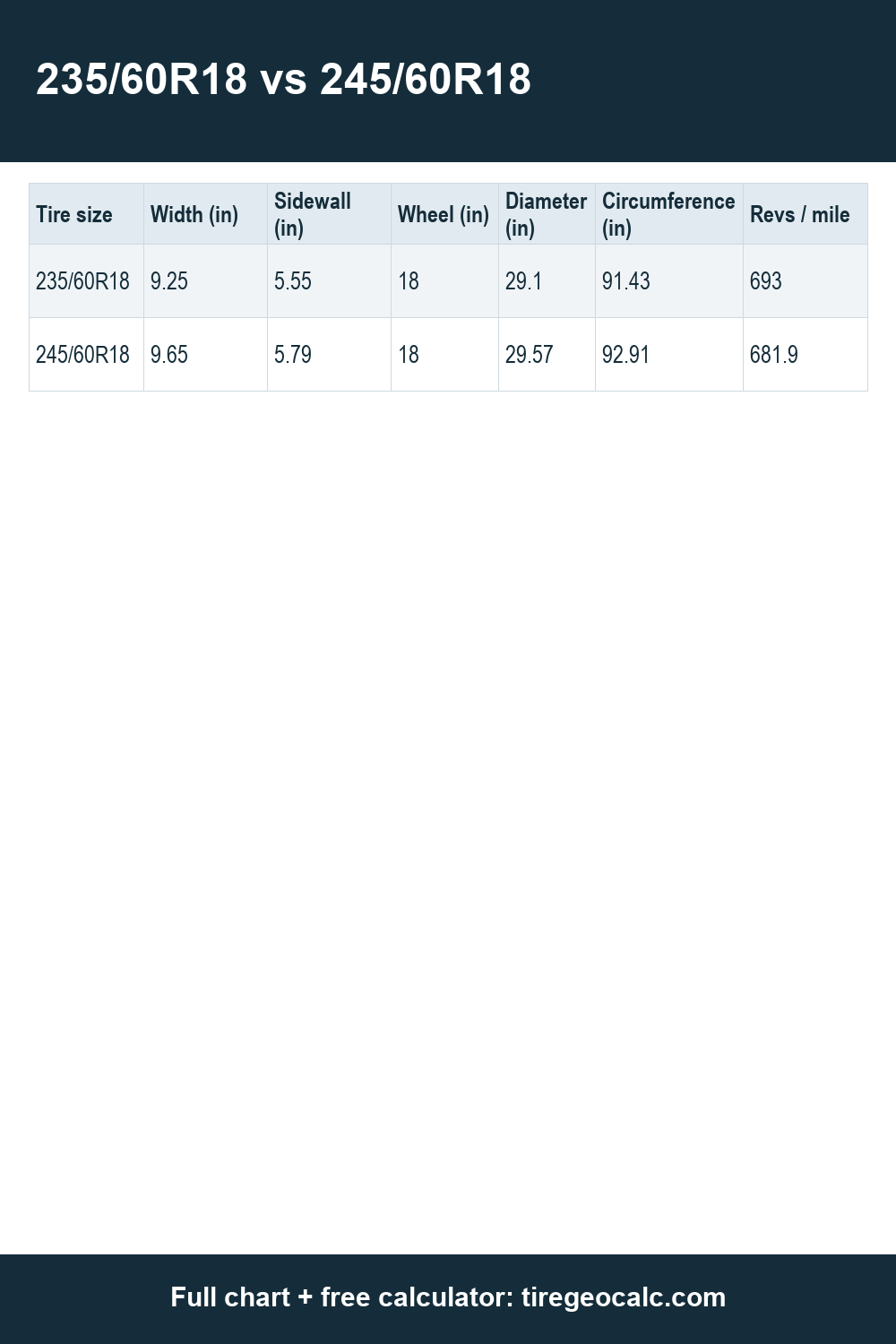
Calculated dimensions are nominal, not measured rolling dimensions or vehicle fitment approval.
Start with the circle behind the speed reading
The original size has a calculated diameter of 739.2 mm, compared with 751.2 mm for the candidate. A distance-per-turn calculation begins with that whole diameter, including the wheel and sidewalls. Using only the wheel diameter would leave out the rubber above and below the wheel and would describe a different circle.
Both codes end in R18, indicating radial construction and an 18-inch wheel diameter. The section widths are 235 mm and 245 mm. Their shared 60 aspect ratio connects width to sidewall height, so the wider marking also leads to a larger calculated outside diameter in this particular comparison.
Build the diameter before calculating circumference
Sidewall height comes from width multiplied by aspect ratio, divided by one hundred. The table gives 141 mm for the original sidewall and 147 mm for the candidate sidewall. Adding twice the relevant sidewall to the 457.2 mm wheel diameter produces the complete diameters used here. Each row must use its own width in that calculation.
To obtain circumference, multiply the complete diameter by pi. Applying that rule to the original produces 2322.3 mm in the display, while the candidate displays 2360 mm. The table retains calculation precision before rounding these results for reading. Recalculating from a shortened intermediate value can create a small difference in the final displayed result.
Use revolutions per mile as a cross-check
Imagine marking a point on each ideal circle and letting each complete a full turn. The larger circle traces a longer distance. To cover a fixed mile, it therefore needs fewer turns. The table reflects this with 693 geometric revolutions per mile for 235/60R18 and 681.9 for 245/60R18.
The formula divides a mile expressed in the chosen length unit by circumference in that same unit. You can check the direction without calculating anything extra: increasing circumference must reduce the number of turns. If a comparison suggests the taller circle needs more revolutions over an equal distance, first check whether the rows or units were reversed.
Work through the indicated-speed example
For this example, assume the speedometer is calibrated to 235/60R18 and has no other error. Actual speed in the model equals indicated speed times new diameter divided by original diameter. Using the candidate diameter of 751.2 mm and reference diameter of 739.2 mm yields 61 mph at an indicated 60 mph after the engine rounds the output.
The other displayed examples follow the same rule: indicated 30 mph corresponds to calculated 30.5 mph, and indicated 75 mph corresponds to calculated 76.2 mph. The instrument reading is the input; calculated actual speed is the output. Neither side of that example should be described as a measurement of your own vehicle.
Avoid giving a rounded display extra meaning
In inches, the original diameter is 29.1 and its circumference is 91.43. The candidate displays 29.57 inches in diameter and 92.91 inches in circumference. Those are unit conversions of the same ideal geometry, not additional measurements that independently confirm the result. Changing the unit changes how you read the value, not the underlying circle.
A displayed whole number may still come from a calculation with more digits. For example, the circumference display of 2360 mm should be read at the engine's presentation precision. It does not imply that a physical tire has exactly that circumference, or that measuring the tread under load will reproduce the geometric figure.
Know where the rotation model ends
This comparison uses nominal unloaded geometry rather than measured rolling circumference. Product construction, the specified measuring conditions and the loaded tire require separate information. When a manufacturer provides rolling data for a specific tire, keep that data labeled separately from the revolutions per mile calculated here instead of silently combining the two sources.
A close circumference is not approval to fit 245/60R18 in place of 235/60R18 on a particular vehicle. The vehicle specification, wheel requirements, service ratings and clearance still need checking against the exact products. Use the table to understand the direction of a geometric change, then use the appropriate documentation to evaluate the actual installation.
Frequently asked questions
Which size needs fewer geometric turns per mile?
The 245/60R18 row shows 681.9 turns per mile, compared with 693 for 235/60R18. Its larger calculated circumference explains that lower count.
Why is the calculated speed higher than the indicated speed?
In this reference direction, the candidate travels farther per modeled turn than the original. The calculation assumes the instrument still interprets those turns using the original diameter.
Does 2360 mm represent a measured rolling circumference?
Here it is the rounded circumference of the nominal candidate circle. It is calculated from diameter and pi, without measuring a loaded tire rolling on a road.
What happens if I reverse the comparison?
The new starting size becomes the calibration reference and the diameter ratio changes accordingly. Recalculate that direction rather than reusing the forward speed figures.
Continue your comparison
Verified against manufacturer data
Published specifications for the named models, checked on the dates below. Differences mean published minus calculated, divided by calculated. These are examples, not specifications for every tire of this size. P, LT and XL designations remain in the source row; matching nominal dimensions does not make their load capacities interchangeable.
| Size / model | Calculated diameter | Published diameter | Difference | Revolutions per mile: calculated / published (difference) | Source / checked |
|---|---|---|---|---|---|
| 235/60R18103H ToyoExtensa A/S II (143430) | 29.10 in | 29.10 in | -0.01% | 693.0 / not recorded in rev/mile | Toyo specifications |
| 235/60 R 18107V XL General TireAltiMAX RT45 (15577560000) | 29.10 in | 29.10 in | -0.01% | 693.0 / 714 (+3.03%) | General Tire specifications |
How we calculate: nominal geometry and measured rolling data can differ. This comparison is not vehicle fitment approval.