 TireGeoCalc
235/50R19 in Inches: Wheel Diameter Versus Tire Height
Quick answer
Nominal geometry235/50R19 · nominal size-code geometry
- Overall diameter
- 28.25in
- Section width
- 9.25in
- Sidewall height
- 4.63in
Calculated from size markings. Not measured rolling dimensions or vehicle fitment approval.
Published
The 19 in 235/50R19 can be misleading if you are trying to picture the tire's outside height. It identifies the wheel diameter inside the assembly, while the calculated overall tire diameter is 28.25 inches. The rubber sidewalls account for the additional height on opposite sides of that wheel. Understanding this distinction helps when reading wheel listings, tire specifications or a size calculator. The following explanation keeps each measurement attached to its physical meaning, then follows the original marking through a worked example without treating a converted dimension as a vehicle-specific mounting recommendation.
Nominal geometry for these tire sizes
The first size is the reference. Dimensions are nominal calculations, not measured rolling data or vehicle fitment approval.
| Tire size | Width (mm) | Width (in) | Sidewall (mm) | Sidewall (in) | Wheel (mm) | Wheel (in) | Diameter (mm) | Diameter (in) | Circumference (mm) | Circumference (in) | Revolutions / mile | Revolutions / km | Diameter change (%) |
|---|---|---|---|---|---|---|---|---|---|---|---|---|---|
| 235/50R19 | 235 | 9.25 | 117.5 | 4.63 | 482.6 | 19 | 717.6 | 28.25 | 2254.4 | 88.76 | 713.9 | 443.6 | 0 |
Nominal size-code geometry. Reference: 235/50R19. Display rounding only; not fitment approval.
- Tire size
- 235/50R19
- Width (mm)
- 235
- Width (in)
- 9.25
- Sidewall (mm)
- 117.5
- Sidewall (in)
- 4.63
- Wheel (mm)
- 482.6
- Wheel (in)
- 19
- Diameter (mm)
- 717.6
- Diameter (in)
- 28.25
- Circumference (mm)
- 2254.4
- Circumference (in)
- 88.76
- Revolutions / mile
- 713.9
- Revolutions / km
- 443.6
- Diameter change (%)
- 0
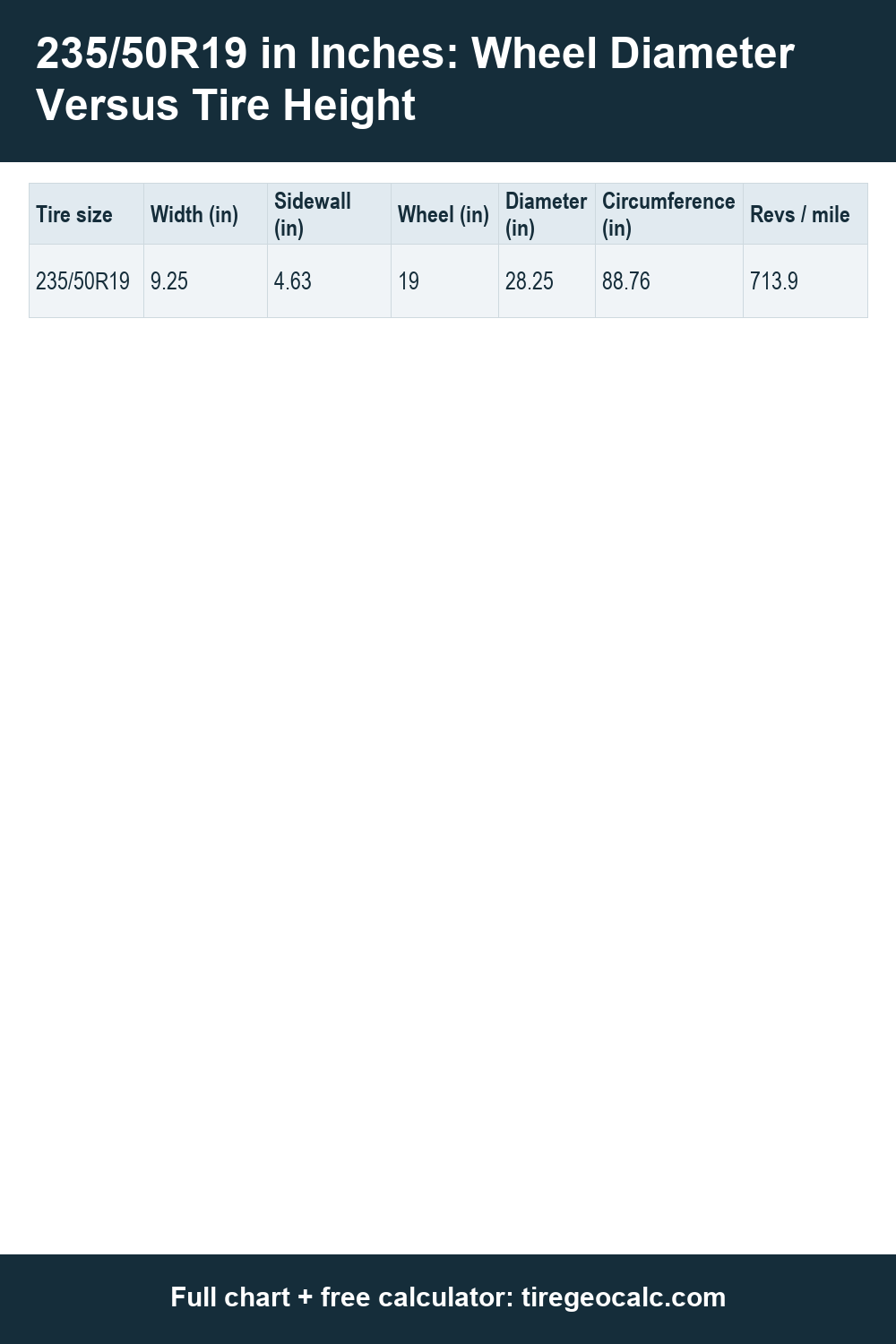
Calculated dimensions are nominal, not measured rolling dimensions or vehicle fitment approval.
Distinguish the inner diameter from the outer circle
Wheel diameter and tire diameter are measured across different circles. The wheel marking refers to the bead-seat diameter, while the nominal tire diameter reaches across the complete tire outline. For this size the wheel is 19 inches, shown as 482.6 mm in the metric column. The complete tire is 717.6 mm across in the calculation. A bare wheel dimension therefore cannot answer the question of how tall the tire assembly will be. When comparing notes with another person, say whether you mean the wheel or the complete tire; using just the word diameter leaves room for a substantial misunderstanding.
Find the sidewall from width and proportion
The 235 describes section width in millimeters, converted here to 9.25 inches. The 50 describes a percentage of that width, so the sidewall calculation multiplies width by the aspect ratio as a fraction. This produces 117.5 mm for a nominal sidewall, displayed in inches as 4.63. R identifies radial construction and does not mean radius. Section width should also remain separate from wheel width: converting the former to inches does not identify the latter. These definitions are useful before any arithmetic because an accurate calculation with the wrong physical label can still lead to the wrong conclusion about a wheel-and-tire package.
Work from the size code to the complete height
The diameter formula adds the wheel diameter to twice the calculated sidewall height, using a common unit throughout. In this worked example the wheel contribution of 482.6 mm is combined with the sidewalls to produce 717.6 mm overall. Convert that final result to inches and the table gives 28.25 inches. Do not reconstruct the result by doubling the rounded 4.63-inch sidewall and then adding the wheel figure. The engine calculates from the original marking before rounding each displayed measurement. Working in that order keeps rounding from being passed from an intermediate result into the final height. It also explains why separate table cells need not add perfectly at their displayed precision.
Move from overall height to circumference
Once the full diameter is known, the nominal circumference is diameter multiplied by pi. The calculated path around 235/50R19 displays as 2254.4 mm or 88.76 inches. The circumference belongs to the outside tire circle, so using the wheel diameter in that formula would answer a different question. Dividing a mile by the tire circumference in matching units yields 713.9 geometric revolutions per mile. This is a way to relate circle size to rotation count, rather than a claim about a particular tire tested on a vehicle. A comparison with another size would need that other circumference and a declared original reference before interpreting a change.
Keep nominal calculations apart from product measurements
The figures on this page come from the printed size code and an ideal geometric model. They are neither measurements taken under load nor a measured rolling circumference. A manufacturer's sheet may describe a specific tire with a stated measuring rim and published dimensions, while this calculation represents the nominal marking alone. Preserve that distinction when filling in a comparison worksheet. Do not replace a measured product value with a converted nominal figure simply because both use inches. If the question concerns actual clearance, obtain the relevant vehicle and product information; a calculated circle cannot reveal how the complete assembly sits or moves within a particular vehicle.
Use the inch figures as questions to investigate
Similarity to the 28.25-inch nominal height does not approve a tire for fitting to your vehicle. The vehicle specification, exact tire requirements and wheel details remain part of that decision. In particular, the conversion supplies no approved rim-width range, offset choice or clearance assessment. Keep those checks alongside the dimensions rather than assuming a shared wheel diameter settles them. A useful next step is to identify the original axle size and the precise candidate you want to examine, then compare their full geometric results. That gives the dimensional question a clear reference while leaving installation approval to the applicable vehicle and tire specifications.
Frequently asked questions
Does 19 inches refer to the outside height of 235/50R19?
It identifies the wheel diameter. The nominal tire diameter also includes the sidewall contributions and displays as 28.25 inches.
Where does the 4.63-inch sidewall figure come from?
The calculator applies the aspect ratio to the nominal section width, then converts that sidewall length to inches and rounds the display.
Should circumference be calculated from the wheel marking?
Use the complete tire diameter when calculating tire circumference. The wheel diameter describes an inner circle and would give a different path.
Why can a specification sheet differ from this conversion?
A sheet can report dimensions for a particular manufactured tire and measuring arrangement. This page instead calculates ideal dimensions from the size marking, so identify which type of value your task requires.
Continue your comparison
Verified against manufacturer data
Published specifications for the named models, checked on the dates below. Differences mean published minus calculated, divided by calculated. These are examples, not specifications for every tire of this size. P, LT and XL designations remain in the source row; matching nominal dimensions does not make their load capacities interchangeable.
| Size / model | Calculated diameter | Published diameter | Difference | Revolutions per mile: calculated / published (difference) | Source / checked |
|---|---|---|---|---|---|
| 235/50R1999H ToyoCelsius II (243980) | 28.25 in | 28.30 in | +0.17% | 713.9 / not recorded in rev/mile | Toyo specifications |
| 235/50 R 1999H SL General TireAltiMAX RT45 (15577210000) | 28.25 in | 28.30 in | +0.17% | 713.9 / 735 (+2.96%) | General Tire specifications |
How we calculate: nominal geometry and measured rolling data can differ. This comparison is not vehicle fitment approval.