 TireGeoCalc
225/45R17 vs 235/45R17: Reading the Sidewall and Speed Change
Quick answer
Nominal geometry225/45R17 → 235/45R17 · original-size calibration assumed
- Diameter difference
- +0.35in
- Diameter change
- +1.42%
- Actual at indicated 60 mph
- 60.85mph
Calculated from size markings. Not measured rolling dimensions or vehicle fitment approval.
Published
To interpret a tire-size speed comparison, begin with the dimensions that create it. Moving from 225/45R17 to 235/45R17 changes section width while retaining the profile number and nominal wheel diameter. The calculated sidewall becomes taller, the outer circle grows, and the speed relationship changes with that circle. This page works through those steps with 225/45R17 as the original reference. The results are mathematical illustrations based on size markings, useful for understanding the table but insufficient to decide whether the candidate belongs on a particular car.
Nominal geometry for these tire sizes
The first size is the reference. Dimensions are nominal calculations, not measured rolling data or vehicle fitment approval.
| Tire size | Width (mm) | Width (in) | Sidewall (mm) | Sidewall (in) | Wheel (mm) | Wheel (in) | Diameter (mm) | Diameter (in) | Circumference (mm) | Circumference (in) | Revolutions / mile | Revolutions / km | Diameter change (%) | Actual at indicated 30 mph | Actual at indicated 60 mph | Actual at indicated 75 mph | Actual minus indicated at 60 mph |
|---|---|---|---|---|---|---|---|---|---|---|---|---|---|---|---|---|---|
| 225/45R17 | 225 | 8.86 | 101.3 | 3.99 | 431.8 | 17 | 634.3 | 24.97 | 1992.7 | 78.45 | 807.6 | 501.8 | 0 | 30 | 60 | 75 | 0 |
| 235/45R17 | 235 | 9.25 | 105.8 | 4.16 | 431.8 | 17 | 643.3 | 25.33 | 2021 | 79.57 | 796.3 | 494.8 | 1.42 | 30.4 | 60.9 | 76.1 | 0.9 |
Nominal size-code geometry. Reference: 225/45R17. Display rounding only; not fitment approval.
- Tire size
- 225/45R17
- Width (mm)
- 225
- Width (in)
- 8.86
- Sidewall (mm)
- 101.3
- Sidewall (in)
- 3.99
- Wheel (mm)
- 431.8
- Wheel (in)
- 17
- Diameter (mm)
- 634.3
- Diameter (in)
- 24.97
- Circumference (mm)
- 1992.7
- Circumference (in)
- 78.45
- Revolutions / mile
- 807.6
- Revolutions / km
- 501.8
- Diameter change (%)
- 0
- Actual at indicated 30 mph
- 30
- Actual at indicated 60 mph
- 60
- Actual at indicated 75 mph
- 75
- Actual minus indicated at 60 mph
- 0
- Tire size
- 235/45R17
- Width (mm)
- 235
- Width (in)
- 9.25
- Sidewall (mm)
- 105.8
- Sidewall (in)
- 4.16
- Wheel (mm)
- 431.8
- Wheel (in)
- 17
- Diameter (mm)
- 643.3
- Diameter (in)
- 25.33
- Circumference (mm)
- 2021
- Circumference (in)
- 79.57
- Revolutions / mile
- 796.3
- Revolutions / km
- 494.8
- Diameter change (%)
- 1.42
- Actual at indicated 30 mph
- 30.4
- Actual at indicated 60 mph
- 60.9
- Actual at indicated 75 mph
- 76.1
- Actual minus indicated at 60 mph
- 0.9
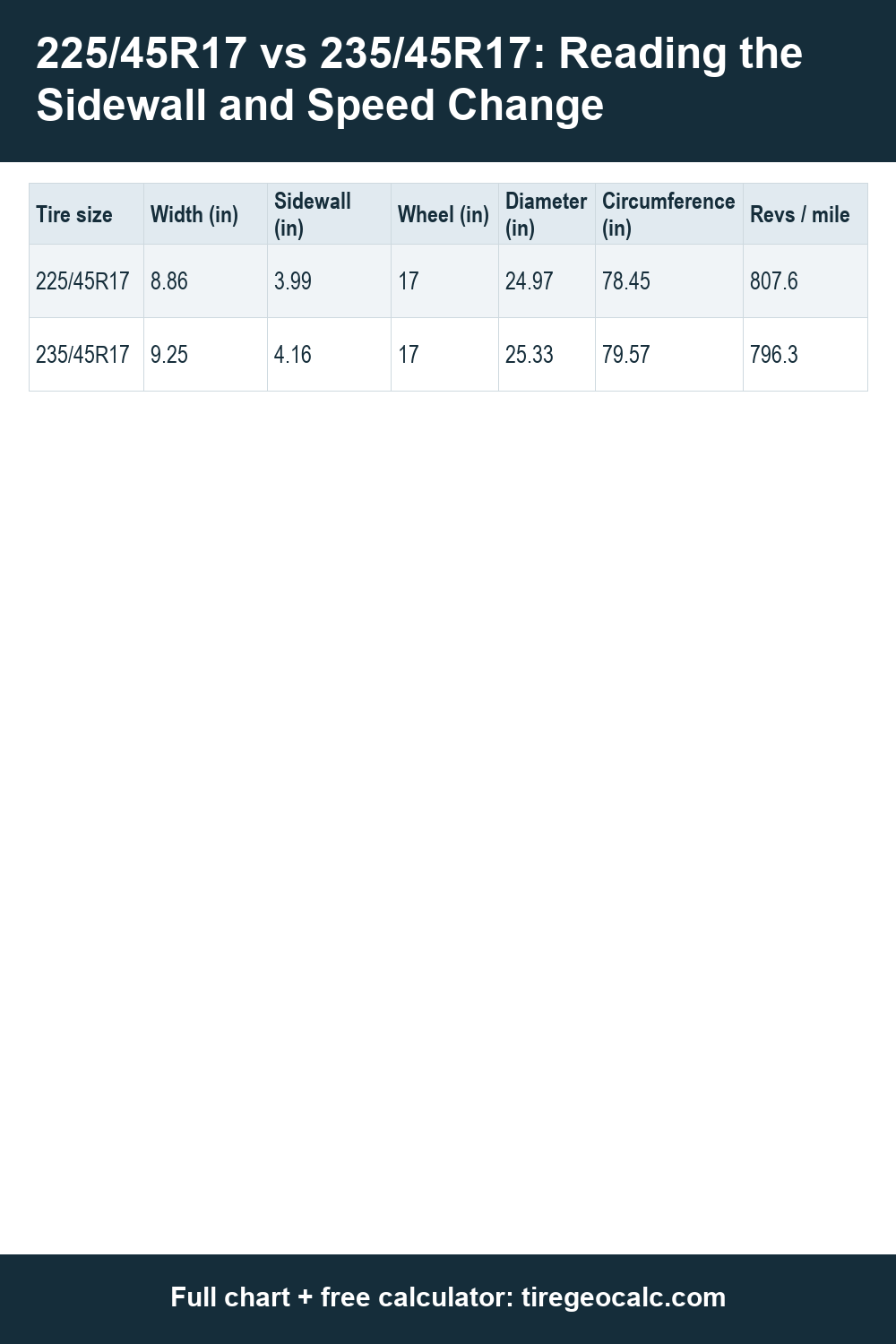
Calculated dimensions are nominal, not measured rolling dimensions or vehicle fitment approval.
Identify what stays fixed in the markings
The 45 profile applies to a width of 225 mm in the original row and 235 mm in the candidate row. Because that profile is a percentage, equal profile numbers do not create equal sidewall heights when the widths differ. Reading the whole marking prevents a width change from being mistaken for a purely sideways change.
The wheel diameter remains 17 inches, represented as 431.8 mm. There is no change in that part of the diameter calculation. However, a shared wheel-diameter marking does not tell you the physical wheel's width, offset or other specifications, all of which remain outside this numerical comparison.
Use unrounded arithmetic behind the displayed dimensions
Sidewall height follows width multiplied by aspect ratio and divided by one hundred. The table displays 101.3 mm for the original sidewall and 105.8 mm for the candidate sidewall. Overall diameter then adds the wheel diameter to both sidewalls. The engine's resulting diameters are 634.3 mm and 643.3 mm.
The sidewall displays are rounded, so they should not be treated as the original arithmetic inputs. Doubling a displayed value can lose precision that the engine kept when calculating the full diameter. Take the diameter directly from its own column instead. This preserves a consistent set of results across millimeters, inches, circumference and the speed example.
Name both the indicated and the calculated speed
For the worked speed example, assume the original instrument calibration matches 225/45R17 and contains no other error. Calculated actual speed equals the indicated speed multiplied by new diameter divided by original diameter. At an indicated 60 mph, changing the modeled tire to 235/45R17 produces 60.9 mph as the displayed calculated actual speed.
The words beside the numbers matter as much as the numbers. One is an assumed instrument indication; the other is a geometric estimate of travel speed. Writing only the candidate result could make it look like a vehicle measurement, which this table does not provide. Keep the reference tire and calibration assumption in the same note.
Check the speed direction against circumference
The candidate's circumference is 2021 mm, compared with 1992.7 mm for the reference. Multiplying diameter by pi gives that circumference. The larger nominal distance per turn explains why the calculated speed is above the indication when calibration remains tied to the original circle. Nothing about that reasoning depends on a claim about how a particular tire performs.
At an indicated 30 mph, the candidate entry is 30.4 mph; at an indicated 75 mph, it is 76.1 mph. These are different examples of the same ratio. Reversing the comparison would require changing the denominator and recalculating the values, not simply swapping the labels on this table.
Keep sideways dimensions beside the height result
The diameter presentation in inches is 24.97 for the original and 25.33 for the candidate. Their section widths appear as 8.86 inches and 9.25 inches. The candidate therefore changes the nominal shape in both width and height, even though the wheel-diameter marking is unchanged. A diameter-only note would miss the width part of the comparison.
Neither set of values supplies a measurement of the space available in a vehicle. The figures cannot show contact during steering movement or determine an allowed rim range. Refer to the exact product drawing and vehicle requirements when those questions arise, and distinguish their measured dimensions from these marking-based estimates.
Recognize where the model ends
Close nominal dimensions are not authorization to fit 235/45R17 in place of 225/45R17 on any specific vehicle. The geometric comparison omits the exact tire's service description, the wheel specification and the vehicle's requirements. It also describes an ideal circle rather than a loaded tire shape or a measured rolling circumference.
Use this page to understand why the speed estimate moves upward, then investigate the actual package using its documentation. No pressure setting, load capacity, comfort result or fuel-use prediction follows from the diameter ratio. If the real starting size differs from the reference here, begin again with that size so the calculation answers the right comparison.
Frequently asked questions
Why are the sidewall values shown with a decimal?
The aspect-ratio calculation can produce a fractional millimeter value. The engine rounds the presentation while retaining precision for the related diameter and speed calculations.
Does 60.9 mph describe my car's measured speed?
It describes the geometric example at an indicated 60 mph with calibration assumed to match the original size exactly. Your instrument and a loaded tire are not measured by this comparison.
Can an unchanged wheel diameter prevent a speed change?
The outer tire circumference determines the ratio used here. Sidewall height can change that circumference while the wheel diameter stays fixed.
What should remain attached to a copied speed figure?
Keep the original size, candidate size, indicated speed and ideal calibration assumption together. Without those labels, the figure loses the context needed to interpret it correctly.
Continue your comparison
Verified against manufacturer data
Published specifications for the named models, checked on the dates below. Differences mean published minus calculated, divided by calculated. These are examples, not specifications for every tire of this size. P, LT and XL designations remain in the source row; matching nominal dimensions does not make their load capacities interchangeable.
| Size / model | Calculated diameter | Published diameter | Difference | Revolutions per mile: calculated / published (difference) | Source / checked |
|---|---|---|---|---|---|
| 225/45R17XL94H ToyoExtensa A/S II (148030) | 24.97 in | 25.00 in | +0.11% | 807.6 / not recorded in rev/mile | Toyo specifications |
| 225/45 R 1794V XL General TireAltiMAX RT45 (15577430000) | 24.97 in | 25.00 in | +0.11% | 807.6 / 832 (+3.02%) | General Tire specifications |
| 235/45R1797V ToyoCelsius II (243710) | 25.33 in | 25.40 in | +0.29% | 796.3 / not recorded in rev/mile | Toyo specifications |
| 235/45 R 1797H XL General TireAltiMAX RT45 (15577490000) | 25.33 in | 25.30 in | -0.11% | 796.3 / 820 (+2.97%) | General Tire specifications |
How we calculate: nominal geometry and measured rolling data can differ. This comparison is not vehicle fitment approval.