 TireGeoCalc
215/65R16 in Inches: From the Size Code to Circumference
Quick answer
Nominal geometry215/65R16 · nominal size-code geometry
- Overall diameter
- 27.00in
- Section width
- 8.46in
- Sidewall height
- 5.50in
Calculated from size markings. Not measured rolling dimensions or vehicle fitment approval.
Published
The inch conversion for 215/65R16 is useful when a size code in millimeters appears beside a specification sheet written in inches. Its calculated diameter displays as 27 inches, but the route to that result matters as much as the number. Width, sidewall and wheel diameter must each be interpreted correctly before the circumference can be understood. This page works through those stages in order and explains why a rounded height is only a description of nominal geometry. Keep the complete 215/65R16 marking when recording the result, especially if the next step is to compare a different tire.
Nominal geometry for these tire sizes
The first size is the reference. Dimensions are nominal calculations, not measured rolling data or vehicle fitment approval.
| Tire size | Width (mm) | Width (in) | Sidewall (mm) | Sidewall (in) | Wheel (mm) | Wheel (in) | Diameter (mm) | Diameter (in) | Circumference (mm) | Circumference (in) | Revolutions / mile | Revolutions / km | Diameter change (%) |
|---|---|---|---|---|---|---|---|---|---|---|---|---|---|
| 215/65R16 | 215 | 8.46 | 139.8 | 5.5 | 406.4 | 16 | 685.9 | 27 | 2154.8 | 84.84 | 746.9 | 464.1 | 0 |
Nominal size-code geometry. Reference: 215/65R16. Display rounding only; not fitment approval.
- Tire size
- 215/65R16
- Width (mm)
- 215
- Width (in)
- 8.46
- Sidewall (mm)
- 139.8
- Sidewall (in)
- 5.5
- Wheel (mm)
- 406.4
- Wheel (in)
- 16
- Diameter (mm)
- 685.9
- Diameter (in)
- 27
- Circumference (mm)
- 2154.8
- Circumference (in)
- 84.84
- Revolutions / mile
- 746.9
- Revolutions / km
- 464.1
- Diameter change (%)
- 0
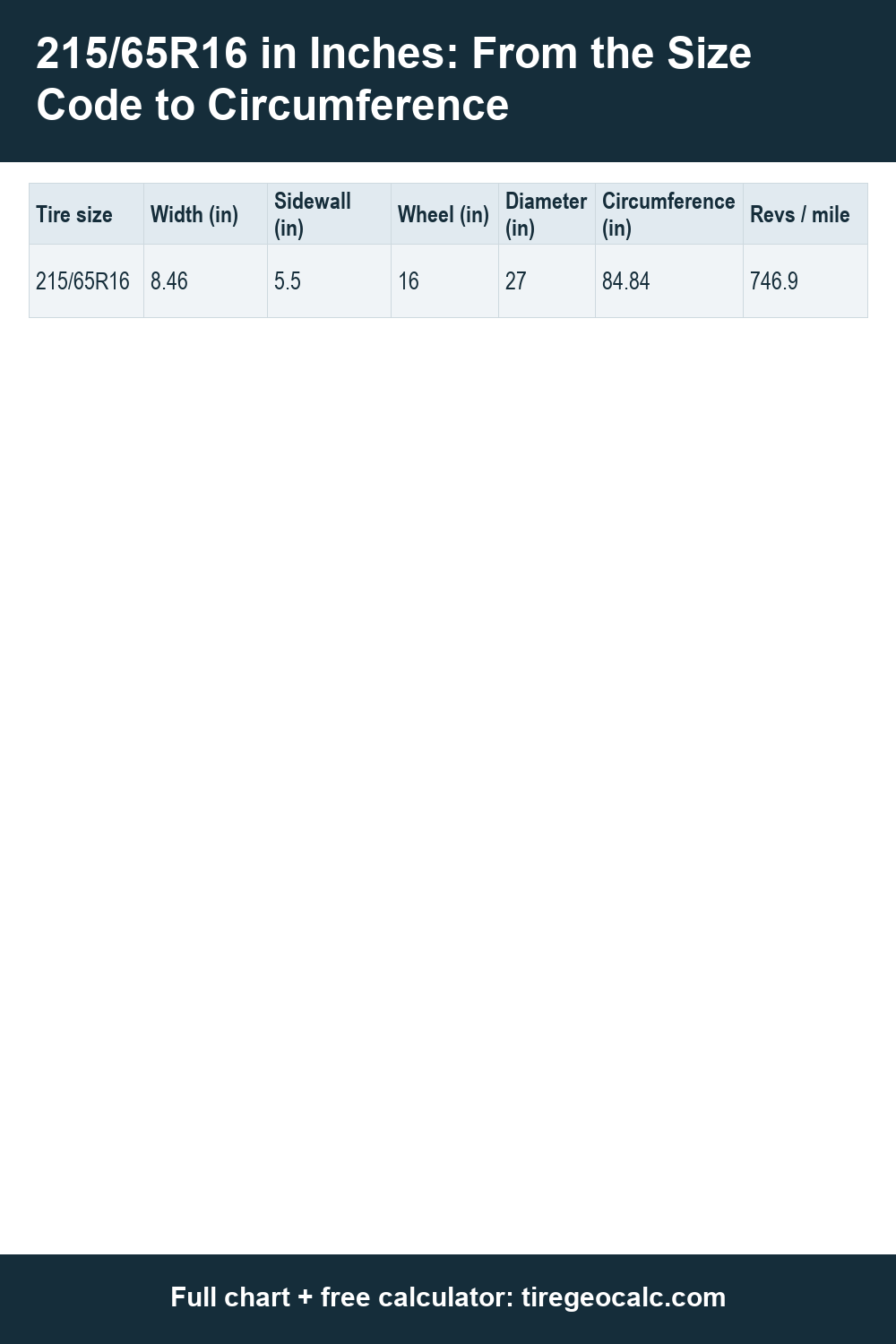
Calculated dimensions are nominal, not measured rolling dimensions or vehicle fitment approval.
Decode the mixed units before converting
In this marking, 215 is the nominal section width in millimeters and 65 is the sidewall-to-width percentage. The final 16 is already an inch measurement: it identifies wheel diameter. The radial construction letter separates that wheel figure from the aspect ratio. Converting the whole string as though every number were millimeters would lose the meaning of the code. Begin instead by assigning a name and unit to each part. Width becomes 8.46 inches in the table, while the wheel stays 16 inches. The aspect ratio remains a proportion, so it is used to calculate a length rather than converted into inches on its own.
Calculate a sidewall before assembling the diameter
The sidewall formula is width multiplied by aspect ratio divided by one hundred. Using the original marking gives a sidewall displayed as 139.8 mm, or 5.5 inches. For overall height, convert the wheel to millimeters and add both sidewalls to it. Here the wheel contribution is 406.4 mm and the full calculation produces a diameter of 685.9 mm. Notice that the sidewall figure shown to the reader has already been rounded. The engine retains the original precision for the diameter step, so manually doubling the displayed sidewall is not the method used to generate the finished table. Follow the formula using the original code when checking the example.
Understand what the displayed 27 inches means
The diameter conversion displays as 27 inches because the inch result has been rounded for presentation. A short whole-number display is not evidence that a manufactured tire measures that exact height. It also does not change the metric tire marking into a flotation size or establish equivalence with another naming system. When comparing a supplier's specification with this page, distinguish a stated product measurement from a mathematical conversion of the code. Both may be written in inches while representing different kinds of information. Record which one you are using, along with the product name and measuring conditions when those appear on the manufacturer's sheet.
Use diameter to obtain the path around the tire
Circumference follows from multiplying the unrounded diameter by pi. For 215/65R16 the result is displayed as 2154.8 mm, equivalent in the table to 84.84 inches. This is a distance around an ideal circular outline, not another width measurement. You can use it to understand how a taller nominal tire would cover more distance during a complete rotation. Avoid dividing a rounded inch diameter into another rounded result to manufacture extra precision. The calculator has already performed the circumference calculation before rounding its output. Retaining the table's unit labels is more helpful than adding decimal places that the displayed values cannot support.
Read rotation counts as geometric estimates
The same ideal circle produces 746.9 revolutions per mile and 464.1 revolutions per kilometer. To obtain a rotation count, divide the chosen travel distance by circumference after expressing both lengths in matching units. The differing counts reflect different travel distances, rather than a change in the tire itself. These are nominal calculations, not measurements under vehicle load or measured rolling circumference data. A real contact patch is not represented by a perfect circle. If an application requires measured rolling information, look for the manufacturer's applicable data and its stated conditions instead of relabeling this calculated count as a road-test result.
Prepare a comparison without skipping the vehicle checks
Matching this calculated diameter closely does not authorize another tire size for a particular vehicle. Vehicle requirements, the exact tire's service description and the wheel specifications still need checking together. The nominal width also does not tell you the approved wheel width or the space available near suspension and bodywork. For a later comparison, write down the original size for the axle in question and calculate the candidate separately. That makes the reference explicit and keeps a conversion page from becoming an unsupported replacement recommendation. Bring any remaining specification questions to the vehicle documentation and the tire manufacturer, with the full size marking available rather than only the rounded inch height.
Frequently asked questions
Is 215/65R16 exactly 27 inches tall?
The nominal diameter rounds to 27 inches in this table. That display does not establish the measured diameter of every product carrying the marking.
What does the 65 describe in this conversion?
It gives the sidewall height as a percentage of nominal section width. Apply that proportion to the width before converting the resulting sidewall length to inches.
Why are there different revolution counts for miles and kilometers?
A mile and a kilometer are different distances. The circumference stays the same, while the distance divided by that circumference changes.
Can I use the inch height as a flotation replacement code?
A converted diameter alone does not supply a complete flotation marking, product specification or vehicle approval. Retain 215/65R16 as the identifier for this calculation.