 TireGeoCalc
215/60R17 vs 225/60R17: Section Width and Overall Diameter
Quick answer
Nominal geometry215/60R17 → 225/60R17 · original-size calibration assumed
- Diameter difference
- +0.47in
- Diameter change
- +1.74%
- Actual at indicated 60 mph
- 61.04mph
Calculated from size markings. Not measured rolling dimensions or vehicle fitment approval.
Published
Moving from 215/60R17 to 225/60R17 changes more than the width printed at the start of the marking. Both sizes keep the same aspect ratio and wheel diameter, yet the wider section also produces a taller calculated sidewall. This page separates sideways space from overall height so the comparison stays clear. Treat 215/60R17 as the original reference and 225/60R17 as the candidate throughout the table. The results describe nominal geometry rather than a measured tire on a vehicle.
Nominal geometry for these tire sizes
The first size is the reference. Dimensions are nominal calculations, not measured rolling data or vehicle fitment approval.
| Tire size | Width (mm) | Width (in) | Sidewall (mm) | Sidewall (in) | Wheel (mm) | Wheel (in) | Diameter (mm) | Diameter (in) | Circumference (mm) | Circumference (in) | Revolutions / mile | Revolutions / km | Diameter change (%) | Actual at indicated 30 mph | Actual at indicated 60 mph | Actual at indicated 75 mph | Actual minus indicated at 60 mph |
|---|---|---|---|---|---|---|---|---|---|---|---|---|---|---|---|---|---|
| 215/60R17 | 215 | 8.46 | 129 | 5.08 | 431.8 | 17 | 689.8 | 27.16 | 2167.1 | 85.32 | 742.6 | 461.5 | 0 | 30 | 60 | 75 | 0 |
| 225/60R17 | 225 | 8.86 | 135 | 5.31 | 431.8 | 17 | 701.8 | 27.63 | 2204.8 | 86.8 | 729.9 | 453.6 | 1.74 | 30.5 | 61 | 76.3 | 1 |
Nominal size-code geometry. Reference: 215/60R17. Display rounding only; not fitment approval.
- Tire size
- 215/60R17
- Width (mm)
- 215
- Width (in)
- 8.46
- Sidewall (mm)
- 129
- Sidewall (in)
- 5.08
- Wheel (mm)
- 431.8
- Wheel (in)
- 17
- Diameter (mm)
- 689.8
- Diameter (in)
- 27.16
- Circumference (mm)
- 2167.1
- Circumference (in)
- 85.32
- Revolutions / mile
- 742.6
- Revolutions / km
- 461.5
- Diameter change (%)
- 0
- Actual at indicated 30 mph
- 30
- Actual at indicated 60 mph
- 60
- Actual at indicated 75 mph
- 75
- Actual minus indicated at 60 mph
- 0
- Tire size
- 225/60R17
- Width (mm)
- 225
- Width (in)
- 8.86
- Sidewall (mm)
- 135
- Sidewall (in)
- 5.31
- Wheel (mm)
- 431.8
- Wheel (in)
- 17
- Diameter (mm)
- 701.8
- Diameter (in)
- 27.63
- Circumference (mm)
- 2204.8
- Circumference (in)
- 86.8
- Revolutions / mile
- 729.9
- Revolutions / km
- 453.6
- Diameter change (%)
- 1.74
- Actual at indicated 30 mph
- 30.5
- Actual at indicated 60 mph
- 61
- Actual at indicated 75 mph
- 76.3
- Actual minus indicated at 60 mph
- 1
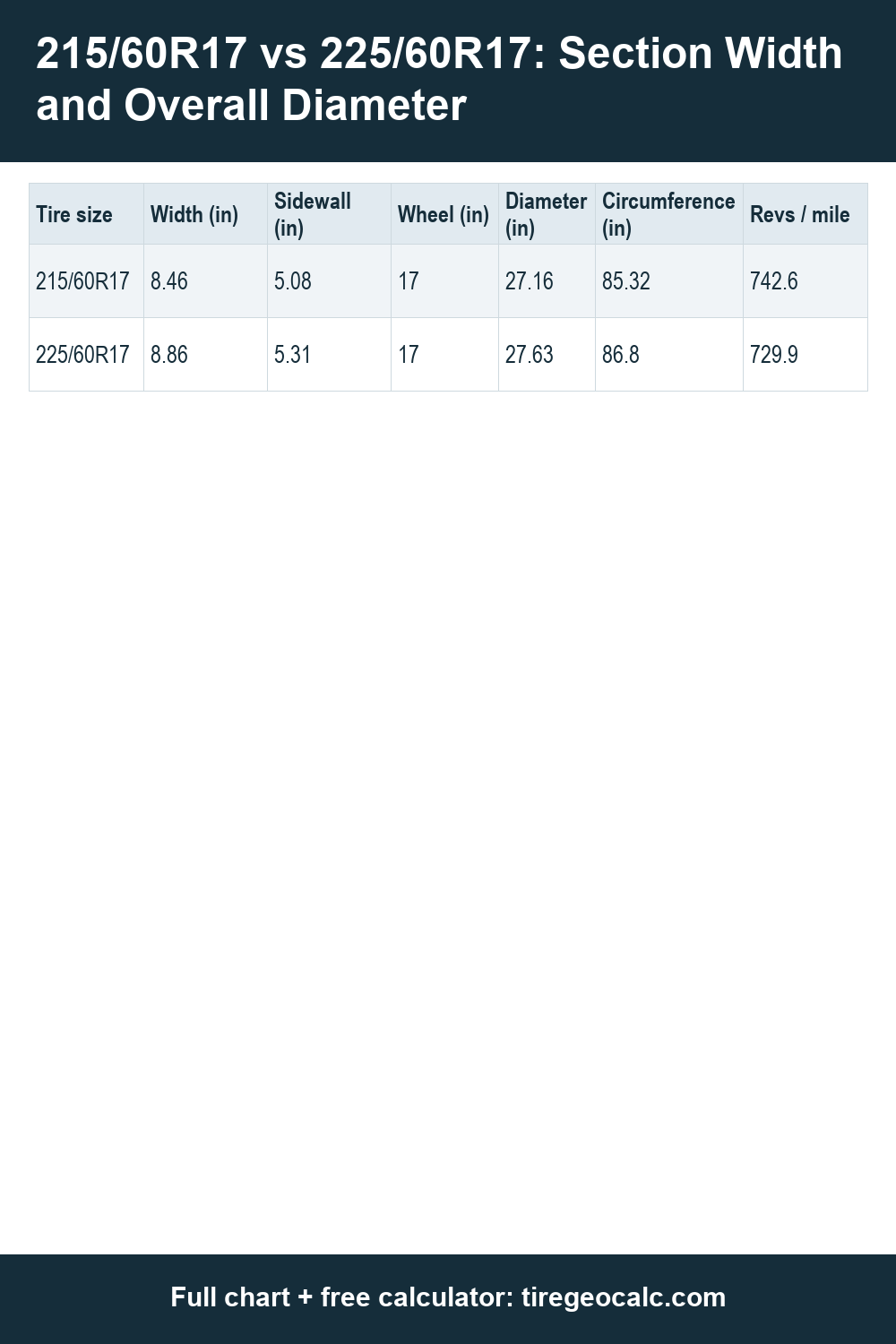
Calculated dimensions are nominal, not measured rolling dimensions or vehicle fitment approval.
Find the dimension that actually changes
The starting width is 215 mm, while the candidate width is 225 mm. In both markings, 60 means that the sidewall height is a percentage of section width. It does not identify a fixed height in millimeters. Applying the same percentage to a wider section therefore gives a taller sidewall as well.
The final 17 identifies the wheel diameter in inches, and R identifies radial construction. Neither marking gives the wheel width or its position relative to the suspension. Keeping the final characters unchanged tells you which wheel diameter enters the calculation, but it does not settle the remaining wheel or vehicle requirements.
Assemble the height from the center outward
To calculate sidewall height, multiply section width by aspect ratio and divide by one hundred. For 215/60R17, the resulting sidewall is 129 mm. The corresponding value for 225/60R17 is 135 mm. These are radial contributions between wheel and tread, so neither value describes the full height of the assembly.
Overall diameter equals the wheel diameter in millimeters plus twice the sidewall height. The wheel contributes 431.8 mm in each row. Adding the sidewalls produces 689.8 mm for the original size and 701.8 mm for the candidate. This worked example explains why a width change can also alter height even though the wheel remains the same diameter.
Keep width and height in separate columns
The inch columns show widths of 8.46 and 8.86, alongside overall diameters of 27.16 and 27.63. Width describes the nominal cross section; diameter describes the circle viewed from the side. Reading those measurements independently avoids treating every increase as additional space in the same direction around the tire.
A wider section does not tell you where its outer edge will sit relative to a fender. That position also depends on the wheel and mounting arrangement. Likewise, a taller nominal diameter does not establish available space during steering or suspension movement. Use the dimensional comparison to identify questions for a physical clearance assessment, rather than to answer that assessment.
Follow the larger circle through a full turn
Multiplying diameter by pi gives geometric circumference. Here, the original circumference is 2167.1 mm and the candidate circumference is 2204.8 mm. The taller circle therefore covers more nominal distance during a complete revolution. This relationship follows from the diameter calculation and does not require any assumption about tread pattern or tire construction.
Dividing a mile by the corresponding circumference gives the geometric revolutions per mile. The table shows 742.6 for the original and 729.9 for the candidate. The direction matters: the longer circumference goes with fewer turns over the same distance. These figures are ideal-circle calculations, not measured rolling circumference or wheel rotations recorded under load.
Read the speed example from the original size
Assume an instrument calibrated to 215/60R17 with no additional error. Calculated actual speed equals indicated speed multiplied by candidate diameter divided by original diameter. Using the 701.8 mm candidate against the 689.8 mm reference gives a displayed result of 61 mph when the instrument indicates 60 mph. The direction is upward because the candidate circle is taller.
At an indicated 30 mph, the table gives 30.5 mph; at an indicated 75 mph, it gives 76.3 mph. These are rounded outputs of the same proportional model. They do not establish the current accuracy of your dashboard, and reversing the original and candidate requires a new calculation with a different reference.
Turn this comparison into the right next checks
Similar dimensions do not approve fitting either of these tires to a particular vehicle. Confirm the original axle specification from the vehicle documentation, then consult the exact tire and wheel specifications. Required service ratings, permitted rim widths and clearance are separate matters that this pair of nominal size markings cannot resolve.
Keep the full size codes beside any manufacturer measurements you collect so you do not mix a calculated value with a measured specification. The useful outcome here is a clear distinction between width, sidewall and diameter. Any decision about an actual installation still needs the details of the vehicle, wheel and specific tire.
Frequently asked questions
Why does 225/60R17 have a taller sidewall?
Its 60 aspect ratio is applied to a larger section width. That produces a calculated sidewall of 135 mm instead of 129 mm, although the wheel diameter is unchanged.
Does the width figure show how far the tire sticks out?
The width figure describes a nominal section dimension. Outer-edge position also involves wheel width and offset, so it cannot be read directly from the first number in the tire code.
Is 27.63 inches the wheel size?
For the candidate row, 27.63 inches is the calculated overall tire diameter. The wheel diameter remains 17 inches and is only part of that overall measurement.
Can I apply the speed result to a different original tire?
The speed result depends on 215/60R17 being the calibration reference. Enter the actual original size in a fresh comparison if your starting specification differs.
Continue your comparison
Verified against manufacturer data
Published specifications for the named models, checked on the dates below. Differences mean published minus calculated, divided by calculated. These are examples, not specifications for every tire of this size. P, LT and XL designations remain in the source row; matching nominal dimensions does not make their load capacities interchangeable.
| Size / model | Calculated diameter | Published diameter | Difference | Revolutions per mile: calculated / published (difference) | Source / checked |
|---|---|---|---|---|---|
| 215/60R1796T ToyoExtensa A/S II (148320) | 27.16 in | 27.20 in | +0.16% | 742.6 / not recorded in rev/mile | Toyo specifications |
| 215/60 R 1796H SL General TireAltiMAX RT45 (15582450000) | 27.16 in | 27.20 in | +0.16% | 742.6 / 765 (+3.01%) | General Tire specifications |
How we calculate: nominal geometry and measured rolling data can differ. This comparison is not vehicle fitment approval.