 TireGeoCalc
215/50R17 vs 225/50R17: Diameter and Revolutions per Mile
Quick answer
Nominal geometry215/50R17 → 225/50R17 · original-size calibration assumed
- Diameter difference
- +0.39in
- Diameter change
- +1.55%
- Actual at indicated 60 mph
- 60.93mph
Calculated from size markings. Not measured rolling dimensions or vehicle fitment approval.
Published
Diameter and revolutions per mile tell the same geometric story from different directions. A larger tire circle covers more nominal distance in a turn, so fewer turns cover a mile. The pair 215/50R17 and 225/50R17 makes that relationship easy to follow because the aspect ratio and wheel diameter stay fixed. Start with the narrower size, then read across to the wider candidate. The aim is to understand what each table column means and how the columns connect, before consulting the separate specifications needed for an actual vehicle.
Nominal geometry for these tire sizes
The first size is the reference. Dimensions are nominal calculations, not measured rolling data or vehicle fitment approval.
| Tire size | Width (mm) | Width (in) | Sidewall (mm) | Sidewall (in) | Wheel (mm) | Wheel (in) | Diameter (mm) | Diameter (in) | Circumference (mm) | Circumference (in) | Revolutions / mile | Revolutions / km | Diameter change (%) | Actual at indicated 30 mph | Actual at indicated 60 mph | Actual at indicated 75 mph | Actual minus indicated at 60 mph |
|---|---|---|---|---|---|---|---|---|---|---|---|---|---|---|---|---|---|
| 215/50R17 | 215 | 8.46 | 107.5 | 4.23 | 431.8 | 17 | 646.8 | 25.46 | 2032 | 80 | 792 | 492.1 | 0 | 30 | 60 | 75 | 0 |
| 225/50R17 | 225 | 8.86 | 112.5 | 4.43 | 431.8 | 17 | 656.8 | 25.86 | 2063.4 | 81.24 | 779.9 | 484.6 | 1.55 | 30.5 | 60.9 | 76.2 | 0.9 |
Nominal size-code geometry. Reference: 215/50R17. Display rounding only; not fitment approval.
- Tire size
- 215/50R17
- Width (mm)
- 215
- Width (in)
- 8.46
- Sidewall (mm)
- 107.5
- Sidewall (in)
- 4.23
- Wheel (mm)
- 431.8
- Wheel (in)
- 17
- Diameter (mm)
- 646.8
- Diameter (in)
- 25.46
- Circumference (mm)
- 2032
- Circumference (in)
- 80
- Revolutions / mile
- 792
- Revolutions / km
- 492.1
- Diameter change (%)
- 0
- Actual at indicated 30 mph
- 30
- Actual at indicated 60 mph
- 60
- Actual at indicated 75 mph
- 75
- Actual minus indicated at 60 mph
- 0
- Tire size
- 225/50R17
- Width (mm)
- 225
- Width (in)
- 8.86
- Sidewall (mm)
- 112.5
- Sidewall (in)
- 4.43
- Wheel (mm)
- 431.8
- Wheel (in)
- 17
- Diameter (mm)
- 656.8
- Diameter (in)
- 25.86
- Circumference (mm)
- 2063.4
- Circumference (in)
- 81.24
- Revolutions / mile
- 779.9
- Revolutions / km
- 484.6
- Diameter change (%)
- 1.55
- Actual at indicated 30 mph
- 30.5
- Actual at indicated 60 mph
- 60.9
- Actual at indicated 75 mph
- 76.2
- Actual minus indicated at 60 mph
- 0.9
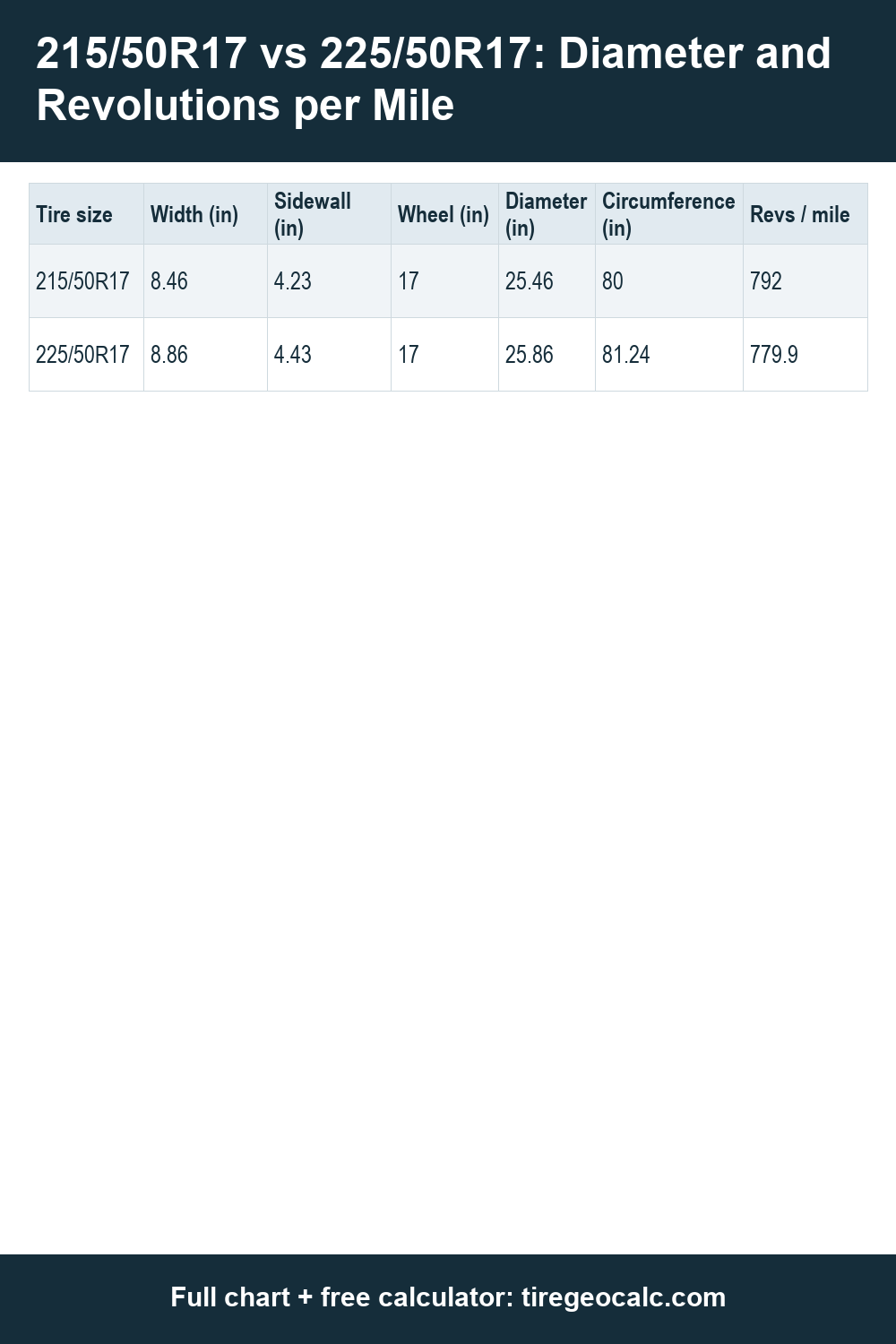
Calculated dimensions are nominal, not measured rolling dimensions or vehicle fitment approval.
Establish the reference before reading the rotation figures
For this page, 215/50R17 is the reference and 225/50R17 is the candidate. Both have a 17-inch nominal wheel diameter, shown as 431.8 mm in the geometry table. Their section widths are different, and the shared 50 aspect ratio means the taller sidewall belongs to the wider section.
Think of the aspect ratio as an instruction applied to each width. It is not a separate height printed in millimeters. You can change width without editing the profile number and still alter the height of the complete assembly. This distinction is the starting point for understanding why the rotation figures differ.
Work outward from the wheel to the tread
Calculate sidewall height by multiplying the section width by the aspect ratio expressed as a fraction of one hundred. That gives the displayed sidewalls of 107.5 mm and 112.5 mm. To calculate the overall diameter, add the wheel diameter to twice the sidewall height. The complete diameters are 646.8 mm for 215/50R17 and 656.8 mm for 225/50R17.
The same results appear as 25.46 inches and 25.86 inches. Use those entries when reading a drawing in inches, while keeping the wheel's 17-inch dimension separate. The wheel number does not describe the height across the outer tread surface.
Convert the circle into distance per turn
The next operation multiplies the calculated diameter by pi. That produces a circumference of 2032 mm for the reference and 2063.4 mm for the candidate. Circumference is the length around the ideal circle, so it provides the distance used for a complete revolution in this model. It is not another label for diameter.
This interpretation explains why looking only at the rotation column can feel backward. The candidate has the larger circumference but the smaller revolutions per mile entry. There is no contradiction: each modeled turn covers more distance, which reduces the count of turns needed for the same nominal mile.
Read the revolutions per mile result without adding a claim
The table shows 792 revolutions per mile for 215/50R17 and 779.9 for 225/50R17. In words, the formula divides the length of a mile by the tire circumference after expressing both lengths in matching units. The engine retains precision during the operation and rounds the result for the displayed column.
These are geometric counts, not measured rolling data. They cannot establish the movement of a loaded tire or account for a particular product's test conditions. If another document lists a different rotation figure for a real tire with the same marking, first compare how the figures were obtained before deciding that either calculation is incorrect.
Use the speed example to check the direction of change
A speed calculation offers a useful cross-check on the relationship. With calibration assumed to match 215/50R17 exactly, multiply indicated speed by the candidate diameter divided by the reference diameter. At an indicated 60 mph, the candidate produces a calculated actual speed of 60.9 mph. A larger circle and fewer turns per mile therefore correspond to a higher calculated speed at the same rotation-based indication.
The table also presents 30.5 mph for an indicated 30 mph and 76.2 mph for an indicated 75 mph. Those entries share the same ideal calibration assumption. They do not measure an instrument or account for any error it already has.
Keep rotation data separate from permission to fit
Matching or nearly matching dimensions never grants vehicle fitment approval for this pair. A real choice still requires the vehicle documentation, tire specifications and wheel details. Section width affects a different part of the dimensional comparison from height, and the table does not provide a clearance measurement or the manufacturer's allowed rim-width range.
Record the nominal calculations as reference information, then add the exact product data under its own labels. Avoid turning a lower revolutions figure into a prediction of fuel use, carrying capacity or comfort. This comparison establishes a relationship among ideal diameter, circumference and rotation; those additional questions require evidence that the size-code model does not contain.
Frequently asked questions
Which size has the larger nominal circumference?
The 225/50R17 row shows 2063.4 mm, compared with 2032 mm for 215/50R17. That ordering also explains the lower modeled revolutions per mile for the candidate.
Are revolutions per mile and revolutions per kilometer interchangeable numbers?
They refer to different travel distances. Compare values under the same heading, or convert units consistently before making a comparison.
Why does the wider size have a taller sidewall here?
Both use the same aspect ratio, so applying that proportion to the larger section width produces the greater calculated height. This reasoning depends on holding the aspect ratio fixed.
Should I recalculate from the displayed inch diameter?
Use the engine's existing circumference and rotation entries. Reusing a rounded inch value can introduce rounding differences into a calculation that originally retained more precision.
Continue your comparison
Verified against manufacturer data
Published specifications for the named models, checked on the dates below. Differences mean published minus calculated, divided by calculated. These are examples, not specifications for every tire of this size. P, LT and XL designations remain in the source row; matching nominal dimensions does not make their load capacities interchangeable.
| Size / model | Calculated diameter | Published diameter | Difference | Revolutions per mile: calculated / published (difference) | Source / checked |
|---|---|---|---|---|---|
| 225/50R17XL98V ToyoExtensa A/S II (148160) | 25.86 in | 25.90 in | +0.16% | 779.9 / not recorded in rev/mile | Toyo specifications |
| 225/50 R 1798V XL General TireAltiMAX RT45 (15577450000) | 25.86 in | 25.90 in | +0.16% | 779.9 / 803 (+2.96%) | General Tire specifications |
| 215/50R17XL95H ToyoExtensa A/S II (148200) | 25.46 in | 25.50 in | +0.14% | 792.0 / not recorded in rev/mile | Toyo specifications |
| 215/50 R 1795V XL General TireAltiMAX RT45 (15577360000) | 25.46 in | 25.50 in | +0.14% | 792.0 / 816 (+3.03%) | General Tire specifications |
How we calculate: nominal geometry and measured rolling data can differ. This comparison is not vehicle fitment approval.