 TireGeoCalc
205/60R16 vs 215/60R16: How Added Width Changes Height
Quick answer
Nominal geometry205/60R16 → 215/60R16 · original-size calibration assumed
- Diameter difference
- +0.47in
- Diameter change
- +1.84%
- Actual at indicated 60 mph
- 61.10mph
Calculated from size markings. Not measured rolling dimensions or vehicle fitment approval.
Published
The shared 60 profile in 205/60R16 and 215/60R16 can make these markings look like a width-only change. It is not: the sidewall calculation uses that percentage against a different width in each row. As width grows, calculated sidewall height grows with it, and the complete tire circle becomes taller. This comparison uses 205/60R16 as its reference and follows the consequences for circumference and nominal rotation. It is a way to organize the dimensions before checking vehicle and product requirements, without treating the markings as a replacement recommendation.
Nominal geometry for these tire sizes
The first size is the reference. Dimensions are nominal calculations, not measured rolling data or vehicle fitment approval.
| Tire size | Width (mm) | Width (in) | Sidewall (mm) | Sidewall (in) | Wheel (mm) | Wheel (in) | Diameter (mm) | Diameter (in) | Circumference (mm) | Circumference (in) | Revolutions / mile | Revolutions / km | Diameter change (%) | Actual at indicated 30 mph | Actual at indicated 60 mph | Actual at indicated 75 mph | Actual minus indicated at 60 mph |
|---|---|---|---|---|---|---|---|---|---|---|---|---|---|---|---|---|---|
| 205/60R16 | 205 | 8.07 | 123 | 4.84 | 406.4 | 16 | 652.4 | 25.69 | 2049.6 | 80.69 | 785.2 | 487.9 | 0 | 30 | 60 | 75 | 0 |
| 215/60R16 | 215 | 8.46 | 129 | 5.08 | 406.4 | 16 | 664.4 | 26.16 | 2087.3 | 82.18 | 771 | 479.1 | 1.84 | 30.6 | 61.1 | 76.4 | 1.1 |
Nominal size-code geometry. Reference: 205/60R16. Display rounding only; not fitment approval.
- Tire size
- 205/60R16
- Width (mm)
- 205
- Width (in)
- 8.07
- Sidewall (mm)
- 123
- Sidewall (in)
- 4.84
- Wheel (mm)
- 406.4
- Wheel (in)
- 16
- Diameter (mm)
- 652.4
- Diameter (in)
- 25.69
- Circumference (mm)
- 2049.6
- Circumference (in)
- 80.69
- Revolutions / mile
- 785.2
- Revolutions / km
- 487.9
- Diameter change (%)
- 0
- Actual at indicated 30 mph
- 30
- Actual at indicated 60 mph
- 60
- Actual at indicated 75 mph
- 75
- Actual minus indicated at 60 mph
- 0
- Tire size
- 215/60R16
- Width (mm)
- 215
- Width (in)
- 8.46
- Sidewall (mm)
- 129
- Sidewall (in)
- 5.08
- Wheel (mm)
- 406.4
- Wheel (in)
- 16
- Diameter (mm)
- 664.4
- Diameter (in)
- 26.16
- Circumference (mm)
- 2087.3
- Circumference (in)
- 82.18
- Revolutions / mile
- 771
- Revolutions / km
- 479.1
- Diameter change (%)
- 1.84
- Actual at indicated 30 mph
- 30.6
- Actual at indicated 60 mph
- 61.1
- Actual at indicated 75 mph
- 76.4
- Actual minus indicated at 60 mph
- 1.1
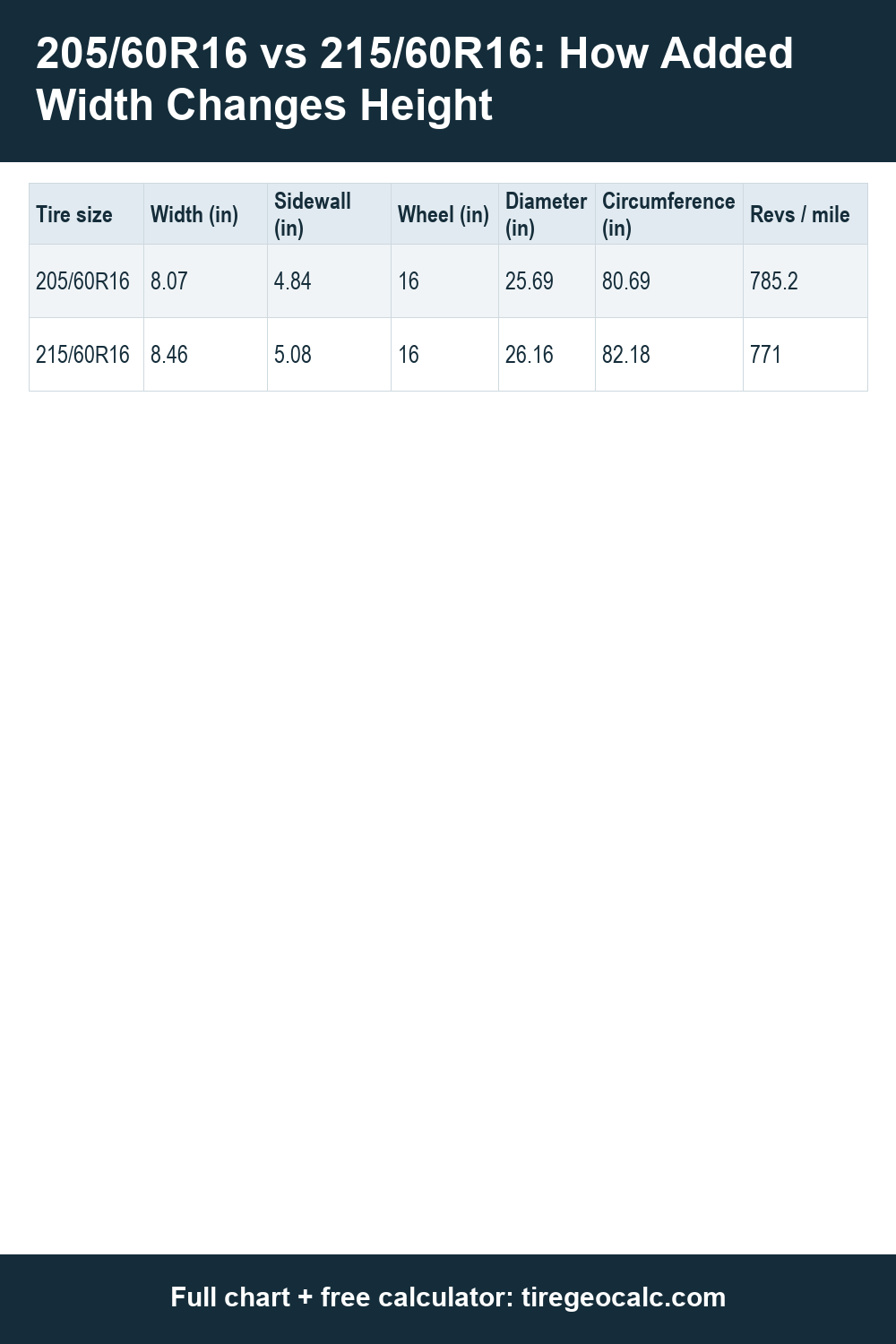
Calculated dimensions are nominal, not measured rolling dimensions or vehicle fitment approval.
A shared profile is a shared proportion
Read 60 as a proportion of the width printed before it. A sidewall that is 60 percent of 205 mm differs from one that is 60 percent of 215 mm. The profile number stays fixed, but the dimension it produces does not. This is why a comparison should keep the width and profile fields connected instead of treating them as independent measurements.
The R16 endings identify the same nominal wheel diameter. In the table, that diameter is 406.4 mm or 16 inches. Holding it constant removes a possible source of confusion: there is no larger wheel hidden behind the candidate's taller overall diameter.
Build the candidate height from its own width
For the worked example, multiply width by aspect ratio and divide by one hundred to obtain a sidewall height. The engine gives 123 mm for 205/60R16 and 129 mm for 215/60R16. Add twice each sidewall height to the common wheel diameter, keeping every term in millimeters. The complete results are 652.4 mm for the reference and 664.4 mm for the candidate.
The inch presentation shows those overall heights as 25.69 inches and 26.16 inches. Both unit systems describe the same calculation. Use a single column when comparing magnitudes, and avoid mixing an inch wheel entry with a millimeter sidewall entry in an addition.
Track the added height around the full circle
A taller nominal diameter also produces a longer nominal circumference. Here the circumference entries are 2049.6 mm for the reference and 2087.3 mm for the candidate. The formula multiplies diameter by pi, so the direction of change is linked to diameter. A larger circumference means more modeled travel during a complete rotation.
You can read the same relationship from the opposite direction in the revolutions per mile column. The reference shows 785.2, and the candidate shows 771. Fewer turns correspond to the larger circle; the number is not evidence that a tire has different construction or a different service rating.
Interpret the speed entry as a calibration example
Suppose the instrument calculation was calibrated exactly to the reference size and has no other source of error. Estimated actual speed equals indicated speed multiplied by candidate diameter divided by reference diameter. The table gives 61.1 mph at an indicated 60 mph after the modeled change to 215/60R16. That result is higher because the candidate's circumference is larger.
The same setup gives 30.6 mph at an indicated 30 mph and 76.4 mph at an indicated 75 mph. Keep the assumption beside these figures whenever you record them. They cannot reveal existing instrument error or prove what a particular vehicle would display after a tire change.
Keep dimensional labels attached to your notes
In inches, the nominal widths are 8.07 and 8.46, while the sidewall heights are 4.84 and 5.08. These paired entries help distinguish extra section width from extra height. Neither width entry is the required wheel width, and neither sidewall entry is a measurement of usable clearance around the car.
A useful comparison note names the size, unit and quantity together. Writing only a number beside a tire code can leave you unsure later whether it described width, diameter or circumference. Preserve the original and candidate labels too, particularly if you later add another possible size to the same notes.
Finish with questions the geometry cannot answer
These calculations describe nominal circles, not loaded tire shapes or measured rolling circumference. An individual product's specification may use a stated measuring rim and test conditions. Read those details before treating the published dimension as directly comparable to the size-code estimate. The table cannot determine an inflation pressure, predict comfort or establish a load capability.
A close dimensional comparison between 205/60R16 and 215/60R16 does not authorize either size for a specific vehicle. Confirm the vehicle specification, exact tire service description, wheel requirements and clearance separately. The result here supplies a focused starting point: unchanged profile and wheel diameter still allow both section width and overall height to increase.
Frequently asked questions
Is the sidewall height unchanged because both markings contain 60?
The common profile applies to different section widths. The displayed sidewall values are 123 mm and 129 mm, so they are not identical.
Which entry should I use to compare overall height?
Use the overall diameter column in millimeters or inches. Sidewall height covers only the part between wheel and tread, while overall diameter includes the wheel and both sidewalls.
Does the 771 figure come from a road test?
It is the candidate's geometric revolutions per mile result. It follows from nominal circumference and should not be labeled as a measured rolling specification.
Can this table choose the wheel width?
It does not contain an approved rim-width range for an exact product. That information belongs in the tire manufacturer's specification and must be checked alongside the wheel details.
Continue your comparison
Verified against manufacturer data
Published specifications for the named models, checked on the dates below. Differences mean published minus calculated, divided by calculated. These are examples, not specifications for every tire of this size. P, LT and XL designations remain in the source row; matching nominal dimensions does not make their load capacities interchangeable.
| Size / model | Calculated diameter | Published diameter | Difference | Revolutions per mile: calculated / published (difference) | Source / checked |
|---|---|---|---|---|---|
| 215/60R1695H ToyoExtensa A/S II (147030) | 26.16 in | 26.10 in | -0.22% | 771.0 / not recorded in rev/mile | Toyo specifications |
| 215/60 R 1695V SL General TireAltiMAX RT45 (15577390000) | 26.16 in | 26.20 in | +0.16% | 771.0 / 794 (+2.98%) | General Tire specifications |
| 205/60R1692H ToyoExtensa A/S II (147880) | 25.69 in | 25.70 in | +0.06% | 785.2 / not recorded in rev/mile | Toyo specifications |
| 205/60 R 1692V SL General TireAltiMAX RT45 (15577320000) | 25.69 in | 25.70 in | +0.06% | 785.2 / 809 (+3.03%) | General Tire specifications |
How we calculate: nominal geometry and measured rolling data can differ. This comparison is not vehicle fitment approval.