 TireGeoCalc
185/65R15 vs 195/60R15: Width Gain and a Shorter Sidewall
Quick answer
Nominal geometry185/65R15 → 195/60R15 · original-size calibration assumed
- Diameter difference
- -0.26in
- Diameter change
- -1.05%
- Actual at indicated 60 mph
- 59.37mph
Calculated from size markings. Not measured rolling dimensions or vehicle fitment approval.
Published
A wider tire marking can describe a shorter assembly. That is the useful surprise in the comparison between 185/65R15 and 195/60R15. The section width increases, but the lower aspect ratio reduces the calculated sidewall height enough to bring the whole diameter down. This page follows that change from the printed markings to circumference and speed. Treat 185/65R15 as the starting size throughout. The figures explain a geometric relationship; they do not select a replacement for your car or describe a particular tire product.
Nominal geometry for these tire sizes
The first size is the reference. Dimensions are nominal calculations, not measured rolling data or vehicle fitment approval.
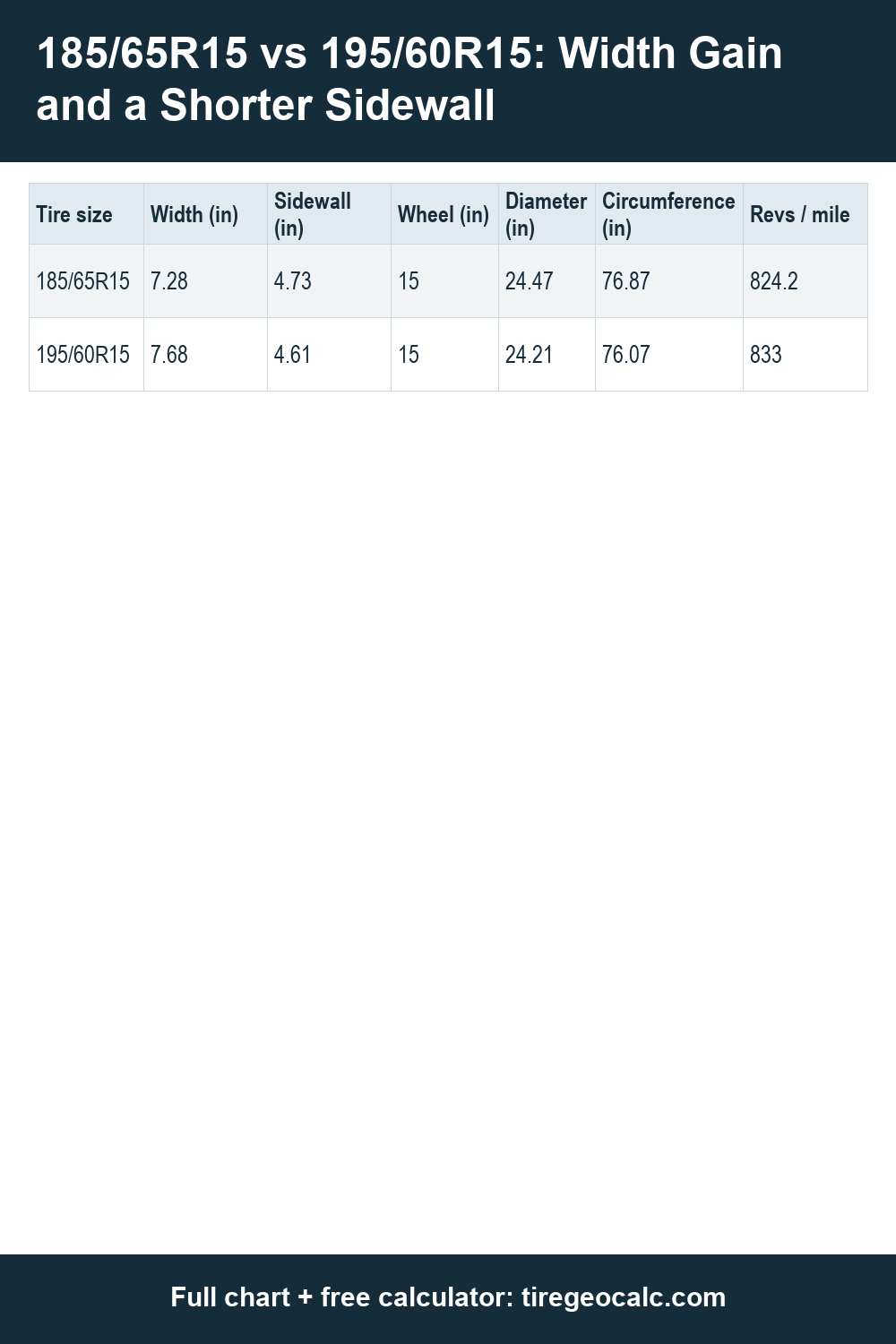
| Tire size | Width (mm) | Width (in) | Sidewall (mm) | Sidewall (in) | Wheel (mm) | Wheel (in) | Diameter (mm) | Diameter (in) | Circumference (mm) | Circumference (in) | Revolutions / mile | Revolutions / km | Diameter change (%) | Actual at indicated 30 mph | Actual at indicated 60 mph | Actual at indicated 75 mph | Actual minus indicated at 60 mph |
|---|---|---|---|---|---|---|---|---|---|---|---|---|---|---|---|---|---|
| 185/65R15 | 185 | 7.28 | 120.3 | 4.73 | 381 | 15 | 621.5 | 24.47 | 1952.5 | 76.87 | 824.2 | 512.2 | 0 | 30 | 60 | 75 | 0 |
| 195/60R15 | 195 | 7.68 | 117 | 4.61 | 381 | 15 | 615 | 24.21 | 1932.1 | 76.07 | 833 | 517.6 | -1.05 | 29.7 | 59.4 | 74.2 | -0.6 |
Nominal size-code geometry. Reference: 185/65R15. Display rounding only; not fitment approval.
- Tire size
- 185/65R15
- Width (mm)
- 185
- Width (in)
- 7.28
- Sidewall (mm)
- 120.3
- Sidewall (in)
- 4.73
- Wheel (mm)
- 381
- Wheel (in)
- 15
- Diameter (mm)
- 621.5
- Diameter (in)
- 24.47
- Circumference (mm)
- 1952.5
- Circumference (in)
- 76.87
- Revolutions / mile
- 824.2
- Revolutions / km
- 512.2
- Diameter change (%)
- 0
- Actual at indicated 30 mph
- 30
- Actual at indicated 60 mph
- 60
- Actual at indicated 75 mph
- 75
- Actual minus indicated at 60 mph
- 0
- Tire size
- 195/60R15
- Width (mm)
- 195
- Width (in)
- 7.68
- Sidewall (mm)
- 117
- Sidewall (in)
- 4.61
- Wheel (mm)
- 381
- Wheel (in)
- 15
- Diameter (mm)
- 615
- Diameter (in)
- 24.21
- Circumference (mm)
- 1932.1
- Circumference (in)
- 76.07
- Revolutions / mile
- 833
- Revolutions / km
- 517.6
- Diameter change (%)
- -1.05
- Actual at indicated 30 mph
- 29.7
- Actual at indicated 60 mph
- 59.4
- Actual at indicated 75 mph
- 74.2
- Actual minus indicated at 60 mph
- -0.6
Calculated dimensions are nominal, not measured rolling dimensions or vehicle fitment approval.
Why the wider marking does not settle the height question
The width entries are 185 mm and 195 mm. They describe nominal section width, while the following numbers describe sidewall height as a percentage of that width. In this pair, the percentage changes from 65 to 60. You therefore have to consider width and aspect ratio together. Reading the wider section alone would point you toward the wrong conclusion about overall height.
Both markings end in R15, so the wheel diameter stays at 15 inches. That gives this comparison a clear focus: the change in assembly height comes from the sidewalls, rather than a different wheel diameter. It says nothing about whether the same physical wheel meets each product's width requirements.
Follow the sidewall calculation before the total diameter
The calculation takes section width, multiplies it by the aspect ratio, and divides by one hundred. The displayed sidewall heights are 120.3 mm for 185/65R15 and 117 mm for 195/60R15. Overall diameter then adds both sidewalls to the wheel diameter expressed in the same unit. The wheel contributes 381 mm in either row.
The resulting diameters are 621.5 mm and 615 mm. These totals come from the engine's full precision arithmetic. Do not rebuild a total by doubling a rounded sidewall entry and expect every displayed decimal to match. Rounding is part of presenting the answer, not an extra change in tire size.
Use inches to describe the same assembly
The inch columns provide another way to picture the pair: the original diameter is 24.47 inches, while the candidate diameter is 24.21 inches. Their nominal section widths are 7.28 inches and 7.68 inches. Keeping width beside height makes the result easier to describe: the candidate is wider across its section yet shorter across the complete circle.
The sidewall entries in inches are 4.73 and 4.61. These are conversions of the sidewall dimension, not measurements of tread depth. A reader comparing a manufacturer's drawing should first identify what its arrows measure. Wheel diameter, section width and overall diameter describe different directions across the assembly.
Connect a smaller circle with more revolutions
Nominal circumference falls from 1952.5 mm to 1932.1 mm. In the geometry model, circumference is diameter multiplied by pi. The shorter circle travels less distance in a complete turn, so it needs more turns to cover a fixed distance. The revolutions per mile entries show this directly: 824.2 for the original and 833 for the candidate.
Those rotation figures are calculated from an ideal circle. They are not recorded rolling results from a vehicle. If a specification sheet provides measured revolutions under stated test conditions, retain that label when comparing it with this table; the measurements and the geometric estimate do not answer precisely the same question.
Keep the speed example pointed from original to candidate
Assume the instrument is calibrated to 185/65R15 without any other error. The formula multiplies indicated speed by candidate diameter divided by original diameter. At an indicated 60 mph, the table gives a calculated actual speed of 59.4 mph with 195/60R15. The result lies below the indicated reading because the candidate covers less distance per turn.
At an indicated 30 mph, the corresponding entry is 29.7 mph. These are illustrative calculations, not observations from your dashboard. Reversing the starting and candidate sizes would reverse the direction of the relationship and require a new calculation rather than reusing the same displayed result.
Take the dimensional result to the product checks
Similar dimensions do not approve installing either tire size on a particular vehicle. Use the vehicle's stated requirements and the exact tire and wheel documentation to investigate the proposed assembly. Check the required service description, permitted rim range and available clearance rather than interpreting a close diameter as an answer to all of them.
For this pair, keep separate notes for lateral space and overall height: they move in different directions. The table cannot establish inflation settings, carrying capacity or vehicle behavior. Its useful conclusion is narrower and clear: under the nominal calculation, 195/60R15 has the wider section, shorter sidewall and smaller circumference.
Frequently asked questions
Does 60 in 195/60R15 mean a sidewall of 60 mm?
It expresses a percentage of section width. The calculated sidewall shown for this size is 117 mm, so the profile number and the sidewall height are different quantities.
Can section width tell me the tread width?
The marking supplies nominal section width. Consult the exact product dimensions for tread width instead of treating the section measurement as a tread measurement.
Why is the candidate shown with more revolutions per mile?
Its calculated circumference is smaller. Covering the same nominal mile therefore requires more complete rotations in the geometric model.
What changes if my original size is different?
Enter that actual reference in a fresh comparison. The diameter and speed relationship must be based on the starting size relevant to the vehicle, not on a convenient nearby row.