 TireGeoCalc
LT Tire Load Range Letter Chart: B, C, D, E, F and G
Quick answer
Nominal geometryLT reference categories · not recommended operating pressures
- Range B · equivalent ply rating
- 4ply
- Range C · equivalent ply rating
- 6ply
- Range D · equivalent ply rating
- 8ply
Calculated from size markings. Not measured rolling dimensions or vehicle fitment approval.
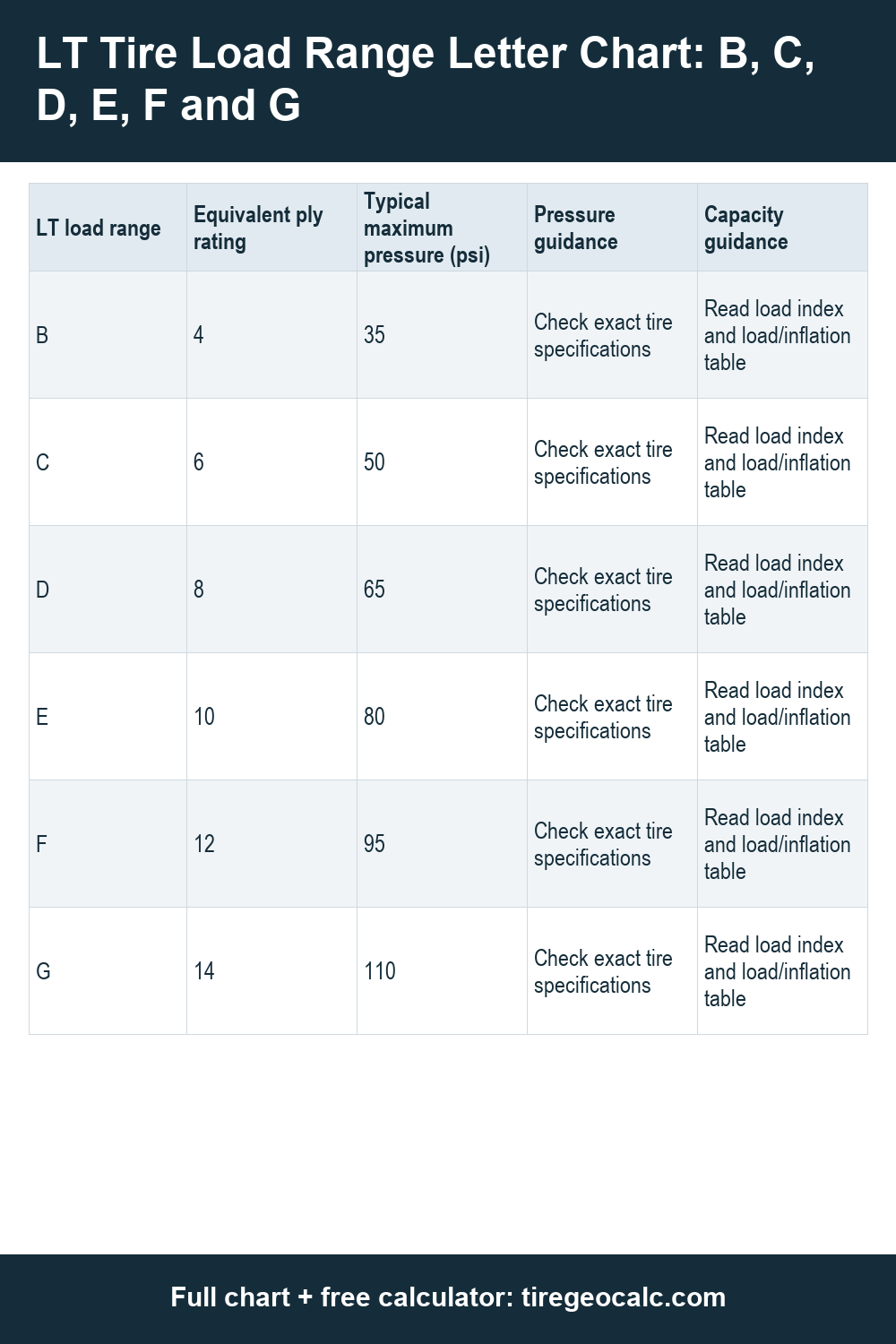
A load range letter describes a tire strength and inflation category, rather than a universal weight capacity. On LT tires, letters B through G correspond to historical equivalent ply ratings. The chart gives the reference pairings requested here; it is not an instruction to inflate every tire to that pressure. Identify the exact tire type before using the letters. These are nominal geometric calculations, not vehicle fitment approval. Check the vehicle manual and exact tire and wheel specifications, including load and speed ratings, approved rim width and clearance; consult the manual for any diameter change exceeding 3%.
LT load range, equivalent ply rating and typical maximum pressure
These are reference categories, not dimensions calculated from a size code. Typical maximum pressure is shown in psi; the exact tire sidewall and manufacturer load/inflation table govern the product. Equivalent ply rating does not count actual casing layers.
| LT load range | Equivalent ply rating | Typical maximum pressure (psi) | Pressure guidance | Capacity guidance |
|---|---|---|---|---|
| B | 4 | 35 | Check exact tire specifications | Read load index and load/inflation table |
| C | 6 | 50 | Check exact tire specifications | Read load index and load/inflation table |
| D | 8 | 65 | Check exact tire specifications | Read load index and load/inflation table |
| E | 10 | 80 | Check exact tire specifications | Read load index and load/inflation table |
| F | 12 | 95 | Check exact tire specifications | Read load index and load/inflation table |
| G | 14 | 110 | Check exact tire specifications | Read load index and load/inflation table |
LT reference categories; typical maxima are not recommended operating pressures.
- LT load range
- B
- Equivalent ply rating
- 4
- Typical maximum pressure (psi)
- 35
- Pressure guidance
- Check exact tire specifications
- Capacity guidance
- Read load index and load/inflation table
- LT load range
- C
- Equivalent ply rating
- 6
- Typical maximum pressure (psi)
- 50
- Pressure guidance
- Check exact tire specifications
- Capacity guidance
- Read load index and load/inflation table
- LT load range
- D
- Equivalent ply rating
- 8
- Typical maximum pressure (psi)
- 65
- Pressure guidance
- Check exact tire specifications
- Capacity guidance
- Read load index and load/inflation table
- LT load range
- E
- Equivalent ply rating
- 10
- Typical maximum pressure (psi)
- 80
- Pressure guidance
- Check exact tire specifications
- Capacity guidance
- Read load index and load/inflation table
- LT load range
- F
- Equivalent ply rating
- 12
- Typical maximum pressure (psi)
- 95
- Pressure guidance
- Check exact tire specifications
- Capacity guidance
- Read load index and load/inflation table
- LT load range
- G
- Equivalent ply rating
- 14
- Typical maximum pressure (psi)
- 110
- Pressure guidance
- Check exact tire specifications
- Capacity guidance
- Read load index and load/inflation table
What the letters and ply ratings mean
Load range B corresponds to a four-ply rating, C to six, D to eight, E to ten, F to twelve and G to fourteen. These are equivalent strength designations inherited from older construction methods. A modern radial tire can achieve its rating without that number of physical plies. Read the separate construction statement if you want to know the actual casing materials and layers.
The letter therefore belongs with the complete specification. A tire marked LT has a different service category from a passenger tire, even when the nominal dimensions look similar. Do not infer the pressure limit of an unfamiliar product from a letter alone. The chart is a quick way to decode familiar LT categories while you collect the exact product information needed for a replacement.
Load range is different from load index
Load index is a numerical code for rated carrying capacity under specified conditions. Load range groups construction and inflation capability; it does not supply one capacity shared by every tire bearing that letter. Two E-range tires in different sizes can have different load indexes. Compare the full service description and its stated conditions rather than treating E as a fixed number of pounds.
Some LT tires show separate single and dual load indexes. Single use means one tire at each end of an axle; dual use means paired tires at each end. Use the appropriate rating for the installation. Neither rating changes the vehicle payload limit, axle rating or permitted trailer weight. Those limits come from the vehicle and trailer documentation, independently of the tire letter.
Why SL and XL are not LT load ranges
SL means Standard Load and XL means Extra Load in passenger-tire terminology. They are not intermediate letters in the LT B-to-G sequence. An XL passenger tire is not automatically equivalent to an LT E tire, and its label cannot be converted directly into one of the chart rows. Compare product capacity, required pressure, approved application and the vehicle instructions as a complete set.
When considering a change between passenger and LT construction, follow the vehicle and tire manufacturer guidance for the intended service. The nominal size calculator cannot model their load/inflation relationships. It also cannot establish ride comfort or whether a wheel, valve or pressure-monitoring sensor is suitable for a higher pressure. Treat those as separate product checks before buying or mounting the replacement.
Using the chart for pickups and trailers
For a pickup carrying tools or towing, identify the specified tire service type, axle loads and recommended cold pressures. A higher load range does not increase the truck rating or permit extra payload. For a trailer, first identify whether the specification calls for ST or LT tires. This LT reference is not a universal ST inflation chart; use the exact trailer and tire documentation.
The typical maximum pressure column is not the recommended everyday setting. Begin with the vehicle placard and manual, then obtain the correct replacement load/inflation guidance when specifications change. Check wheels and valves as well as tires. Record pressures cold and use equipment rated for the intended pressure. If markings conflict or are unclear, have the tire manufacturer or a qualified installer resolve the specification before use.
Frequently asked questions
Does ten-ply mean ten actual layers?
No. A ten-ply rating is an equivalent strength designation associated here with load range E. Actual construction is listed separately on the product and may use a different number of layers and materials.
Should every E-range tire run at 80 psi?
No. The chart shows a typical maximum reference, not a universal operating recommendation. Follow the vehicle guidance and exact tire load/inflation information; also check wheel and valve pressure ratings.
Does a higher load range increase payload?
No. Vehicle payload, axle and towing limits remain independent constraints. Select the required tire capacity for the application without treating a stronger tire category as permission to exceed those limits.
Is XL the same as LT load range E?
No. XL is a passenger-tire Extra Load category. LT load range E belongs to a different classification. Use the complete service specifications and approved application instead of matching the labels by appearance.
Continue your comparison
These are nominal geometric calculations, not vehicle fitment approval. Check the vehicle manual and exact tire and wheel specifications, including load and speed ratings, approved rim width and clearance; consult the manual for any diameter change exceeding 3%.
Reference tables: Load index chart and Speed rating chart.