 TireGeoCalc
Tire Load Index Chart
Quick answer
Nominal geometryLoad-index reference range · capacity per tire under specified conditions
- Index 70
- 335kg
- Index 126
- 1700kg
Calculated from size markings. Not measured rolling dimensions or vehicle fitment approval.
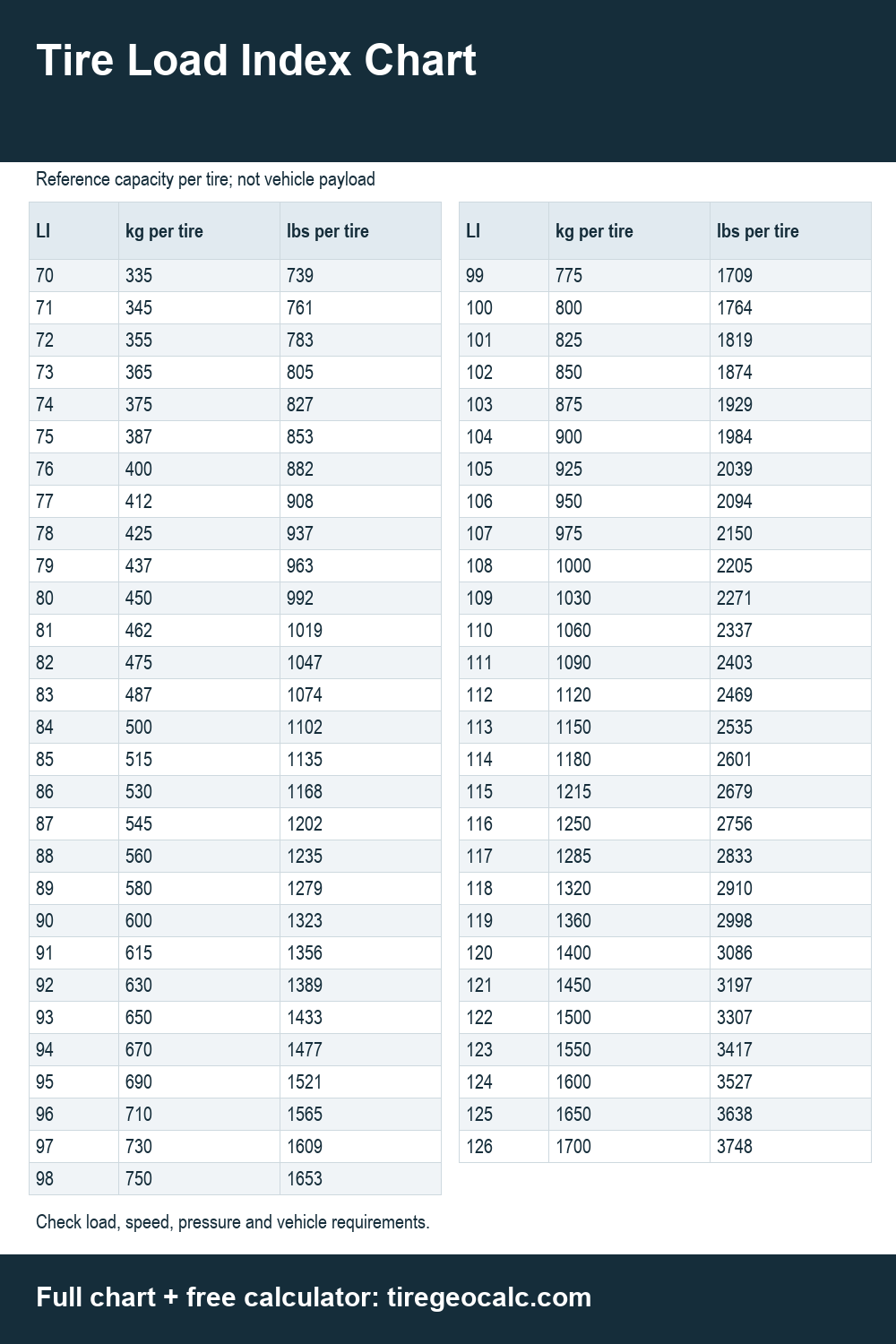
A tire load index is a numerical code for the maximum load one tire can carry under its specified operating conditions. It is not the weight in kilograms and it is not a measurement of tire size. This tire load index chart covers passenger cars, SUVs and many light-truck service descriptions, with indexes from 70 through 126. Find the number in the service description, then read across to the capacity per tire. These load capacities are reference values, not vehicle fitment approval or a payload allowance. Never fit a lower load index than required by the vehicle certificate, door placard or manufacturer. Check the vehicle manual and exact tire and wheel specifications, including load and speed ratings, approved rim width, clearance and the required inflation pressure; consult the manual for any diameter change exceeding 3%.
Load index 70–126: capacity per tire
The kilogram column uses the standard ETRTO/ISO load-index mapping. Pounds are calculated as kilograms multiplied by 2.20462, rounded to the nearest whole pound. Each row describes one tire at the conditions specified for that product; the values are not capacities for an axle or a complete vehicle. Read dual-service markings using the appropriate single or dual index.
| LI | kg per tire | lbs per tire |
|---|---|---|
| 70 | 335 | 739 |
| 71 | 345 | 761 |
| 72 | 355 | 783 |
| 73 | 365 | 805 |
| 74 | 375 | 827 |
| 75 | 387 | 853 |
| 76 | 400 | 882 |
| 77 | 412 | 908 |
| 78 | 425 | 937 |
| 79 | 437 | 963 |
| 80 | 450 | 992 |
| 81 | 462 | 1019 |
| 82 | 475 | 1047 |
| 83 | 487 | 1074 |
| 84 | 500 | 1102 |
| 85 | 515 | 1135 |
| 86 | 530 | 1168 |
| 87 | 545 | 1202 |
| 88 | 560 | 1235 |
| 89 | 580 | 1279 |
| 90 | 600 | 1323 |
| 91 | 615 | 1356 |
| 92 | 630 | 1389 |
| 93 | 650 | 1433 |
| 94 | 670 | 1477 |
| 95 | 690 | 1521 |
| 96 | 710 | 1565 |
| 97 | 730 | 1609 |
| 98 | 750 | 1653 |
| 99 | 775 | 1709 |
| 100 | 800 | 1764 |
| 101 | 825 | 1819 |
| 102 | 850 | 1874 |
| 103 | 875 | 1929 |
| 104 | 900 | 1984 |
| 105 | 925 | 2039 |
| 106 | 950 | 2094 |
| 107 | 975 | 2150 |
| 108 | 1000 | 2205 |
| 109 | 1030 | 2271 |
| 110 | 1060 | 2337 |
| 111 | 1090 | 2403 |
| 112 | 1120 | 2469 |
| 113 | 1150 | 2535 |
| 114 | 1180 | 2601 |
| 115 | 1215 | 2679 |
| 116 | 1250 | 2756 |
| 117 | 1285 | 2833 |
| 118 | 1320 | 2910 |
| 119 | 1360 | 2998 |
| 120 | 1400 | 3086 |
| 121 | 1450 | 3197 |
| 122 | 1500 | 3307 |
| 123 | 1550 | 3417 |
| 124 | 1600 | 3527 |
| 125 | 1650 | 3638 |
| 126 | 1700 | 3748 |
Standard load-index reference; capacity per tire under the specified operating conditions.
- LI
- 70
- kg per tire
- 335
- lbs per tire
- 739
- LI
- 71
- kg per tire
- 345
- lbs per tire
- 761
- LI
- 72
- kg per tire
- 355
- lbs per tire
- 783
- LI
- 73
- kg per tire
- 365
- lbs per tire
- 805
- LI
- 74
- kg per tire
- 375
- lbs per tire
- 827
- LI
- 75
- kg per tire
- 387
- lbs per tire
- 853
- LI
- 76
- kg per tire
- 400
- lbs per tire
- 882
- LI
- 77
- kg per tire
- 412
- lbs per tire
- 908
- LI
- 78
- kg per tire
- 425
- lbs per tire
- 937
- LI
- 79
- kg per tire
- 437
- lbs per tire
- 963
- LI
- 80
- kg per tire
- 450
- lbs per tire
- 992
- LI
- 81
- kg per tire
- 462
- lbs per tire
- 1019
- LI
- 82
- kg per tire
- 475
- lbs per tire
- 1047
- LI
- 83
- kg per tire
- 487
- lbs per tire
- 1074
- LI
- 84
- kg per tire
- 500
- lbs per tire
- 1102
- LI
- 85
- kg per tire
- 515
- lbs per tire
- 1135
- LI
- 86
- kg per tire
- 530
- lbs per tire
- 1168
- LI
- 87
- kg per tire
- 545
- lbs per tire
- 1202
- LI
- 88
- kg per tire
- 560
- lbs per tire
- 1235
- LI
- 89
- kg per tire
- 580
- lbs per tire
- 1279
- LI
- 90
- kg per tire
- 600
- lbs per tire
- 1323
- LI
- 91
- kg per tire
- 615
- lbs per tire
- 1356
- LI
- 92
- kg per tire
- 630
- lbs per tire
- 1389
- LI
- 93
- kg per tire
- 650
- lbs per tire
- 1433
- LI
- 94
- kg per tire
- 670
- lbs per tire
- 1477
- LI
- 95
- kg per tire
- 690
- lbs per tire
- 1521
- LI
- 96
- kg per tire
- 710
- lbs per tire
- 1565
- LI
- 97
- kg per tire
- 730
- lbs per tire
- 1609
- LI
- 98
- kg per tire
- 750
- lbs per tire
- 1653
- LI
- 99
- kg per tire
- 775
- lbs per tire
- 1709
- LI
- 100
- kg per tire
- 800
- lbs per tire
- 1764
- LI
- 101
- kg per tire
- 825
- lbs per tire
- 1819
- LI
- 102
- kg per tire
- 850
- lbs per tire
- 1874
- LI
- 103
- kg per tire
- 875
- lbs per tire
- 1929
- LI
- 104
- kg per tire
- 900
- lbs per tire
- 1984
- LI
- 105
- kg per tire
- 925
- lbs per tire
- 2039
- LI
- 106
- kg per tire
- 950
- lbs per tire
- 2094
- LI
- 107
- kg per tire
- 975
- lbs per tire
- 2150
- LI
- 108
- kg per tire
- 1000
- lbs per tire
- 2205
- LI
- 109
- kg per tire
- 1030
- lbs per tire
- 2271
- LI
- 110
- kg per tire
- 1060
- lbs per tire
- 2337
- LI
- 111
- kg per tire
- 1090
- lbs per tire
- 2403
- LI
- 112
- kg per tire
- 1120
- lbs per tire
- 2469
- LI
- 113
- kg per tire
- 1150
- lbs per tire
- 2535
- LI
- 114
- kg per tire
- 1180
- lbs per tire
- 2601
- LI
- 115
- kg per tire
- 1215
- lbs per tire
- 2679
- LI
- 116
- kg per tire
- 1250
- lbs per tire
- 2756
- LI
- 117
- kg per tire
- 1285
- lbs per tire
- 2833
- LI
- 118
- kg per tire
- 1320
- lbs per tire
- 2910
- LI
- 119
- kg per tire
- 1360
- lbs per tire
- 2998
- LI
- 120
- kg per tire
- 1400
- lbs per tire
- 3086
- LI
- 121
- kg per tire
- 1450
- lbs per tire
- 3197
- LI
- 122
- kg per tire
- 1500
- lbs per tire
- 3307
- LI
- 123
- kg per tire
- 1550
- lbs per tire
- 3417
- LI
- 124
- kg per tire
- 1600
- lbs per tire
- 3527
- LI
- 125
- kg per tire
- 1650
- lbs per tire
- 3638
- LI
- 126
- kg per tire
- 1700
- lbs per tire
- 3748
Read 108V and 104S as two separate ratings
In a service description ending in 108V, 108 is the load index and V is the speed symbol. Index 108 corresponds to 1,000 kg per tire in this chart. V describes a separate speed category; it does not add kilograms to the load capacity. Do not read the whole marking as a model number or assume that a faster speed symbol permits a heavier load.
A marking of 104S has load index 104, corresponding to 900 kg per tire, followed by speed symbol S. Compare both parts with the vehicle specification. Tire manufacturers may specify load adjustments at high speeds, so the chart alone cannot establish every operating limit. Two tires with the same dimensions can have different service descriptions and different permitted loads.
Understand 121/118R on an LT tire
On a light-truck tire marked 121/118R, the first index applies to single-tire service and the second to dual-tire service. Index 121 corresponds to 1,450 kg per tire when used singly; index 118 corresponds to 1,320 kg per tire when used in an approved dual arrangement. R is the speed symbol in this service description. The R inside a size such as LT245/75R16 instead identifies radial construction.
Dual service means two tires alongside each other at each end of an axle, not simply having a front and rear axle. The lower dual rating still applies to each tire, rather than to the pair. Four tires in dual service at index 118 have an arithmetic capacity of 5,280 kg under the specified conditions. Axle, wheel, spacing, inflation and vehicle limits still govern that installation.
XL and Reinforced need the correct inflation conditions
XL means Extra Load; Reinforced is another marking used for reinforced passenger-tire construction. These descriptions identify a tire category designed for higher load at specified inflation conditions compared with an equivalent standard-load design. They are not extra kilograms that can be added to the capacity in the chart. Read the actual load index on the exact product rather than choosing from the XL label alone.
The capacity depends on the applicable load-and-inflation schedule. The sidewall maximum pressure is not automatically the recommended everyday cold pressure for your vehicle. Start with the vehicle placard and manual, then obtain the tire manufacturer guidance when changing construction or category. Passenger and LT tires can use different schedules, and some passenger-tire applications on light trucks require a capacity adjustment. Use the linked LT versus P-metric guide before comparing these categories.
Why a lower load index is not a suitable shortcut
The vehicle certificate, door placard and manufacturer specifications establish the required tire service description. A replacement that physically fits the wheel can still have too little load capacity. Do not reduce the required load index because you usually drive alone, carry little luggage or found a close overall diameter in a size calculator. Load distribution changes with passengers, cargo, towing and driving conditions.
A higher index does not increase the vehicle gross weight rating or make a wheel stronger. Check each axle requirement and the rating of every component. Where original front and rear specifications differ, preserve the approved arrangement. Record the complete size, load index, speed symbol and construction category before comparing replacements, rather than looking at the numerical index in isolation.
Multiply capacity by four, not the index code
For four identical tires in single service, multiply the capacity in kg or lbs per tire by four to obtain a simple set total. Four index-91 tires give 615 times four, or 2,460 kg; four index-100 tires give 800 times four, or 3,200 kg. Multiplying the index number itself by four gives no useful weight because the index is a lookup code, not a unit of mass.
That arithmetic total is not available payload. The vehicle already carries its own weight, loads are not always distributed equally, and axle or wheel limits may be lower. Use the vehicle gross and axle ratings, the actual loaded axle weights and the required tire pressures. For mixed indexes or dual service, work from the correct capacity at each wheel position instead of applying a single four-tire shortcut.
Frequently asked questions
Is load index 91 the same as 91 kg?
No. Index 91 is a code corresponding to 615 kg per tire under the applicable conditions. The index and the kilogram capacity use different scales. Read the matching table row before doing a total-load calculation.
Does XL automatically mean a higher load index?
XL identifies Extra Load construction, not a fixed capacity. Compare the numerical load index and the load-and-inflation schedule for the exact tire. The XL marking alone does not tell you how much weight that tire can support.
Which number in 121/118R applies to dual rear wheels?
Use 118 for approved dual-tire service, corresponding to 1,320 kg per tire. Use 121 for single-tire service, corresponding to 1,450 kg per tire. Neither number is the capacity of a complete pair.
Does four times tire capacity tell me how much cargo I can carry?
No. The sum includes support for the vehicle itself and assumes the relevant tire operating conditions. Payload also depends on the vehicle weight and its gross, axle, wheel and other component ratings. Consult the vehicle loading information.
Continue your comparison
These load capacities are reference values, not vehicle fitment approval or a payload allowance. Never fit a lower load index than required by the vehicle certificate, door placard or manufacturer. Check the vehicle manual and exact tire and wheel specifications, including load and speed ratings, approved rim width, clearance and the required inflation pressure; consult the manual for any diameter change exceeding 3%.
Reference tables: Load index chart and Speed rating chart.