 TireGeoCalc
Wheel Size Comparison: 17 vs 18 vs 20 Inch
Quick answer
Nominal geometryTable example: 265/70R17 → 265/65R18 · original-size calibration assumed
- 265/65R18 diameter
- 31.56in
- Diameter change
- -0.14%
- Actual at indicated 60 mph
- 59.92mph
Calculated from size markings. Not measured rolling dimensions or vehicle fitment approval.
A wheel size comparison needs a tire size for each wheel. A 20-inch wheel does not automatically create a taller assembly than a 17-inch wheel because the tire sidewall can be shorter. The useful comparison is the entire wheel-and-tire diameter. The examples below are within about 1% for most rows, plus examples that fall 1–2.5% short and a still shorter counterexample. These nominal dimensions do not approve fitment; check the vehicle manual and exact product specifications before choosing a package.
17, 18 and 20-inch combinations compared
All rows use 265/70R17 as the reference. Near-equal circumference means near-equal diameter in this calculation. The sidewall column shows how the share of rubber changes as wheel diameter increases.
| Tire size | Reference size | Diameter / height (mm) | Diameter / height (in) | Sidewall (mm) | Circumference (mm) | Revolutions / mile | Diameter change (%) | Actual at indicated 60 mph | Actual minus indicated (mph) | Manual check |
|---|---|---|---|---|---|---|---|---|---|---|
| 265/70R17 | 265/70R17 | 802.8 | 31.61 | 185.5 | 2522.1 | 638.1 | 0.00% | 60.00 mph | 0.00 mph | |
| 265/65R18 | 265/70R17 | 801.7 | 31.56 | 172.3 | 2518.6 | 639.0 | -0.14% | 59.92 mph | -0.08 mph | |
| 275/60R18 | 265/70R17 | 787.2 | 30.99 | 165.0 | 2473.1 | 650.7 | -1.94% | 58.83 mph | -1.17 mph | |
| 265/55R20 | 265/70R17 | 799.5 | 31.48 | 145.8 | 2511.7 | 640.7 | -0.41% | 59.75 mph | -0.25 mph | |
| 275/55R20 | 265/70R17 | 810.5 | 31.91 | 151.3 | 2546.3 | 632.0 | +0.96% | 60.58 mph | +0.58 mph | |
| 275/50R20 | 265/70R17 | 783.0 | 30.83 | 137.5 | 2459.9 | 654.2 | -2.47% | 58.52 mph | -1.48 mph | |
| 275/45R20 | 265/70R17 | 755.5 | 29.74 | 123.8 | 2373.5 | 678.1 | -5.89% | 56.46 mph | -3.54 mph | Over 3%: check the vehicle manual |
| 285/50R20 | 265/70R17 | 793.0 | 31.22 | 142.5 | 2491.3 | 646.0 | -1.22% | 59.27 mph | -0.73 mph |
Nominal dimensions calculated from tire size markings; rounding is for display only.
- Tire size
- 265/70R17
- Reference size
- 265/70R17
- Diameter / height (mm)
- 802.8
- Diameter / height (in)
- 31.61
- Sidewall (mm)
- 185.5
- Circumference (mm)
- 2522.1
- Revolutions / mile
- 638.1
- Diameter change (%)
- 0.00%
- Actual at indicated 60 mph
- 60.00 mph
- Actual minus indicated (mph)
- 0.00 mph
- Manual check
- Tire size
- 265/65R18
- Reference size
- 265/70R17
- Diameter / height (mm)
- 801.7
- Diameter / height (in)
- 31.56
- Sidewall (mm)
- 172.3
- Circumference (mm)
- 2518.6
- Revolutions / mile
- 639.0
- Diameter change (%)
- -0.14%
- Actual at indicated 60 mph
- 59.92 mph
- Actual minus indicated (mph)
- -0.08 mph
- Manual check
- Tire size
- 275/60R18
- Reference size
- 265/70R17
- Diameter / height (mm)
- 787.2
- Diameter / height (in)
- 30.99
- Sidewall (mm)
- 165.0
- Circumference (mm)
- 2473.1
- Revolutions / mile
- 650.7
- Diameter change (%)
- -1.94%
- Actual at indicated 60 mph
- 58.83 mph
- Actual minus indicated (mph)
- -1.17 mph
- Manual check
- Tire size
- 265/55R20
- Reference size
- 265/70R17
- Diameter / height (mm)
- 799.5
- Diameter / height (in)
- 31.48
- Sidewall (mm)
- 145.8
- Circumference (mm)
- 2511.7
- Revolutions / mile
- 640.7
- Diameter change (%)
- -0.41%
- Actual at indicated 60 mph
- 59.75 mph
- Actual minus indicated (mph)
- -0.25 mph
- Manual check
- Tire size
- 275/55R20
- Reference size
- 265/70R17
- Diameter / height (mm)
- 810.5
- Diameter / height (in)
- 31.91
- Sidewall (mm)
- 151.3
- Circumference (mm)
- 2546.3
- Revolutions / mile
- 632.0
- Diameter change (%)
- +0.96%
- Actual at indicated 60 mph
- 60.58 mph
- Actual minus indicated (mph)
- +0.58 mph
- Manual check
- Tire size
- 275/50R20
- Reference size
- 265/70R17
- Diameter / height (mm)
- 783.0
- Diameter / height (in)
- 30.83
- Sidewall (mm)
- 137.5
- Circumference (mm)
- 2459.9
- Revolutions / mile
- 654.2
- Diameter change (%)
- -2.47%
- Actual at indicated 60 mph
- 58.52 mph
- Actual minus indicated (mph)
- -1.48 mph
- Manual check
- Tire size
- 275/45R20
- Reference size
- 265/70R17
- Diameter / height (mm)
- 755.5
- Diameter / height (in)
- 29.74
- Sidewall (mm)
- 123.8
- Circumference (mm)
- 2373.5
- Revolutions / mile
- 678.1
- Diameter change (%)
- -5.89%
- Actual at indicated 60 mph
- 56.46 mph
- Actual minus indicated (mph)
- -3.54 mph
- Manual check
- Over 3%: check the vehicle manual
- Tire size
- 285/50R20
- Reference size
- 265/70R17
- Diameter / height (mm)
- 793.0
- Diameter / height (in)
- 31.22
- Sidewall (mm)
- 142.5
- Circumference (mm)
- 2491.3
- Revolutions / mile
- 646.0
- Diameter change (%)
- -1.22%
- Actual at indicated 60 mph
- 59.27 mph
- Actual minus indicated (mph)
- -0.73 mph
- Manual check
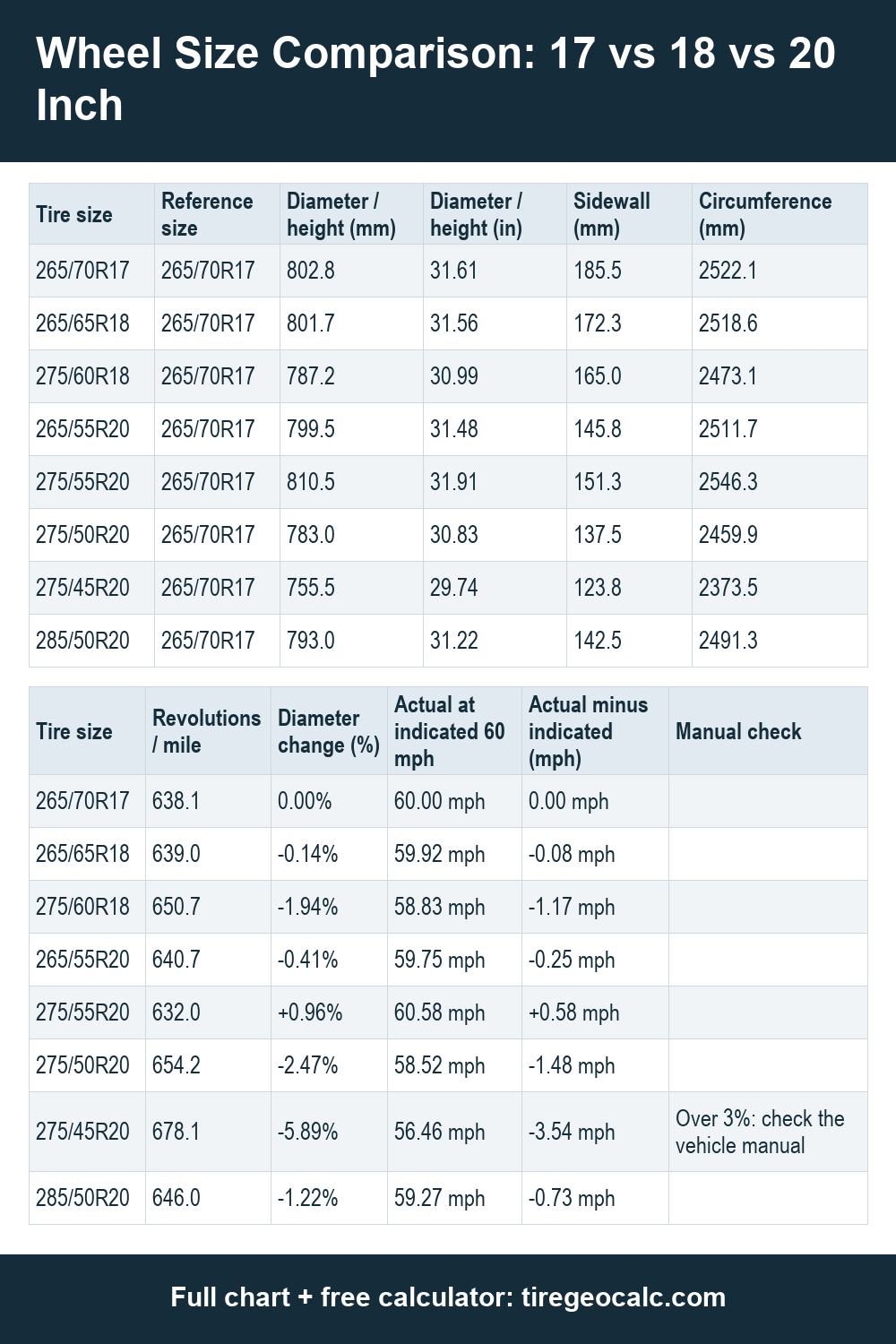
Calculated dimensions are nominal, not measured rolling dimensions or vehicle fitment approval.
Separate wheel diameter from tire diameter
The wheel number describes diameter at the tire bead seat. The tire adds one sidewall above and one below it. Keeping overall height approximately constant means replacing some sidewall with wheel diameter. This explains plus sizing; bare wheel measurements cannot describe assembly height.
Aspect ratio is a percentage of width. A 55-profile tire has different sidewall heights at different widths, so read the complete code. The chart calculates each sidewall from its own width and aspect ratio, converts the wheel diameter to millimeters, then adds that wheel diameter to two sidewalls.
Follow the reference through the chart
Begin at 265/70R17 and follow the diameter and circumference columns. The 265/65R18 and 265/55R20 examples keep width unchanged while the wheel grows. The 275/60R18 and 275/55R20 rows introduce a wider section. Compare percentage differences against the reference to find the closest height.
The 275/50R20 and 275/45R20 rows show why 20-inch combinations are not equivalent. The former stays below 3% change; the latter exceeds it and carries a manual-check flag. Keeping width and wheel diameter unchanged while reducing aspect ratio removes height from both sidewalls, changing circumference and the calculated speed together.
Understand what equal circumference preserves
Circumference equals pi multiplied by diameter, so their percentage changes are equal. Keeping circumference close preserves approximately the same distance per wheel revolution. Geometric revolutions per mile move in the opposite direction: a larger circle needs fewer turns. These columns express the same relationship.
The speed calculation assumes calibration to the reference tire without other instrument error; actual minus indicated shows the direction of change. A taller tire can make the speedometer read below actual speed; UK/EU rules prohibit under-reading, so check the vehicle manual even below 3%. Existing instrument error affects the real reading.
Check the package beyond its height
A wheel package also has width, offset, bolt pattern, center bore and brake-clearance requirements. Tire width affects space beside the assembly, while offset moves it relative to suspension and body. Height cannot tell you whether steering movement will bring the tire into contact with nearby components or whether the wheel clears the brakes.
These are nominal calculations, not fitment approval: check the vehicle manual and exact product specifications, including for changes exceeding 3%. Start a fresh calculator comparison if your original size differs. Follow the bigger-wheels guide to choose an aspect ratio for your own vehicle, because the 265/70R17 reference here is a pickup/SUV size.
Frequently asked questions
Can 17 and 20-inch wheels have the same overall height?
They can produce similar nominal assembly heights when the tire on the larger wheel has less sidewall. Exact equality depends on the complete sizes. Compare the calculated diameters using the complete tire codes.
Are 275/55R20 and 275/50R20 interchangeable?
Their dimensions differ. Reducing the aspect ratio from 55 to 50 removes height from both sidewalls even though width and wheel diameter match. Compare that difference against your original size to understand the change.
Does the chart predict ride quality?
No. It calculates dimensions and a theoretical speed relationship. It does not model tire construction, pressure, wheel mass, suspension or road conditions, so it does not rank comfort or handling.
Which size should I use as the original?
Use the original specification for the vehicle and axle you are investigating. If that is not 265/70R17, enter your own reference in the calculator. Percentage differences must be calculated against the correct starting size.