 TireGeoCalc
What Tire Size Fits a 3-Inch Lift? Start with These Checks
Published
A 3-inch lift description is not enough information to name a tire size that fits. It supplies no exact tire model, wheel dimensions or clearance measurements for your vehicle. The useful first step is to separate a tire geometry comparison from the installation assessment. The example below compares two size codes only; neither size is a recommendation for a lifted vehicle.
Nominal tire dimensions
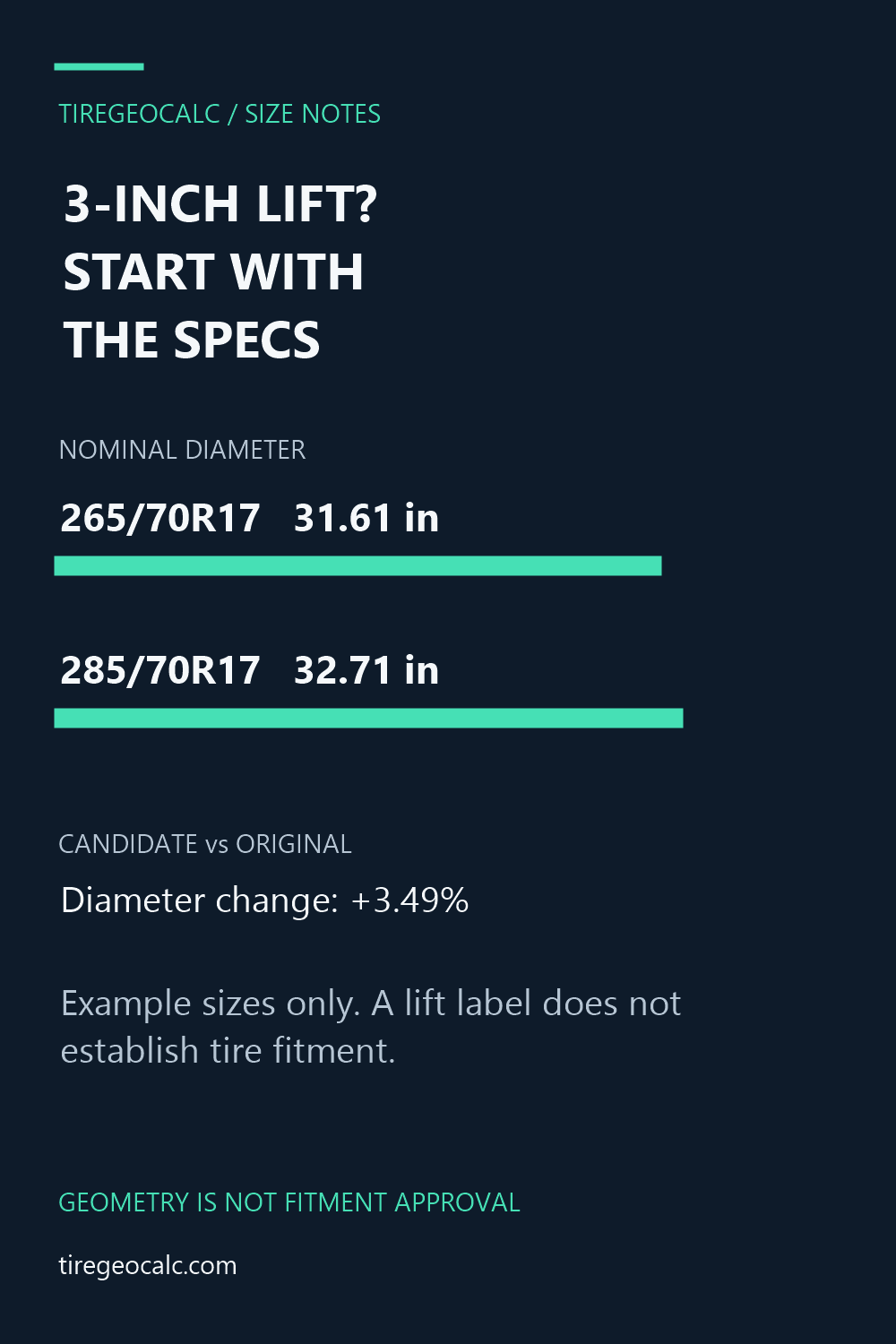
The first size is the original reference. Values come from the tire geometry engine and are rounded only for display.
| Size | Width (in) | Sidewall (in) | Diameter (in) | Diameter (mm) | Circumference (mm) | Geometric rev/mile |
|---|---|---|---|---|---|---|
| 265/70R17 | 10.43 | 7.30 | 31.61 | 802.8 | 2522.1 | 638.1 |
| 285/70R17 | 11.22 | 7.85 | 32.71 | 830.8 | 2610.0 | 616.6 |
Calculated nominal dimensions, not measured rolling data or fitment approval.
- Size
- 265/70R17
- Width (in)
- 10.43
- Sidewall (in)
- 7.30
- Diameter (in)
- 31.61
- Diameter (mm)
- 802.8
- Circumference (mm)
- 2522.1
- Geometric rev/mile
- 638.1
- Size
- 285/70R17
- Width (in)
- 11.22
- Sidewall (in)
- 7.85
- Diameter (in)
- 32.71
- Diameter (mm)
- 830.8
- Circumference (mm)
- 2610.0
- Geometric rev/mile
- 616.6
Candidate minus original: diameter 28.0 mm (3.49%); nominal radius 14.0 mm. Radius change is not a measured clearance gain.
| Indicated mph | Calculated actual mph |
|---|---|
| 30 | 31.05 |
| 60 | 62.09 |
| 75 | 77.62 |
Original calibration assumed; theoretical actual mph for the candidate.
- Indicated mph
- 30
- Calculated actual mph
- 31.05
- Indicated mph
- 60
- Calculated actual mph
- 62.09
- Indicated mph
- 75
- Calculated actual mph
- 77.62
Start with what the lift label does not tell you
The question asks for a single tire size, but the supplied information does not identify a vehicle or a particular lift kit. It also leaves out the wheels and the tires currently installed. Naming a compatible tire from the lift description alone would require facts that are not present. Treat that missing information as a reason to gather specifications before narrowing the purchase.
Write down the exact vehicle configuration, the kit identifier and the installation instructions. Keep the current wheel diameter, width and offset with those notes. Record the original tire size specified for the vehicle and the exact tire model you want to investigate. These details make a fitment question specific enough for the relevant manufacturers or an installer to assess.
Use tire dimensions to describe a candidate clearly
The chart uses 265/70R17 as a reference and 285/70R17 as an illustrative candidate. They were selected to demonstrate the calculation, not because a lift manufacturer approved them. Both have the same wheel diameter marking and aspect ratio, while their nominal section widths differ. This means the wider example also has taller calculated sidewalls.
The engine obtains sidewall height from width multiplied by aspect ratio divided by 100. It adds two sidewalls to the wheel diameter to calculate overall diameter. Circumference and geometric revolutions then follow from that ideal circle. Read the numbers as a description of the candidate, not as a diagram of the space available around your actual tires.
Separate tire radius from the lift description
A diameter increase spans the whole tire. Half of that difference is the nominal radius increase. The table lists this geometric change so you can avoid comparing total tire height directly with a lift label. Neither value supplies the missing vehicle measurements. There is no formula here that adds a kit label to a tire diameter and returns an approved replacement size.
Do not interpret the radius difference as measured ground clearance or as a statement that the tire will avoid contact. The calculation has no information about the shape of the wheel opening, nearby components, wheel position or movement during operation. Those are questions for the exact installation and documentation, outside the tire engine's nominal geometry.
Ask for evidence that matches the complete setup
Look for guidance that identifies your vehicle, kit, wheel dimensions and exact tire model together. A statement about a different wheel or another vehicle configuration does not fill those gaps. Manufacturer specifications and installation requirements should define the assessment rather than an image of a similar-looking vehicle or a tire diameter mentioned without context.
A qualified installer can use the actual combination to assess clearance and the checks required by the relevant instructions. Bring the complete specifications and explain how the vehicle will be used. This page cannot perform that inspection remotely. Its role is to make the dimensions and unanswered questions clear enough that the assessment is based on the intended setup.
Keep calibration and product requirements in the decision
A candidate with a different nominal diameter also changes the theoretical distance traveled per counted wheel revolution. The speed table illustrates that ratio relative to the reference size. It assumes the original calibration remains unchanged. If your original size is different, use that actual reference in the calculator rather than copying the example's percentages or speed results.
Fitment also requires checking the tire and wheel specifications against the vehicle requirements, including load and speed ratings. Geometry alone cannot set operating pressure or predict ride quality, carrying capacity or fuel use. The shopping searches are research starting points, not approved lift-kit packages. Resolve the documentation and installation questions before purchasing a tire based on the lift label.
Frequently asked questions
Does a 3-inch lift guarantee a particular tire size?
No. The lift description alone does not supply the exact vehicle, wheel, tire or clearance information needed for fitment.
Are the sizes in the example recommendations?
No. They demonstrate nominal geometry only and are not approved sizes for any lift or vehicle.
Can I add the lift height to my tire diameter?
That arithmetic does not establish compatibility. Tire diameter, nominal radius and the kit description are different inputs.
What should I collect before choosing tires?
Collect the vehicle configuration, lift instructions, wheel dimensions, original tire specification and exact candidate tire data for an installation assessment.
Continue your research
Nominal geometry does not establish vehicle fitment. Check the exact tire, wheel and vehicle documentation before installation.
Reference tables: Load index chart and Speed rating chart.