 TireGeoCalc
Tire Width Comparison: 245 vs 265 vs 285
Quick answer
Nominal geometryTable example: 245/70R17 → 265/70R17 · original-size calibration assumed
- 265/70R17 diameter
- 31.61in
- Diameter change
- +3.61%
- Actual at indicated 60 mph
- 62.17mph
Calculated from size markings. Not measured rolling dimensions or vehicle fitment approval.
Compare 245, 265 and 285 mm tire widths in inches and see how width changes overall height. A width code describes nominal section width, rather than the tread contact patch or the wheel width. This comparison keeps the wheel at 17 inches and groups two aspect ratios separately so that the effect of changing width is visible. Each group uses its own 245 mm reference; percentages from different groups must not be added together. These are nominal geometric calculations, not vehicle fitment approval. Check the vehicle manual and exact tire and wheel specifications, including load and speed ratings, approved rim width and clearance; consult the manual for any diameter change exceeding 3%.
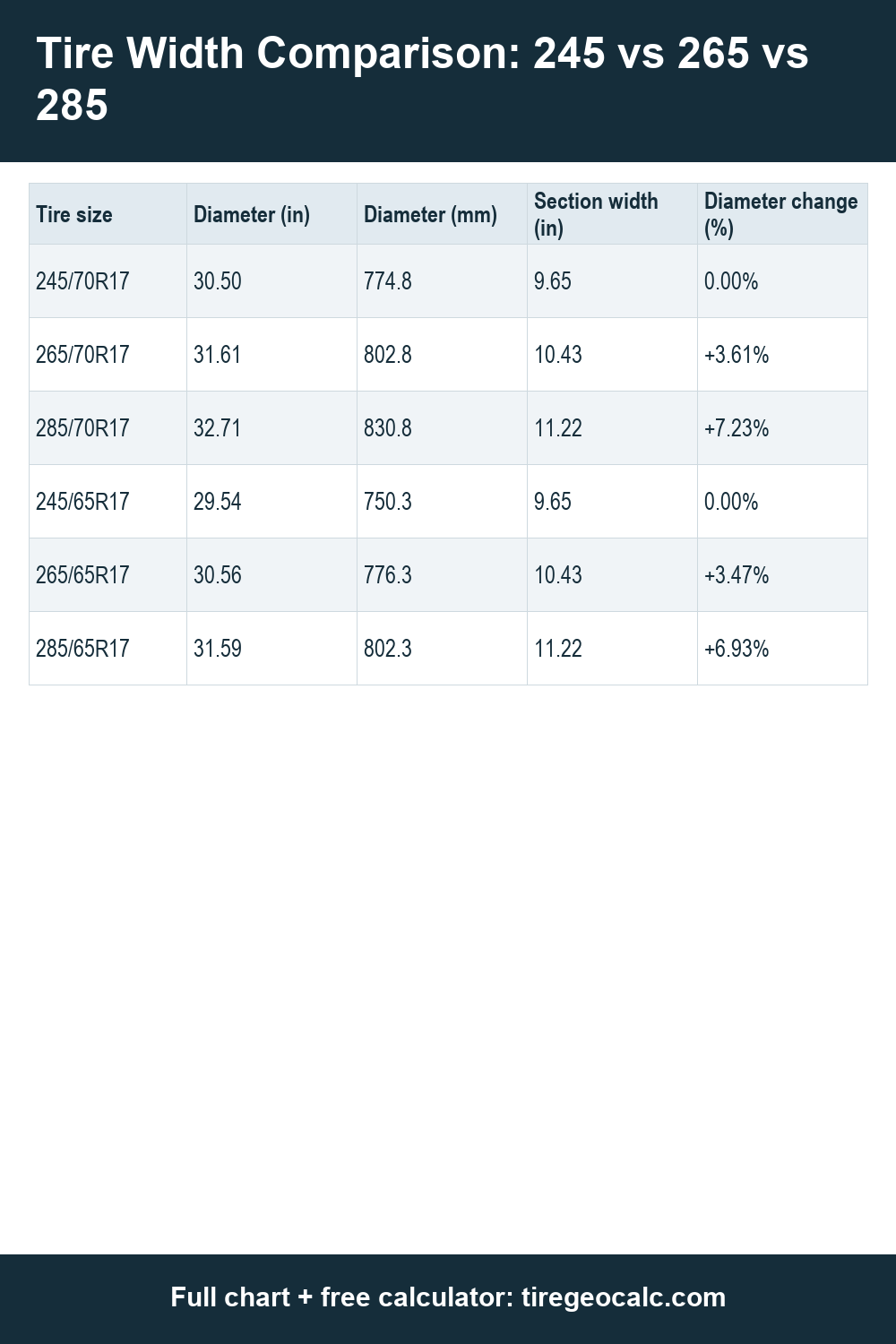
Tire Width Comparison: 245 vs 265 vs 285: calculated chart
The /70R17 rows use 245/70R17 as the reference; the /65R17 rows use 245/65R17. Width and diameter are nominal calculations. Rim approval is a separate product-specific check.
| Tire size | Diameter (in) | Diameter (mm) | Section width (in) | Diameter change (%) |
|---|---|---|---|---|
| 245/70R17 | 30.50 | 774.8 | 9.65 | 0.00% |
| 265/70R17 | 31.61 | 802.8 | 10.43 | +3.61% |
| 285/70R17 | 32.71 | 830.8 | 11.22 | +7.23% |
| 245/65R17 | 29.54 | 750.3 | 9.65 | 0.00% |
| 265/65R17 | 30.56 | 776.3 | 10.43 | +3.47% |
| 285/65R17 | 31.59 | 802.3 | 11.22 | +6.93% |
Nominal dimensions; changes are relative to the reference size stated above.
- Tire size
- 245/70R17
- Diameter (in)
- 30.50
- Diameter (mm)
- 774.8
- Section width (in)
- 9.65
- Diameter change (%)
- 0.00%
- Tire size
- 265/70R17
- Diameter (in)
- 31.61
- Diameter (mm)
- 802.8
- Section width (in)
- 10.43
- Diameter change (%)
- +3.61%
- Tire size
- 285/70R17
- Diameter (in)
- 32.71
- Diameter (mm)
- 830.8
- Section width (in)
- 11.22
- Diameter change (%)
- +7.23%
- Tire size
- 245/65R17
- Diameter (in)
- 29.54
- Diameter (mm)
- 750.3
- Section width (in)
- 9.65
- Diameter change (%)
- 0.00%
- Tire size
- 265/65R17
- Diameter (in)
- 30.56
- Diameter (mm)
- 776.3
- Section width (in)
- 10.43
- Diameter change (%)
- +3.47%
- Tire size
- 285/65R17
- Diameter (in)
- 31.59
- Diameter (mm)
- 802.3
- Section width (in)
- 11.22
- Diameter change (%)
- +6.93%
Convert millimeters before comparing wheel dimensions
Divide the first number in the tire marking by 25.4 to convert millimeters to inches. The calculated section widths are 9.65 inches for 245, 10.43 inches for 265 and 11.22 inches for 285. Moving from 245 to 265 adds 20 mm of nominal width, and moving from 265 to 285 adds another 20 mm. Each step is about 0.79 inches across the whole section, rather than on each side.
Section width includes the sidewalls and should not be confused with tread width. A tire mounted on a different approved measuring rim can have a different published section width. Nominal markings allow consistent geometric comparisons, but they cannot predict the exact shoulder position on a particular wheel. For clearance, consult the exact tire dimensions and the wheel offset as well as its bead-seat width.
Width also changes sidewall height
At a constant aspect ratio, increasing width also increases sidewall height. The 70 in a /70 marking means seventy percent of section width. A 20 mm width increase therefore adds 14 mm to each sidewall at /70, or 28 mm to overall diameter. At /65 the same width step adds 13 mm per sidewall and 26 mm to diameter. Both groups retain the same 17-inch wheel.
Compare within one group first. Reading 245/65R17 against 285/70R17 changes width and aspect ratio together, so it does not isolate width. The percentage denominator is the original overall diameter, not section width. A twenty-millimeter width step thus produces different diameter percentages in the two groups. Use the calculator to compare any pair that has a different original reference.
Find an approved rim range for the complete size
The existing rim-width guide has a sourced table, but it does not provide approved ranges for these six sizes. It gives 245/45R20 as a specific example with a 7.5 to 9.5 inch approved range. That example must not be transferred to 245/70R17 or 245/65R17 merely because the section width matches. Aspect ratio, construction and the exact tire specification matter when selecting an approved wheel.
An approximate range is not an approved fitment specification. The general rule in the linked guide is to use the manufacturer-approved rim width range for the complete tire size and product. Tire Rack also describes an approximate section-width change of 0.2 inches for each 0.5-inch change in rim width within an approved range. That rule estimates section width; it does not establish the allowable rim range for a 265 or 285 tire.
Read height changes alongside clearance and calibration
A wider and taller candidate occupies additional space around the wheel. Wheel offset determines where that space is taken relative to the suspension and fender. Steering and suspension movement can bring the assembly closer to surrounding parts, so static measurements alone do not establish clearance. The chart does not model vehicle geometry, chains, brake clearance or the exact tread shoulder shape.
Increasing circumference increases distance per revolution and changes the speed relationship if calibration stays unchanged. A taller tire can make indicated speed lower than actual speed under the original-calibration assumption. Published rolling circumference can differ from this ideal-circle calculation. Record the original axle sizes, required load and speed ratings and wheel specification before comparing candidates, then use manufacturer data to resolve product-specific details.
Frequently asked questions
Is a 285 tire always taller than a 265?
Only when the other dimensions produce that result. At the same aspect ratio and wheel diameter, greater width increases sidewall height and overall diameter. Different aspect ratios can reverse the comparison.
Can all 245 tires use the same rim width?
No. Use the approved range for the complete tire specification. The 245/45R20 example in the linked guide does not establish a range for every other 245 mm tire.
Is section width the same as contact patch width?
No. Section width measures the tire section including sidewalls under specified conditions. Contact patch shape also depends on construction, load and pressure; the width code alone cannot describe it.
Why compare /65 and /70 separately?
Keeping aspect ratio fixed isolates the effect of width. Each group starts with its own 245 mm reference, so its percentage differences answer a specific original-to-candidate comparison.
Continue your comparison
These are nominal geometric calculations, not vehicle fitment approval. Check the vehicle manual and exact tire and wheel specifications, including load and speed ratings, approved rim width and clearance; consult the manual for any diameter change exceeding 3%.
Reference tables: Load index chart and Speed rating chart.