 TireGeoCalc
Do Bigger Tires Hurt Gas Mileage?
Quick answer
Nominal geometryTable example: 265/70R17 → 285/70R17 · original-size calibration assumed
- 285/70R17 diameter
- 32.71in
- Diameter change
- +3.49%
- Actual at indicated 60 mph
- 62.09mph
Calculated from size markings. Not measured rolling dimensions or vehicle fitment approval.
Bigger tires can increase fuel use, but a changed dashboard MPG reading combines driving effects with a possible distance-measurement error. A taller tire covers more distance per revolution, so an odometer still calibrated to the original tire counts fewer miles than traveled. Separate that measurement effect before judging the tire change. The table calculates only geometry and the resulting correction, not a fuel-economy penalty. These are nominal geometric calculations, not vehicle fitment approval. Check the vehicle manual and exact tire and wheel specifications, including load and speed ratings, approved rim width and clearance; consult the manual for any diameter change exceeding 3%.
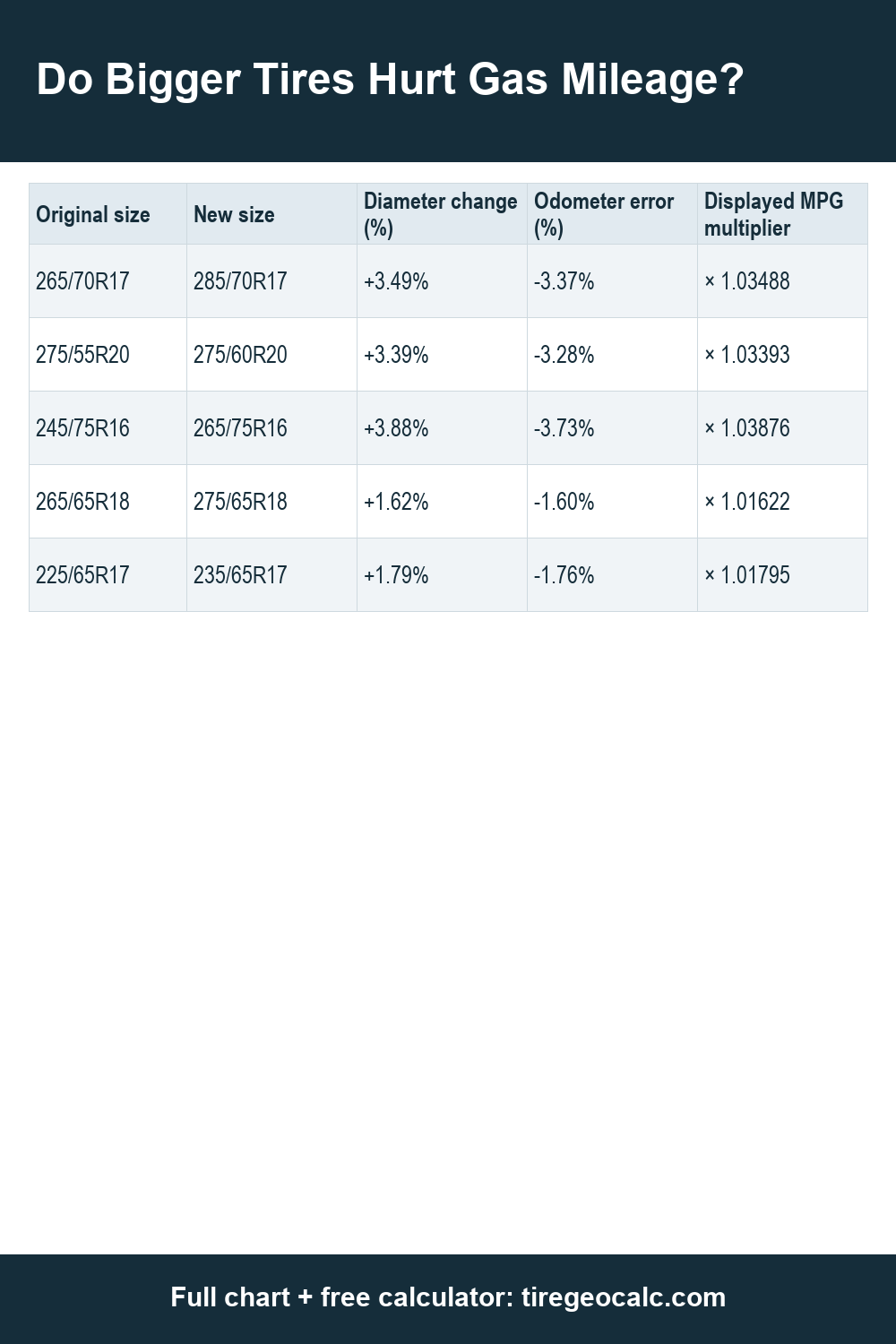
Calculated diameter and odometer effects for five size changes
Original size is the calibration reference. Odometer error is (indicated distance / real distance − 1) × 100; negative means under-counting. Multiply displayed MPG by the listed diameter ratio only when distance remains calibrated to the original size and fuel quantity is measured correctly.
| Original size | New size | Diameter change (%) | Odometer error (%) | Displayed MPG multiplier |
|---|---|---|---|---|
| 265/70R17 | 285/70R17 | +3.49% | -3.37% | × 1.03488 |
| 275/55R20 | 275/60R20 | +3.39% | -3.28% | × 1.03393 |
| 245/75R16 | 265/75R16 | +3.88% | -3.73% | × 1.03876 |
| 265/65R18 | 275/65R18 | +1.62% | -1.60% | × 1.01622 |
| 225/65R17 | 235/65R17 | +1.79% | -1.76% | × 1.01795 |
Original distance calibration assumed; correction is not a prediction of fuel consumption.
- Original size
- 265/70R17
- New size
- 285/70R17
- Diameter change (%)
- +3.49%
- Odometer error (%)
- -3.37%
- Displayed MPG multiplier
- × 1.03488
- Original size
- 275/55R20
- New size
- 275/60R20
- Diameter change (%)
- +3.39%
- Odometer error (%)
- -3.28%
- Displayed MPG multiplier
- × 1.03393
- Original size
- 245/75R16
- New size
- 265/75R16
- Diameter change (%)
- +3.88%
- Odometer error (%)
- -3.73%
- Displayed MPG multiplier
- × 1.03876
- Original size
- 265/65R18
- New size
- 275/65R18
- Diameter change (%)
- +1.62%
- Odometer error (%)
- -1.60%
- Displayed MPG multiplier
- × 1.01622
- Original size
- 225/65R17
- New size
- 235/65R17
- Diameter change (%)
- +1.79%
- Odometer error (%)
- -1.76%
- Displayed MPG multiplier
- × 1.01795
Correct the distance before comparing MPG
MPG is distance divided by fuel used. If the fuel quantity is correct but the indicated distance is too small, calculated MPG is also too small. The geometric correction is MPG real = MPG displayed × diameter new ÷ diameter old. Use the complete original and replacement sizes, keep full precision during division and round only the final result. The same ratio corrects an indicated trip distance.
Diameter growth and odometer error are different percentages because they use different denominators. A diameter increase is measured against the original diameter; odometer error here is measured against true distance. The table computes both explicitly. Its MPG multiplier corrects only this distance component. It does not predict how many gallons the vehicle will consume or restore any efficiency lost through the tire change.
Weight and rolling resistance can change fuel demand
A heavier tire and wheel package requires more energy to accelerate, especially with repeated stops. Tire diameter alone does not reveal assembly mass: compare actual tire and wheel specifications. A larger-looking tire can differ in construction, load category and tread depth, each of which can change mass. The calculator does not contain those product properties, so it cannot turn this mechanism into a percentage MPG loss.
Rolling resistance depends on the specific tire design, compound, tread, inflation and operating conditions. An aggressive tread and different casing can change energy losses even when two tires share the same dimensions. Maintain the pressure specified for the application; do not choose pressure simply to chase a fuel reading. Compare product information and your own controlled records rather than assuming that width alone determines resistance.
Aerodynamics and effective gearing also matter
A wider exposed tire or a change that raises the vehicle can alter airflow. The size of that effect depends on the vehicle, wheel position, speed and body shape. Larger nominal diameter does not by itself quantify drag. Roof loads, wind and driving speed can obscure a tire-related change, so keep those factors comparable when checking fuel records before and after a replacement.
A taller tire also makes the effective final drive taller: each wheel revolution covers more ground. Engine speed at a given road speed can change, but lower engine rpm does not guarantee lower fuel use. Engine load, transmission shifts, terrain and towing conditions influence the result. There is no single tire-diameter multiplier that converts gearing changes into a reliable fuel-consumption prediction for every vehicle.
Measure a before-and-after result consistently
Record fuel added and distance over several comparable fill intervals, using a consistent filling method and similar routes, loads and speeds. Establish whether the vehicle has already been recalibrated for the replacement tires. If it has, applying the original-size correction again would introduce error. Dashboard MPG may also use software estimates that this simple distance model does not describe; a fuel log makes the assumptions clearer.
Nominal geometry is a starting estimate. Manufacturer rolling circumference, tire wear, load and inflation can affect distance per revolution. Use suitable measured distance evidence or matched rolling specifications when available. Compare corrected before-and-after MPG while keeping the uncorrected records too. A remaining difference is an observation under those conditions, not proof that every larger tire produces the same fuel-economy change.
Frequently asked questions
Will bigger tires always reduce MPG?
No universal reduction follows from diameter alone. Assembly weight, rolling resistance, airflow, gearing and driving conditions all matter. This chart estimates the distance-measurement correction and deliberately makes no numerical fuel-use forecast.
Why can displayed MPG fall without an equal real loss?
An unchanged odometer calibration counts fewer miles on taller tires. If fuel measurement is correct, that smaller indicated distance reduces calculated MPG. Correct the distance component before comparing actual fuel economy.
Should I correct MPG after recalibration?
Not with the original-size ratio if the recalibration already accounts for the new tires. First establish the distance reference used by the vehicle or your fuel log. Otherwise you could apply the same correction twice.
Can I use tire width alone for the correction?
No. Calculate overall diameter from the complete size, including aspect ratio and wheel diameter. Two tires with the same width can have different diameters and therefore different distance corrections.
Continue your comparison
These are nominal geometric calculations, not vehicle fitment approval. Check the vehicle manual and exact tire and wheel specifications, including load and speed ratings, approved rim width and clearance; consult the manual for any diameter change exceeding 3%.
Reference tables: Load index chart and Speed rating chart.