 TireGeoCalc
Are Tire Sizes Interchangeable?
Quick answer
Nominal geometryTable example: 225/45R17 → 225/50R17 · original-size calibration assumed
- 225/50R17 diameter
- 25.86in
- Diameter change
- +3.55%
- Actual at indicated 60 mph
- 62.13mph
Calculated from size markings. Not measured rolling dimensions or vehicle fitment approval.
Two tire sizes can be replacement candidates when their overall diameters are close and every wheel and vehicle requirement is satisfied. A difference within plus or minus 3% is a useful initial screen, not permission to install a tire. The table keeps each original size beside its candidate so you can see exactly what changed. These are nominal geometric calculations, not vehicle fitment approval. Check the vehicle manual and exact tire and wheel specifications, including load and speed ratings, approved rim width and clearance; consult the manual for any diameter change exceeding 3%.
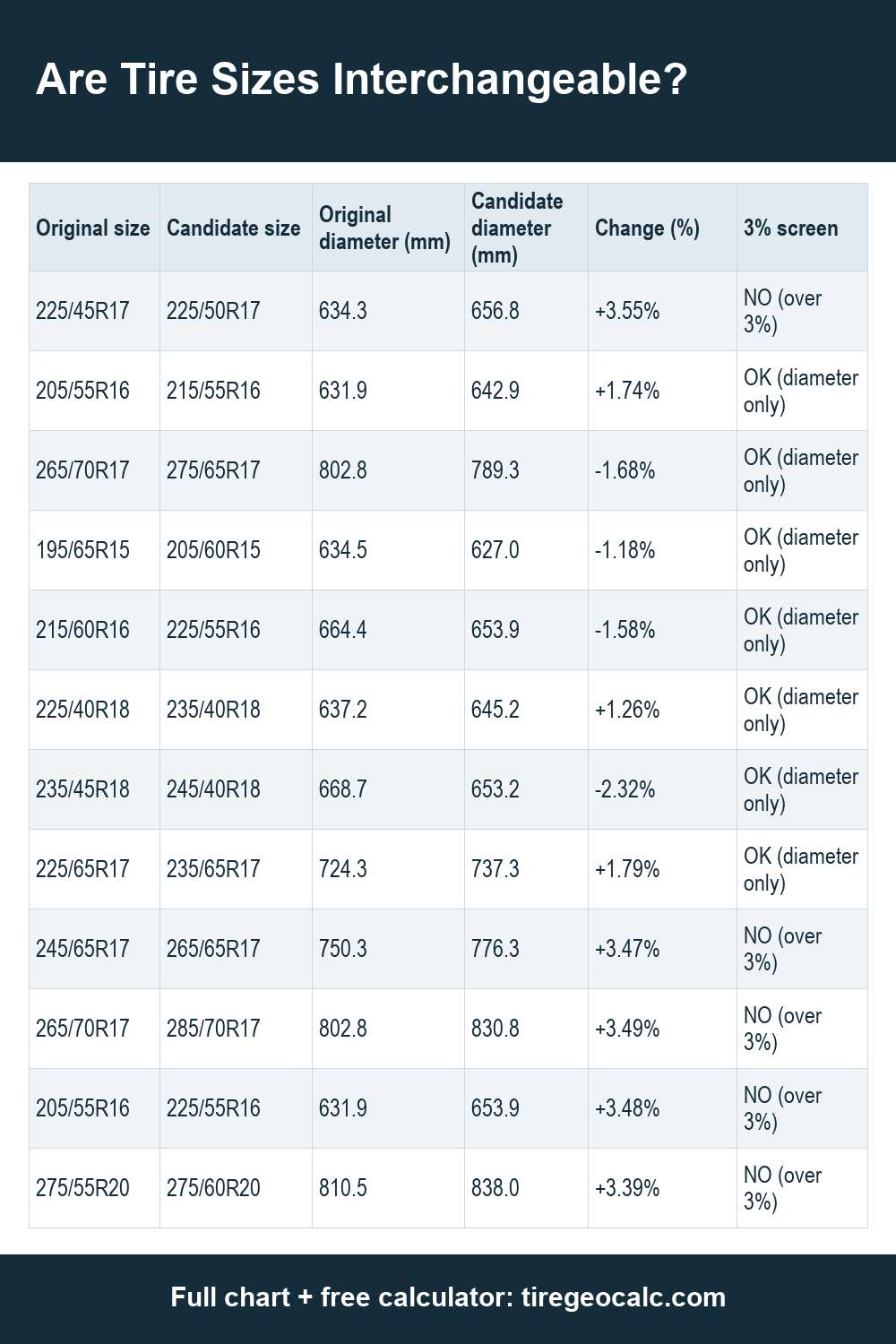
12 tire size pairs: diameter comparison
Read left to right: original size first, candidate second. Percentage change uses the original diameter as its denominator. OK means the nominal diameter change is within ±3% only; NO means it exceeds 3%. Neither label confirms vehicle compatibility. All pairs use the same bead-seat diameter, but their approved rim-width ranges still need checking.
| Original size | Candidate size | Original diameter (mm) | Candidate diameter (mm) | Change (%) | 3% screen |
|---|---|---|---|---|---|
| 225/45R17 | 225/50R17 | 634.3 | 656.8 | +3.55% | NO (over 3%) |
| 205/55R16 | 215/55R16 | 631.9 | 642.9 | +1.74% | OK (diameter only) |
| 265/70R17 | 275/65R17 | 802.8 | 789.3 | -1.68% | OK (diameter only) |
| 195/65R15 | 205/60R15 | 634.5 | 627.0 | -1.18% | OK (diameter only) |
| 215/60R16 | 225/55R16 | 664.4 | 653.9 | -1.58% | OK (diameter only) |
| 225/40R18 | 235/40R18 | 637.2 | 645.2 | +1.26% | OK (diameter only) |
| 235/45R18 | 245/40R18 | 668.7 | 653.2 | -2.32% | OK (diameter only) |
| 225/65R17 | 235/65R17 | 724.3 | 737.3 | +1.79% | OK (diameter only) |
| 245/65R17 | 265/65R17 | 750.3 | 776.3 | +3.47% | NO (over 3%) |
| 265/70R17 | 285/70R17 | 802.8 | 830.8 | +3.49% | NO (over 3%) |
| 205/55R16 | 225/55R16 | 631.9 | 653.9 | +3.48% | NO (over 3%) |
| 275/55R20 | 275/60R20 | 810.5 | 838.0 | +3.39% | NO (over 3%) |
OK is a diameter screen only, not fitment approval. Original to candidate direction.
- Original size
- 225/45R17
- Candidate size
- 225/50R17
- Original diameter (mm)
- 634.3
- Candidate diameter (mm)
- 656.8
- Change (%)
- +3.55%
- 3% screen
- NO (over 3%)
- Original size
- 205/55R16
- Candidate size
- 215/55R16
- Original diameter (mm)
- 631.9
- Candidate diameter (mm)
- 642.9
- Change (%)
- +1.74%
- 3% screen
- OK (diameter only)
- Original size
- 265/70R17
- Candidate size
- 275/65R17
- Original diameter (mm)
- 802.8
- Candidate diameter (mm)
- 789.3
- Change (%)
- -1.68%
- 3% screen
- OK (diameter only)
- Original size
- 195/65R15
- Candidate size
- 205/60R15
- Original diameter (mm)
- 634.5
- Candidate diameter (mm)
- 627.0
- Change (%)
- -1.18%
- 3% screen
- OK (diameter only)
- Original size
- 215/60R16
- Candidate size
- 225/55R16
- Original diameter (mm)
- 664.4
- Candidate diameter (mm)
- 653.9
- Change (%)
- -1.58%
- 3% screen
- OK (diameter only)
- Original size
- 225/40R18
- Candidate size
- 235/40R18
- Original diameter (mm)
- 637.2
- Candidate diameter (mm)
- 645.2
- Change (%)
- +1.26%
- 3% screen
- OK (diameter only)
- Original size
- 235/45R18
- Candidate size
- 245/40R18
- Original diameter (mm)
- 668.7
- Candidate diameter (mm)
- 653.2
- Change (%)
- -2.32%
- 3% screen
- OK (diameter only)
- Original size
- 225/65R17
- Candidate size
- 235/65R17
- Original diameter (mm)
- 724.3
- Candidate diameter (mm)
- 737.3
- Change (%)
- +1.79%
- 3% screen
- OK (diameter only)
- Original size
- 245/65R17
- Candidate size
- 265/65R17
- Original diameter (mm)
- 750.3
- Candidate diameter (mm)
- 776.3
- Change (%)
- +3.47%
- 3% screen
- NO (over 3%)
- Original size
- 265/70R17
- Candidate size
- 285/70R17
- Original diameter (mm)
- 802.8
- Candidate diameter (mm)
- 830.8
- Change (%)
- +3.49%
- 3% screen
- NO (over 3%)
- Original size
- 205/55R16
- Candidate size
- 225/55R16
- Original diameter (mm)
- 631.9
- Candidate diameter (mm)
- 653.9
- Change (%)
- +3.48%
- 3% screen
- NO (over 3%)
- Original size
- 275/55R20
- Candidate size
- 275/60R20
- Original diameter (mm)
- 810.5
- Candidate diameter (mm)
- 838.0
- Change (%)
- +3.39%
- 3% screen
- NO (over 3%)
Start with the wheel you actually have
The final number in a metric size identifies wheel diameter in inches. A tire marked R17 needs a 17-inch bead seat; it cannot mount on a 16-inch or 18-inch wheel. For a replacement on your existing wheels, this number must stay the same. Changing wheels is a separate package comparison involving brake clearance, offset, bolt pattern and other specifications.
Matching wheel diameter does not settle wheel width. Read the approved rim-width range for each exact tire model and confirm that your actual wheel width falls inside both ranges. A wider section may be allowed on some wheels but outside the range on others. Do not infer an approved range from this table: size markings alone do not include the necessary product information.
Use the diameter screen in the correct direction
Overall diameter adds two sidewalls to the wheel diameter. One sidewall is section width multiplied by aspect ratio divided by 100; wheel diameter is converted using 25.4 millimeters per inch. The tire engine calculates both full-precision diameters before calculating the percentage. Displayed values are rounded only after the calculation, so a rounded figure should not decide a borderline case.
The 225/45R17 to 225/50R17 pair keeps width and wheel diameter unchanged, yet increasing the aspect ratio adds height twice, once above and once below the wheel. It exceeds the screen. The 205/55R16 to 215/55R16 pair instead changes section width, which also changes sidewall height because 55 is a percentage of width. The pickup example 265/70R17 to 275/65R17 combines a wider section with a lower aspect ratio.
Reversing the sizes changes the reference diameter and therefore the percentage. Use the documented original size as the starting point for every candidate. A taller tire makes the speedometer show less than the actual speed under the original-size calibration assumption; in the UK/EU the speedometer must not indicate below actual speed. Existing calibration affects the real result, so this table cannot certify speedometer compliance.
Check load and speed before comparing prices
The size code does not include the complete service description. Check that replacement load index and speed rating are equal to or higher than the vehicle requirements and the original specified ratings. Read the actual sidewall and product specification rather than assuming that a larger tire carries more weight. Construction, reinforcement and inflation conditions also matter to the usable load capacity.
Two products carrying the same size can have different service descriptions. Confirm the required pressure using vehicle and tire documentation; a nominal diameter calculation does not produce a pressure recommendation. If the candidate uses a different load category or construction, ask a qualified tire professional to reconcile the specifications before ordering. A shopping link is simply a way to browse products, not a declaration that those products fit.
Finish the vehicle checks before installation
Check clearance at full steering lock and through suspension travel, including space near struts, fenders and brake components. Extra width and extra height occupy different areas. Nominal calculations cannot model your wheel offset, bodywork, suspension modifications or the exact tire shape. Manufacturer dimensions may vary from the ideal geometric diameter used here, particularly when measured on a different rim width.
Use the vehicle-approved axle arrangement. An original staggered setup needs its front and rear requirements assessed separately; an AWD vehicle may impose a much tighter rolling-circumference tolerance than this general screen. Do not use the OK label to justify mixing sizes across an axle or bypassing drivetrain instructions. Record the complete original and proposed specifications, then use the alternatives tool and calculator below to investigate candidates consistently.
Frequently asked questions
Does OK mean these tires are interchangeable?
It means only that the calculated diameter change is within ±3%. Same wheel diameter, an overlapping approved rim-width range containing your wheel width, suitable service ratings and vehicle-specific requirements still have to be satisfied.
Can I change width while keeping the same aspect ratio?
Width also changes sidewall height because aspect ratio is a percentage. Compare both complete size codes; then check the exact product rim-width ranges and lateral clearance.
Why is a difference over 3% marked NO?
It fails this general geometric screen. NO is a prompt to stop treating that pair as a close-diameter replacement. The vehicle documentation remains the authority for any approved size change.
Can a close size affect driving instruments?
Yes. Changed circumference changes distance traveled per revolution and the relationship used for speed and odometer calculations. The calculator estimates the geometric change, while actual instrument behavior requires vehicle-specific verification.
Continue your comparison
These are nominal geometric calculations, not vehicle fitment approval. Check the vehicle manual and exact tire and wheel specifications, including load and speed ratings, approved rim width and clearance; consult the manual for any diameter change exceeding 3%.
Reference tables: Load index chart and Speed rating chart.