 TireGeoCalc
33x12.50R18 vs 295/70R18: Height, Width and Speed
Quick answer
Nominal geometry33X12.50R18 → 295/70R18 · original-size calibration assumed
- Diameter difference
- +1.26in
- Diameter change
- +3.82%
- Actual at indicated 60 mph
- 62.29mph
Calculated from size markings. Not measured rolling dimensions or vehicle fitment approval.
Published
33x12.50R18 vs 295/70R18 compares a flotation size with a metric size. The first directly states a nominal overall height and width in inches; the second needs width and sidewall calculations to obtain outside height. Both use the same wheel diameter. This guide converts the two systems into common units before comparing speed, ideal radius and the space each assembly occupies.
Calculated dimensions and changes from the original tire
The first row, 33x12.50R18, is the original reference. All dimensions come from the tire geometry engine. Candidate percentages and speed results use that same original; figures are rounded only for display.
| Tire size | Width (mm) | Width (in) | Sidewall (mm) | Sidewall (in) | Wheel (mm) | Wheel (in) | Diameter (mm) | Diameter (in) | Circumference (mm) | Circumference (in) | Revolutions / mile | Revolutions / km | Diameter change (%) | Actual at indicated 30 mph | Actual at indicated 60 mph | Actual at indicated 75 mph | Actual minus indicated at 60 mph |
|---|---|---|---|---|---|---|---|---|---|---|---|---|---|---|---|---|---|
| 33x12.50R18 | 317.5 | 12.5 | 190.5 | 7.5 | 457.2 | 18 | 838.2 | 33 | 2633.3 | 103.67 | 611.2 | 379.8 | 0 | 30 | 60 | 75 | 0 |
| 295/70R18 | 295 | 11.61 | 206.5 | 8.13 | 457.2 | 18 | 870.2 | 34.26 | 2733.8 | 107.63 | 588.7 | 365.8 | 3.82 | 31.1 | 62.3 | 77.9 | 2.3 |
Nominal size-code geometry. Reference: 33x12.50R18. Display rounding only; not fitment approval.
- Tire size
- 33x12.50R18
- Width (mm)
- 317.5
- Width (in)
- 12.5
- Sidewall (mm)
- 190.5
- Sidewall (in)
- 7.5
- Wheel (mm)
- 457.2
- Wheel (in)
- 18
- Diameter (mm)
- 838.2
- Diameter (in)
- 33
- Circumference (mm)
- 2633.3
- Circumference (in)
- 103.67
- Revolutions / mile
- 611.2
- Revolutions / km
- 379.8
- Diameter change (%)
- 0
- Actual at indicated 30 mph
- 30
- Actual at indicated 60 mph
- 60
- Actual at indicated 75 mph
- 75
- Actual minus indicated at 60 mph
- 0
- Tire size
- 295/70R18
- Width (mm)
- 295
- Width (in)
- 11.61
- Sidewall (mm)
- 206.5
- Sidewall (in)
- 8.13
- Wheel (mm)
- 457.2
- Wheel (in)
- 18
- Diameter (mm)
- 870.2
- Diameter (in)
- 34.26
- Circumference (mm)
- 2733.8
- Circumference (in)
- 107.63
- Revolutions / mile
- 588.7
- Revolutions / km
- 365.8
- Diameter change (%)
- 3.82
- Actual at indicated 30 mph
- 31.1
- Actual at indicated 60 mph
- 62.3
- Actual at indicated 75 mph
- 77.9
- Actual minus indicated at 60 mph
- 2.3
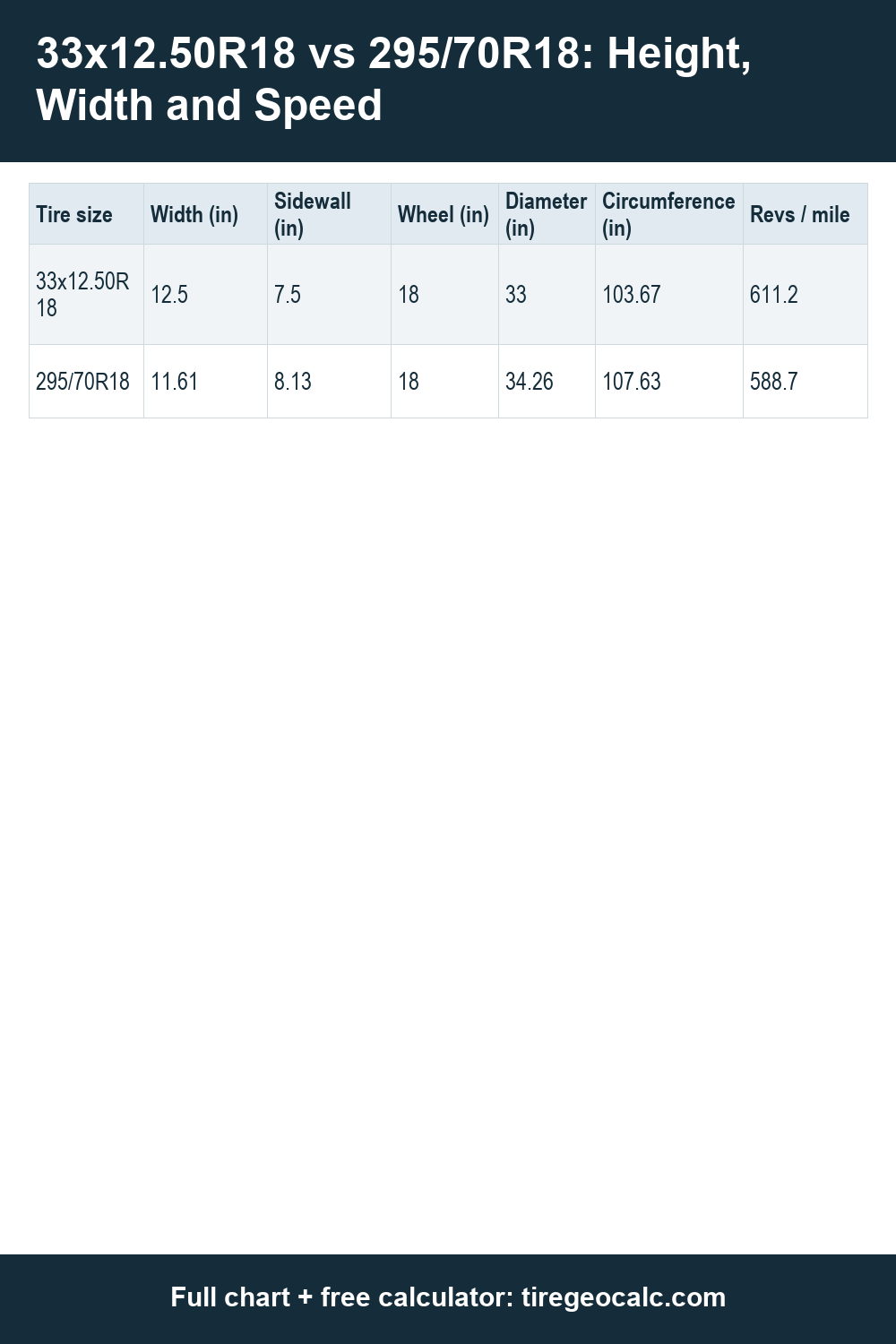
The calculated change from 33x12.50R18 to 295/70R18
Using 33x12.50R18 as original, 295/70R18 changes nominal diameter from 33.00 to 34.26 inches. The difference is +32.00 mm, or +3.82% of the original diameter. Nominal section width changes by -22.50 mm and one sidewall changes by +16.00 mm. Those figures are calculated from the complete markings. They describe different dimensions, so a diameter result cannot stand in for a lateral clearance result.
The ideal radius difference is +16.00 mm (+0.63 inches). This is the geometric contribution to wheel center height, not a verified loaded ground clearance change. At an indicated 60 mph, the candidate gives a theoretical 62.29 mph actual speed, or +2.29 mph actual minus indicated. The assumption is calibration to the original circumference with no other instrument error; actual vehicle readings require their own evidence.
A flotation label and a metric truck label in common units
A flotation height label and a metric width label are not numbers of the same kind. The leading number in the flotation code describes nominal diameter, while the metric leading number describes section width. Comparing them directly has no dimensional meaning. Read the common unit table first, then compare the calculated heights and widths as separate properties. The shared wheel diameter does not make the two markings equivalent.
This pair is particularly useful for a truck owner moving between catalog naming systems. Preserve the full product marking, including construction and service information, because the shorter marketing description may omit it. A flotation nominal height is not a guarantee of the exact measured height of every model carrying that label. Use the product sheet when the real envelope matters to clearance or a spare arrangement.
Keep circumference, calibration and mounting separate
Circumference is calculated from diameter, and the candidate to original circumference ratio gives the theoretical actual speed multiplier. A taller circle travels farther per revolution, while a shorter one travels less. Reversing original and candidate changes the percentage denominator. Do not reverse this comparison by simply changing the sign of a rounded result; enter the actual original in the calculator and compute the other direction directly.
These calculations describe an ideal circle rather than a loaded rolling test. Exact product dimensions, wear, inflation and load can affect the real assembly. Wheel diameter matching does not establish an approved rim width, offset or vehicle clearance. Keep the actual tire model and complete service markings in the comparison record, and check the vehicle instructions if the dimensional change is outside its specified equipment.
What this pair means for the actual assembly
The wider looking flotation notation should not be assumed to identify the taller candidate. The metric tire's diameter is calculated from its own width, ratio and wheel. The table fixes the flotation size as original, so all percentage and speed results follow that direction. If the installed original is actually the metric tire, reverse the inputs rather than applying this signed percentage unchanged.
For a modified pickup or utility vehicle, evaluate wheel width, offset and movement clearance using the exact products. A shared bead seat diameter answers only one mounting question. The broader or taller part of an assembly can approach different obstacles. Keep the ideal radius difference distinct from any lift, trim or wheel change, and avoid treating a rounded height label as a complete installation plan.
Frequently asked questions
Does the flotation height label guarantee an exact measured diameter?
No. It is a nominal size designation. The exact tire model's published dimensions and measurement conditions are needed when real outside height or clearance is important.
Do the speed and radius figures establish real vehicle fitment?
No. They describe nominal geometry under a stated reference assumption. The exact tire and wheel, vehicle specifications and clearance through movement must be assessed separately; loaded dimensions and instrument behavior are not measured here.
What changes if 33x12.50R18 is the replacement rather than the original?
Reverse the inputs in the calculator. Percentage change uses the original diameter as denominator, and theoretical speed uses candidate circumference divided by original circumference. A reversed comparison therefore needs a fresh calculation rather than only a changed sign on the displayed percentage.
Continue your comparison
These are nominal geometric calculations, not vehicle fitment approval. Check the vehicle manual and exact tire and wheel specifications, including load and speed ratings, approved rim width and clearance; consult the manual for any diameter change exceeding 3%.
Reference tables: Load index chart and Speed rating chart.