 TireGeoCalc
295/60R20 vs 305/55R20: Size and Speed Changes
Quick answer
Nominal geometry295/60R20 → 305/55R20 · original-size calibration assumed
- Diameter difference
- -0.73in
- Diameter change
- -2.15%
- Actual at indicated 60 mph
- 58.71mph
Calculated from size markings. Not measured rolling dimensions or vehicle fitment approval.
Published
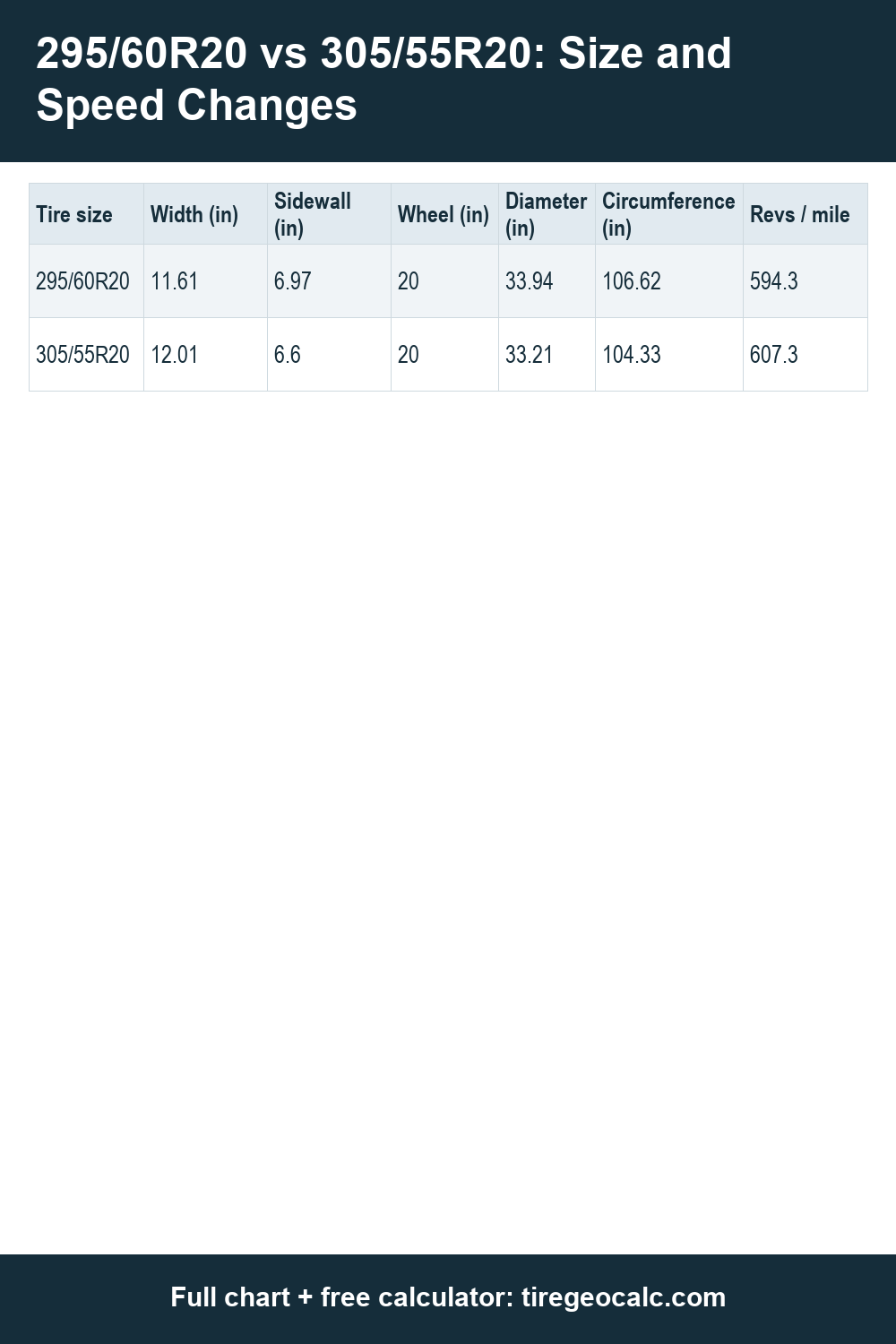
295/60R20 versus 305/55R20 is a pickup and large SUV oriented comparison in which more width comes with less height. Both tires use a twenty inch wheel. The drop from sixty to fifty five percent outweighs the wider section, so the candidate is a different proportion rather than a uniformly larger tire. Read the first size as the original throughout this comparison, including the speed and radius examples below.
Calculated tire dimensions and changes from the original
The first row, 295/60R20, is the original reference. All measurements are derived from the tire geometry engine. Percentages and theoretical speed values keep that same original throughout; rounding is for display only.
| Tire size | Width (mm) | Width (in) | Sidewall (mm) | Sidewall (in) | Wheel (mm) | Wheel (in) | Diameter (mm) | Diameter (in) | Circumference (mm) | Circumference (in) | Revolutions / mile | Revolutions / km | Diameter change (%) | Actual at indicated 30 mph | Actual at indicated 60 mph | Actual at indicated 75 mph | Actual minus indicated at 60 mph |
|---|---|---|---|---|---|---|---|---|---|---|---|---|---|---|---|---|---|
| 295/60R20 | 295 | 11.61 | 177 | 6.97 | 508 | 20 | 862 | 33.94 | 2708.1 | 106.62 | 594.3 | 369.3 | 0 | 30 | 60 | 75 | 0 |
| 305/55R20 | 305 | 12.01 | 167.8 | 6.6 | 508 | 20 | 843.5 | 33.21 | 2649.9 | 104.33 | 607.3 | 377.4 | -2.15 | 29.4 | 58.7 | 73.4 | -1.3 |
Nominal size-code geometry. Reference: 295/60R20. Display rounding only; not fitment approval.
- Tire size
- 295/60R20
- Width (mm)
- 295
- Width (in)
- 11.61
- Sidewall (mm)
- 177
- Sidewall (in)
- 6.97
- Wheel (mm)
- 508
- Wheel (in)
- 20
- Diameter (mm)
- 862
- Diameter (in)
- 33.94
- Circumference (mm)
- 2708.1
- Circumference (in)
- 106.62
- Revolutions / mile
- 594.3
- Revolutions / km
- 369.3
- Diameter change (%)
- 0
- Actual at indicated 30 mph
- 30
- Actual at indicated 60 mph
- 60
- Actual at indicated 75 mph
- 75
- Actual minus indicated at 60 mph
- 0
- Tire size
- 305/55R20
- Width (mm)
- 305
- Width (in)
- 12.01
- Sidewall (mm)
- 167.8
- Sidewall (in)
- 6.6
- Wheel (mm)
- 508
- Wheel (in)
- 20
- Diameter (mm)
- 843.5
- Diameter (in)
- 33.21
- Circumference (mm)
- 2649.9
- Circumference (in)
- 104.33
- Revolutions / mile
- 607.3
- Revolutions / km
- 377.4
- Diameter change (%)
- -2.15
- Actual at indicated 30 mph
- 29.4
- Actual at indicated 60 mph
- 58.7
- Actual at indicated 75 mph
- 73.4
- Actual minus indicated at 60 mph
- -1.3
A wider truck candidate with less sidewall and less height
The original's broad section is multiplied by a relatively tall ratio. Increasing width while lowering that ratio creates a shorter candidate sidewall. With the wheel held fixed, two shorter sidewalls reduce outside diameter and ideal radius. The resulting theoretical actual speed decreases under original calibration, despite the larger first number in the candidate code.
This pair is particularly useful when two products are described using the same approximate inch class. A rounded label can hide a meaningful diameter difference and a separate width difference. Preserve the original metric markings and compare exact product dimensions rather than choosing by a nickname. Neither nominal circle is a measured loaded truck tire.
Speed, radius and wheel position in this pair
Starting from 295/60R20, the candidate 305/55R20 has 33.21 inches of calculated height instead of 33.94. Its -18.50 mm diameter change amounts to -2.15% of the original. The speed example follows the same ratio: a 60 mph indication becomes 58.71 mph theoretically, while 75 indicated becomes 73.39 mph. Reversing the original and candidate would change the denominator, so a return to the first size requires a fresh calculation rather than merely reversing a rounded percentage sign.
A pickup owner seeking greater radius should notice that 305/55R20 gives up 9.25 mm of sidewall relative to 295/60R20. The unchanged twenty inch center leaves a 18.50 mm diameter loss and 9.25 mm reduction in ideal wheel center height. Its 305 mm section is broader, so that lower circle does not guarantee improved clearance beside the shoulder. Researching the candidate may make sense for a documented lower wider proportion, while the original retains more nominal radius. Neither choice determines towing capacity or operating pressure; those questions require the vehicle and exact product specifications rather than a width nickname.
Put the dimensional result in context
If the vehicle is used for carrying or towing, retain its documented tire and wheel requirements throughout the research. A broader tire is not evidence of greater usable load capacity, and geometry cannot choose pressure. Record service descriptions, wheel capacity and approved rim ranges with the actual products. Then use the nominal changes as part of a complete assessment of the intended assembly.
Frequently asked questions
Would the wider candidate increase my towing clearance or capacity?
Changing 295/60R20 to 305/55R20 reduces nominal radius while adding section width. A pickup owner seeking under axle clearance would therefore not gain it from this geometric change. Someone researching a broader lower profile may still investigate the candidate if the documented requirements allow it. Keeping the original retains the taller nominal circle; neither option raises the vehicle's towing or payload rating. Compare complete service markings, exact wheel capacity and product requirements before buying, rather than inferring a carrying benefit from the candidate's larger width number.
Which distance definition accompanies the revolution count for 295/60R20?
The nominal circle covers 106.62 inches per revolution, giving 594.28 turns over a mile. These figures derive from 862.00 mm of outside diameter before rounding. A manufacturer's rolling figure may use specified operating conditions, so keep that product information distinct from the size code calculation instead of mixing the two definitions in one comparison.
Can two tires in the same rounded truck class differ meaningfully here?
The original and candidate may be described using similar approximate inch language, yet the broader candidate loses nominal radius. Preserve both complete metric codes so that the width gain and height loss stay visible. A pickup owner comparing products for carrying use also needs their full service markings and actual wheel requirements rather than an approximate class nickname.
Continue your comparison
These are nominal geometric calculations, not vehicle fitment approval. Check the vehicle manual and exact tire and wheel specifications, including load and speed ratings, approved rim width and clearance; consult the manual for any diameter change exceeding 3%.
Reference tables: Load index chart and Speed rating chart.