 TireGeoCalc
285/75R16 vs 305/70R16: Height, Width and Speed
Quick answer
Nominal geometry285/75R16 → 305/70R16 · original-size calibration assumed
- Diameter difference
- -0.02in
- Diameter change
- -0.06%
- Actual at indicated 60 mph
- 59.96mph
Calculated from size markings. Not measured rolling dimensions or vehicle fitment approval.
Published
285/75R16 vs 305/70R16 compares two tall truck tire proportions around the same wheel opening. The candidate is considerably broader in its label but has a lower aspect ratio. That combination is a useful reminder to calculate before calling a tire taller. The table follows both inputs and distinguishes a close diameter relationship from the broader casing's mounting and clearance requirements.
Calculated dimensions and changes from the original tire
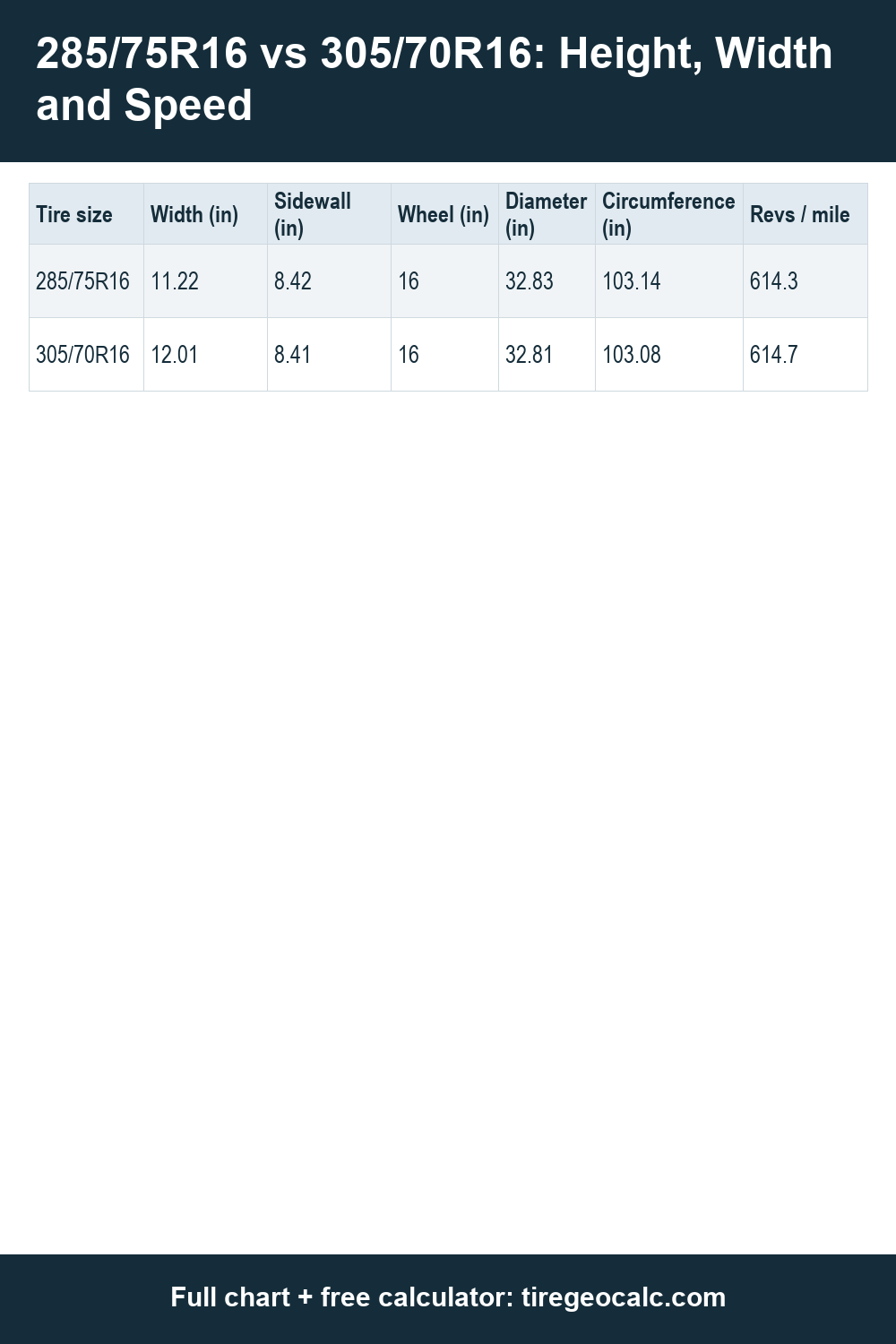
The first row, 285/75R16, is the original reference. All dimensions come from the tire geometry engine. Candidate percentages and speed results use that same original; figures are rounded only for display.
| Tire size | Width (mm) | Width (in) | Sidewall (mm) | Sidewall (in) | Wheel (mm) | Wheel (in) | Diameter (mm) | Diameter (in) | Circumference (mm) | Circumference (in) | Revolutions / mile | Revolutions / km | Diameter change (%) | Actual at indicated 30 mph | Actual at indicated 60 mph | Actual at indicated 75 mph | Actual minus indicated at 60 mph |
|---|---|---|---|---|---|---|---|---|---|---|---|---|---|---|---|---|---|
| 285/75R16 | 285 | 11.22 | 213.8 | 8.42 | 406.4 | 16 | 833.9 | 32.83 | 2619.8 | 103.14 | 614.3 | 381.7 | 0 | 30 | 60 | 75 | 0 |
| 305/70R16 | 305 | 12.01 | 213.5 | 8.41 | 406.4 | 16 | 833.4 | 32.81 | 2618.2 | 103.08 | 614.7 | 381.9 | -0.06 | 30 | 60 | 75 | 0 |
Nominal size-code geometry. Reference: 285/75R16. Display rounding only; not fitment approval.
- Tire size
- 285/75R16
- Width (mm)
- 285
- Width (in)
- 11.22
- Sidewall (mm)
- 213.8
- Sidewall (in)
- 8.42
- Wheel (mm)
- 406.4
- Wheel (in)
- 16
- Diameter (mm)
- 833.9
- Diameter (in)
- 32.83
- Circumference (mm)
- 2619.8
- Circumference (in)
- 103.14
- Revolutions / mile
- 614.3
- Revolutions / km
- 381.7
- Diameter change (%)
- 0
- Actual at indicated 30 mph
- 30
- Actual at indicated 60 mph
- 60
- Actual at indicated 75 mph
- 75
- Actual minus indicated at 60 mph
- 0
- Tire size
- 305/70R16
- Width (mm)
- 305
- Width (in)
- 12.01
- Sidewall (mm)
- 213.5
- Sidewall (in)
- 8.41
- Wheel (mm)
- 406.4
- Wheel (in)
- 16
- Diameter (mm)
- 833.4
- Diameter (in)
- 32.81
- Circumference (mm)
- 2618.2
- Circumference (in)
- 103.08
- Revolutions / mile
- 614.7
- Revolutions / km
- 381.9
- Diameter change (%)
- -0.06
- Actual at indicated 30 mph
- 30
- Actual at indicated 60 mph
- 60
- Actual at indicated 75 mph
- 75
- Actual minus indicated at 60 mph
- 0
Tall truck tires with competing width and ratio changes
The sidewall products are the key to this pair. Compare width multiplied by ratio for each tire, rather than comparing the middle numbers on their own. The same wheel diameter then allows a direct outside height comparison. Width can change much more noticeably than height here, which is why the nominal speed effect and the practical side clearance question may have very different significance.
For an off road pickup or utility vehicle, a broad casing should be checked against the specific wheel's approved tire range. A wheel used with the first size is not automatically approved for the second model and size. If a different wheel is introduced, record its offset and rating separately. The tire code does not reveal either property, nor does it determine where the wider shoulders will sit.
The calculated change from 285/75R16 to 305/70R16
Using 285/75R16 as original, 305/70R16 changes nominal diameter from 32.83 to 32.81 inches. The difference is -0.50 mm, or -0.06% of the original diameter. Nominal section width changes by +20.00 mm and one sidewall changes by -0.25 mm. Those figures are calculated from the complete markings. They describe different dimensions, so a diameter result cannot stand in for a lateral clearance result.
The ideal radius difference is -0.25 mm (-0.01 inches). This is the geometric contribution to wheel center height, not a verified loaded ground clearance change. At an indicated 60 mph, the candidate gives a theoretical 59.96 mph actual speed, or -0.04 mph actual minus indicated. The assumption is calibration to the original circumference with no other instrument error; actual vehicle readings require their own evidence.
What this pair means for the actual assembly
A nearly matched diameter does not promise matching measured outside height across all tire models. Deep tread, construction and the published measuring setup can affect product dimensions. Keep nominal results and actual specification values together without merging them. If a clearance margin is tight enough for those differences to matter, a generic size calculation is only the starting screen, not the final measurement.
Do not treat nominal similarity as evidence for equivalent weight, rolling resistance or road behavior. A wider candidate may be built differently, and the geometry contains none of those details. Likewise, preserving circumference does not establish loading suitability. Check the vehicle's service requirements and the actual tire information before interpreting this as a practical alternative rather than simply a close shape comparison.
Keep circumference, calibration and mounting separate
Circumference is calculated from diameter, and the candidate to original circumference ratio gives the theoretical actual speed multiplier. A taller circle travels farther per revolution, while a shorter one travels less. Reversing original and candidate changes the percentage denominator. Do not reverse this comparison by simply changing the sign of a rounded result; enter the actual original in the calculator and compute the other direction directly.
These calculations describe an ideal circle rather than a loaded rolling test. Exact product dimensions, wear, inflation and load can affect the real assembly. Wheel diameter matching does not establish an approved rim width, offset or vehicle clearance. Keep the actual tire model and complete service markings in the comparison record, and check the vehicle instructions if the dimensional change is outside its specified equipment.
Frequently asked questions
Can a visibly wider truck tire have a closely matched diameter?
Yes. A reduced aspect ratio can offset much of the width increase in the sidewall calculation. That leaves the lateral mounting question unresolved even when circumference and speed changes are small.
Do the speed and radius figures establish real vehicle fitment?
No. They describe nominal geometry under a stated reference assumption. The exact tire and wheel, vehicle specifications and clearance through movement must be assessed separately; loaded dimensions and instrument behavior are not measured here.
What changes if 285/75R16 is the replacement rather than the original?
Reverse the inputs in the calculator. Percentage change uses the original diameter as denominator, and theoretical speed uses candidate circumference divided by original circumference. A reversed comparison therefore needs a fresh calculation rather than only a changed sign on the displayed percentage.
Continue your comparison
These are nominal geometric calculations, not vehicle fitment approval. Check the vehicle manual and exact tire and wheel specifications, including load and speed ratings, approved rim width and clearance; consult the manual for any diameter change exceeding 3%.
Reference tables: Load index chart and Speed rating chart.