 TireGeoCalc
285/70R18 vs 295/65R18: Size and Speed Changes
Quick answer
Nominal geometry285/70R18 → 295/65R18 · original-size calibration assumed
- Diameter difference
- -0.61in
- Diameter change
- -1.81%
- Actual at indicated 60 mph
- 58.91mph
Calculated from size markings. Not measured rolling dimensions or vehicle fitment approval.
Published
The change from 285/70R18 to 295/65R18 increases nominal section width and lowers the sidewall ratio on the same eighteen inch wheel. It is useful for pickup and large SUV tire research because the wider candidate is shorter. Calling it bigger would obscure the most important dimensional trade in the pair. Read the first size as the original throughout this comparison, including the speed and radius examples below.
Calculated tire dimensions and changes from the original
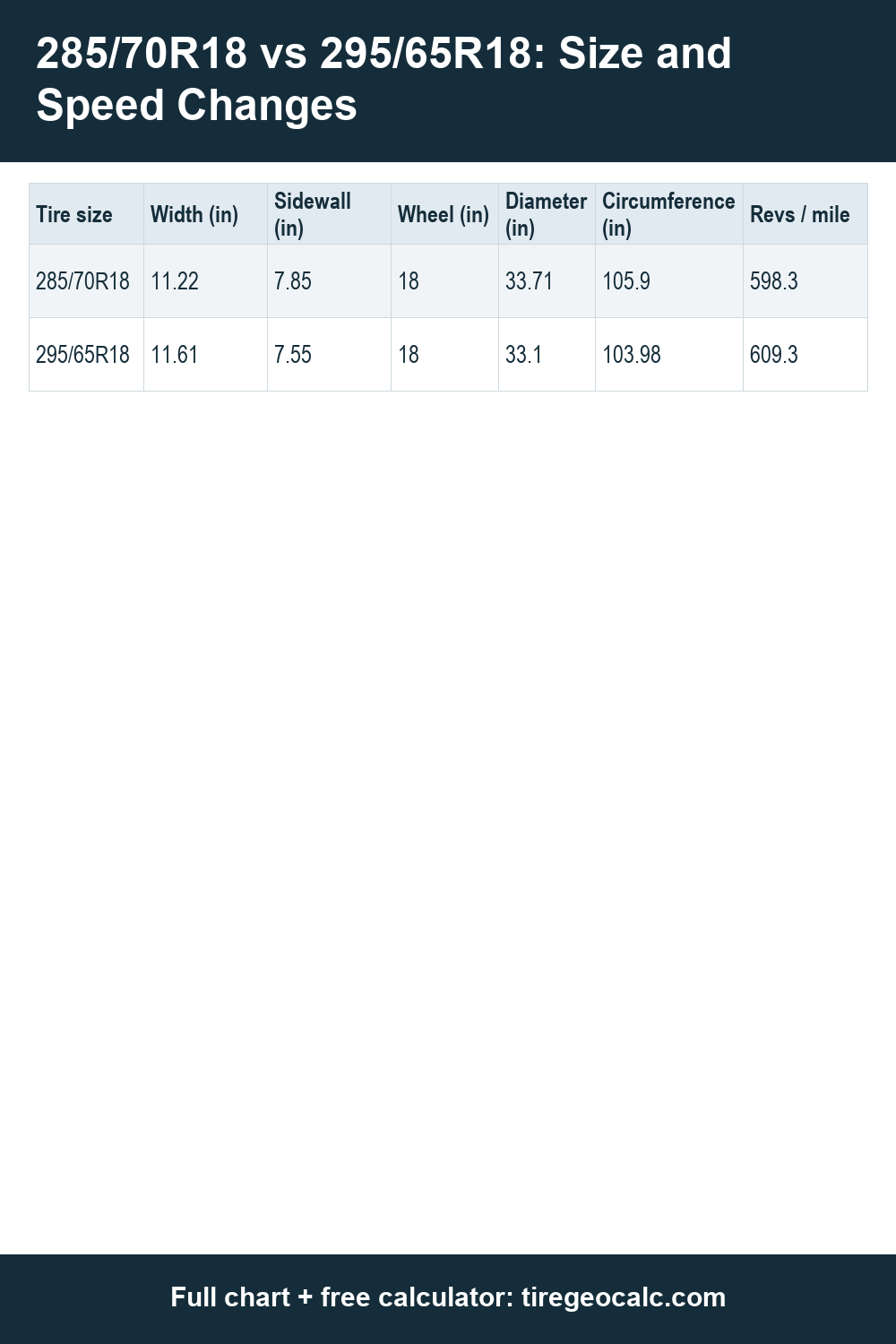
The first row, 285/70R18, is the original reference. All measurements are derived from the tire geometry engine. Percentages and theoretical speed values keep that same original throughout; rounding is for display only.
| Tire size | Width (mm) | Width (in) | Sidewall (mm) | Sidewall (in) | Wheel (mm) | Wheel (in) | Diameter (mm) | Diameter (in) | Circumference (mm) | Circumference (in) | Revolutions / mile | Revolutions / km | Diameter change (%) | Actual at indicated 30 mph | Actual at indicated 60 mph | Actual at indicated 75 mph | Actual minus indicated at 60 mph |
|---|---|---|---|---|---|---|---|---|---|---|---|---|---|---|---|---|---|
| 285/70R18 | 285 | 11.22 | 199.5 | 7.85 | 457.2 | 18 | 856.2 | 33.71 | 2689.8 | 105.9 | 598.3 | 371.8 | 0 | 30 | 60 | 75 | 0 |
| 295/65R18 | 295 | 11.61 | 191.8 | 7.55 | 457.2 | 18 | 840.7 | 33.1 | 2641.1 | 103.98 | 609.3 | 378.6 | -1.81 | 29.5 | 58.9 | 73.6 | -1.1 |
Nominal size-code geometry. Reference: 285/70R18. Display rounding only; not fitment approval.
- Tire size
- 285/70R18
- Width (mm)
- 285
- Width (in)
- 11.22
- Sidewall (mm)
- 199.5
- Sidewall (in)
- 7.85
- Wheel (mm)
- 457.2
- Wheel (in)
- 18
- Diameter (mm)
- 856.2
- Diameter (in)
- 33.71
- Circumference (mm)
- 2689.8
- Circumference (in)
- 105.9
- Revolutions / mile
- 598.3
- Revolutions / km
- 371.8
- Diameter change (%)
- 0
- Actual at indicated 30 mph
- 30
- Actual at indicated 60 mph
- 60
- Actual at indicated 75 mph
- 75
- Actual minus indicated at 60 mph
- 0
- Tire size
- 295/65R18
- Width (mm)
- 295
- Width (in)
- 11.61
- Sidewall (mm)
- 191.8
- Sidewall (in)
- 7.55
- Wheel (mm)
- 457.2
- Wheel (in)
- 18
- Diameter (mm)
- 840.7
- Diameter (in)
- 33.1
- Circumference (mm)
- 2641.1
- Circumference (in)
- 103.98
- Revolutions / mile
- 609.3
- Revolutions / km
- 378.6
- Diameter change (%)
- -1.81
- Actual at indicated 30 mph
- 29.5
- Actual at indicated 60 mph
- 58.9
- Actual at indicated 75 mph
- 73.6
- Actual minus indicated at 60 mph
- -1.1
A broad truck tire that gives up height when it gets wider
The five point ratio drop outweighs the ten millimeter increase in width. Both sidewalls become shorter, reducing outside diameter and ideal radius. The theoretical actual speed under original calibration therefore decreases. Read those signs together before deciding whether the candidate matches the reason you started comparing sizes.
For a tall truck package, the lost ideal radius is different from body lift height or suspension lift height. This chart contains no lift kit geometry and no loaded clearance measurement. A smaller circle may change space around the tire, but it does not certify clearance at steering lock or suspension compression. Those conditions need an assessment of the actual assembly.
Speed, radius and wheel position in this pair
With 285/70R18 as original, 295/65R18 changes the calculated outside diameter from 856.20 to 840.70 mm. The signed difference is -15.50 mm (-0.61 inches), or -1.81%. At an indicated 60 mph, original circumference calibration would give 58.91 mph on the candidate, a -1.09 mph shift. At an indicated 30 mph the corresponding value is 29.46 mph. These numbers compare two ideal circles rather than measuring the existing instrument error.
For this tall pickup pair, the drop to a sixty five ratio takes the sidewall down to 191.75 mm from 199.50 mm. The outside diameter loses 15.50 mm even as section width rises to 295 mm. A 7.75 mm reduction in ideal radius explains the geometric direction of the ground clearance change. A driver seeking a lower wider proportion might investigate the candidate; someone trying to retain the taller original circle has a different objective. Both use eighteen inch wheels, but actual shoulder placement still depends on the installed wheel and exact tire rather than the nominal diameter result.
Put the dimensional result in context
The additional width may also matter even while the tire becomes shorter. Wheel offset and the product's measured section determine where its shoulders sit relative to nearby hardware. Preserve those specifications with the service description. Do not accept an approximate rounded inch tire class as proof that two products occupy the same space or meet the same carrying requirements.
Frequently asked questions
Which choice preserves more nominal radius on a tall truck?
Between 285/70R18 and 295/65R18, the original has the taller circle even though its section is narrower. A pickup owner trying to preserve under axle height should notice that before interpreting the candidate's larger first number as an increase everywhere. Someone investigating a wider lower proportion may still find the candidate worth documenting, provided the vehicle and wheel requirements allow it. Those motives are different. Separate the desire for width from the desire for radius, and do not credit either tire with a loaded clearance result that has not been measured.
How does the outside height of 285/70R18 become a revolutions figure?
Multiplying 33.71 inches of diameter by pi gives 105.90 inches around the circle. One mile divided by that unrounded distance yields 598.31 revolutions. The calculation has no input for tread wear or tire deflection, so it cannot reconstruct the rolling travel of the physical tire currently on the vehicle.
Is body lift height interchangeable with the lost tire radius?
The nominal radius reduction belongs to the tire circle, whereas a body lift describes another part of the vehicle arrangement. Adding a lift number to this table would mix different geometric questions. If a pickup owner needs under axle or body clearance evidence, identify the relevant component and assess the actual loaded installation.
Continue your comparison
These are nominal geometric calculations, not vehicle fitment approval. Check the vehicle manual and exact tire and wheel specifications, including load and speed ratings, approved rim width and clearance; consult the manual for any diameter change exceeding 3%.
Reference tables: Load index chart and Speed rating chart.