 TireGeoCalc
285/55R20 vs 275/60R20: Dimensions and Speed Change
Quick answer
Nominal geometry285/55R20 → 275/60R20 · original-size calibration assumed
- Diameter difference
- +0.65in
- Diameter change
- +2.01%
- Actual at indicated 60 mph
- 61.21mph
Calculated from size markings. Not measured rolling dimensions or vehicle fitment approval.
Published
285/55R20 vs 275/60R20 is a comparison of two complete tire assemblies. This page uses 285/55R20 as the original reference and 275/60R20 as the candidate throughout the calculated table. In nominal geometry, the candidate is taller and narrower. Follow the width, sidewall and diameter columns separately to see why. The figures describe dimensions from the size codes, not a vehicle fitment decision or a test of a particular tire model. Keeping the comparison direction clear also makes the speedometer and percentage columns easier to interpret.
Calculated tire dimensions in millimeters and inches
All figures are computed from the complete size codes. The first row is the original reference. Rounding is for display only; these are not measured rolling specifications.
| Tire size | Width (mm) | Width (in) | Sidewall (mm) | Sidewall (in) | Wheel (mm) | Wheel (in) | Diameter (mm) | Diameter (in) | Circumference (mm) | Circumference (in) | Revolutions / mile | Revolutions / km | Diameter change (%) | Actual at indicated 30 mph | Actual at indicated 60 mph | Actual at indicated 75 mph | Actual minus indicated at 60 mph |
|---|---|---|---|---|---|---|---|---|---|---|---|---|---|---|---|---|---|
| 285/55R20 | 285 | 11.22 | 156.8 | 6.17 | 508 | 20 | 821.5 | 32.34 | 2580.8 | 101.61 | 623.6 | 387.5 | 0 | 30 | 60 | 75 | 0 |
| 275/60R20 | 275 | 10.83 | 165 | 6.5 | 508 | 20 | 838 | 32.99 | 2632.7 | 103.65 | 611.3 | 379.8 | 2.01 | 30.6 | 61.2 | 76.5 | 1.2 |
Nominal size-code geometry. Reference: 285/55R20. Display rounding only; not fitment approval.
- Tire size
- 285/55R20
- Width (mm)
- 285
- Width (in)
- 11.22
- Sidewall (mm)
- 156.8
- Sidewall (in)
- 6.17
- Wheel (mm)
- 508
- Wheel (in)
- 20
- Diameter (mm)
- 821.5
- Diameter (in)
- 32.34
- Circumference (mm)
- 2580.8
- Circumference (in)
- 101.61
- Revolutions / mile
- 623.6
- Revolutions / km
- 387.5
- Diameter change (%)
- 0
- Actual at indicated 30 mph
- 30
- Actual at indicated 60 mph
- 60
- Actual at indicated 75 mph
- 75
- Actual minus indicated at 60 mph
- 0
- Tire size
- 275/60R20
- Width (mm)
- 275
- Width (in)
- 10.83
- Sidewall (mm)
- 165
- Sidewall (in)
- 6.5
- Wheel (mm)
- 508
- Wheel (in)
- 20
- Diameter (mm)
- 838
- Diameter (in)
- 32.99
- Circumference (mm)
- 2632.7
- Circumference (in)
- 103.65
- Revolutions / mile
- 611.3
- Revolutions / km
- 379.8
- Diameter change (%)
- 2.01
- Actual at indicated 30 mph
- 30.6
- Actual at indicated 60 mph
- 61.2
- Actual at indicated 75 mph
- 76.5
- Actual minus indicated at 60 mph
- 1.2
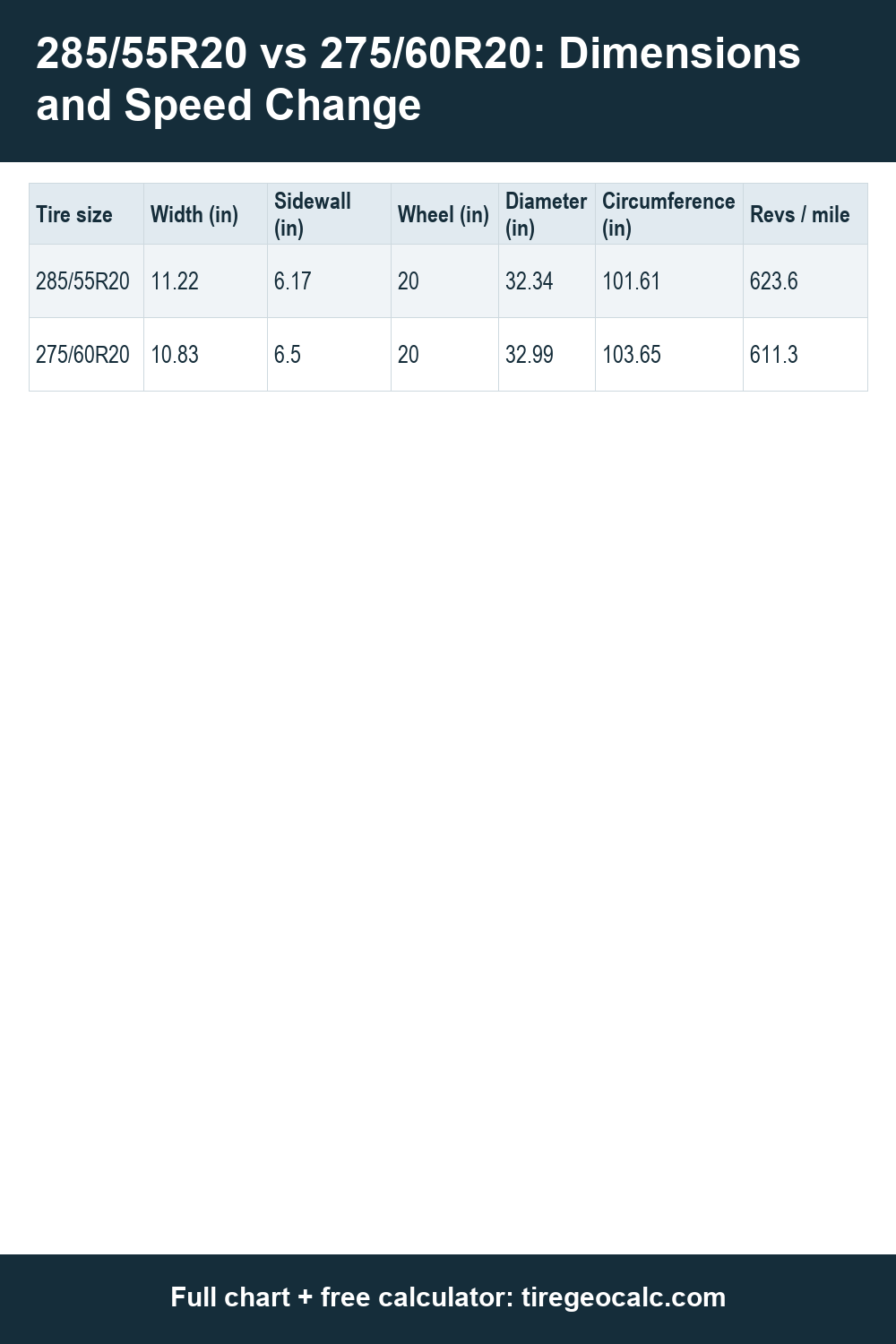
Decode the markings in the same units
285/55R20 and 275/60R20 are metric markings. Each first number is nominal section width in millimeters, each middle number is sidewall height as a percentage of that width, and each final number is wheel diameter in inches. Equal aspect ratios do not necessarily give equal sidewalls, because the percentage applies to each tire's own width. Read each complete marking rather than comparing isolated numbers.
Both codes specify the same wheel diameter. That makes it useful to isolate the sidewall contribution: any difference in overall height comes from the tire dimensions around that common wheel. Matching wheel diameter still leaves rim width and clearance unresolved.
Read diameter and sidewall as different dimensions
For this pair, 275/60R20 is taller than 285/55R20 in the ideal size-code model. Overall diameter includes the wheel and both sidewalls. Sidewall height describes only one radial section outside the wheel. The calculated table keeps the two measurements separate and shows millimeters beside inches. Read the unrounded calculation through its displayed values rather than adding previously rounded dimensions to reconstruct a new result.
Nominal width is section width, not a measured tread width. It does not predict how much tire extends inward or outward on a particular wheel. Rim width, offset and actual product shape affect that position. Likewise, half the diameter difference is the geometric radius difference, not a measured gain in loaded ground clearance. Suspension movement and steering clearance require checks on the actual vehicle.
Interpret circumference and speed in the stated direction
The circumference entries follow directly from diameter. A taller circle covers more distance in a revolution, while a shorter circle covers less. The revolutions per mile and kilometer columns show the inverse relationship. In this comparison, 285/55R20 remains the reference even if the candidate has a more familiar size label. Reversing the original and candidate changes the percentage denominator and the direction of the speed effect.
The actual-speed columns assume the instrument was calibrated to the original circumference and has no other error. They show theoretical road speed at the listed indicated speeds; actual minus indicated makes the direction explicit. These values do not measure the existing instrument calibration. If the vehicle has already been recalibrated, applying the old ratio again would be inappropriate. Manufacturer rolling data or suitable measured distance evidence can refine a real calibration assessment.
Make the replacement check specific
Start with the vehicle specification for the axle you are assessing, then confirm whether 285/55R20 really is that original size. If it is not, enter the correct original in the calculator before interpreting a percentage or speed figure. Compare the exact tire model and service description as well as its size. The bare codes 285/55R20 and 275/60R20 do not establish equivalent load capacity, speed rating or required operating pressure.
A close diameter is only one part of the comparison. Check approved wheel width, wheel attachment, brake clearance and space through steering and suspension travel. Tire construction and wheel mass are also outside this geometry model. It cannot predict fuel consumption, ride comfort, stopping distance or traction from size alone. Use the table to identify dimensional changes, and resolve mounting and operating requirements from the actual vehicle and product specifications before making a replacement decision.
Frequently asked questions
Which is taller, 285/55R20 or 275/60R20?
With 285/55R20 as the reference, 275/60R20 is taller in nominal geometry. Read the diameter row for the calculated difference; this is not a measured loaded radius.
Does a small diameter difference prove interchangeability?
No. Diameter does not establish load or speed suitability, approved wheel width, offset or clearance. Those requirements must be checked for the actual vehicle, wheel and tire products.
Can I reverse the comparison?
Yes, by using the other tire as the original in the calculator. Percentage and theoretical speed changes must then use that new original as their reference.
Continue your comparison
These are nominal geometric calculations, not vehicle fitment approval. Check the vehicle manual and exact tire and wheel specifications, including load and speed ratings, approved rim width and clearance; consult the manual for any diameter change exceeding 3%.
Reference tables: Load index chart and Speed rating chart.