 TireGeoCalc
275/35R20 vs 285/35R20: Size and Speed Changes
Quick answer
Nominal geometry275/35R20 → 285/35R20 · original-size calibration assumed
- Diameter difference
- +0.28in
- Diameter change
- +1.00%
- Actual at indicated 60 mph
- 60.60mph
Calculated from size markings. Not measured rolling dimensions or vehicle fitment approval.
Published
275/35R20 and 285/35R20 are broad performance tire proportions that share wheel diameter and aspect ratio. The comparison is relevant to large coupe and sedan wheel package research, especially when the rear tire is being considered. The nominal width step also creates a smaller but real outside height step. Read the first size as the original throughout this comparison, including the speed and radius examples below.
Calculated tire dimensions and changes from the original
The first row, 275/35R20, is the original reference. All measurements are derived from the tire geometry engine. Percentages and theoretical speed values keep that same original throughout; rounding is for display only.
| Tire size | Width (mm) | Width (in) | Sidewall (mm) | Sidewall (in) | Wheel (mm) | Wheel (in) | Diameter (mm) | Diameter (in) | Circumference (mm) | Circumference (in) | Revolutions / mile | Revolutions / km | Diameter change (%) | Actual at indicated 30 mph | Actual at indicated 60 mph | Actual at indicated 75 mph | Actual minus indicated at 60 mph |
|---|---|---|---|---|---|---|---|---|---|---|---|---|---|---|---|---|---|
| 275/35R20 | 275 | 10.83 | 96.3 | 3.79 | 508 | 20 | 700.5 | 27.58 | 2200.7 | 86.64 | 731.3 | 454.4 | 0 | 30 | 60 | 75 | 0 |
| 285/35R20 | 285 | 11.22 | 99.8 | 3.93 | 508 | 20 | 707.5 | 27.85 | 2222.7 | 87.51 | 724.1 | 449.9 | 1 | 30.3 | 60.6 | 75.7 | 0.6 |
Nominal size-code geometry. Reference: 275/35R20. Display rounding only; not fitment approval.
- Tire size
- 275/35R20
- Width (mm)
- 275
- Width (in)
- 10.83
- Sidewall (mm)
- 96.3
- Sidewall (in)
- 3.79
- Wheel (mm)
- 508
- Wheel (in)
- 20
- Diameter (mm)
- 700.5
- Diameter (in)
- 27.58
- Circumference (mm)
- 2200.7
- Circumference (in)
- 86.64
- Revolutions / mile
- 731.3
- Revolutions / km
- 454.4
- Diameter change (%)
- 0
- Actual at indicated 30 mph
- 30
- Actual at indicated 60 mph
- 60
- Actual at indicated 75 mph
- 75
- Actual minus indicated at 60 mph
- 0
- Tire size
- 285/35R20
- Width (mm)
- 285
- Width (in)
- 11.22
- Sidewall (mm)
- 99.8
- Sidewall (in)
- 3.93
- Wheel (mm)
- 508
- Wheel (in)
- 20
- Diameter (mm)
- 707.5
- Diameter (in)
- 27.85
- Circumference (mm)
- 2222.7
- Circumference (in)
- 87.51
- Revolutions / mile
- 724.1
- Revolutions / km
- 449.9
- Diameter change (%)
- 1
- Actual at indicated 30 mph
- 30.3
- Actual at indicated 60 mph
- 60.6
- Actual at indicated 75 mph
- 75.7
- Actual minus indicated at 60 mph
- 0.6
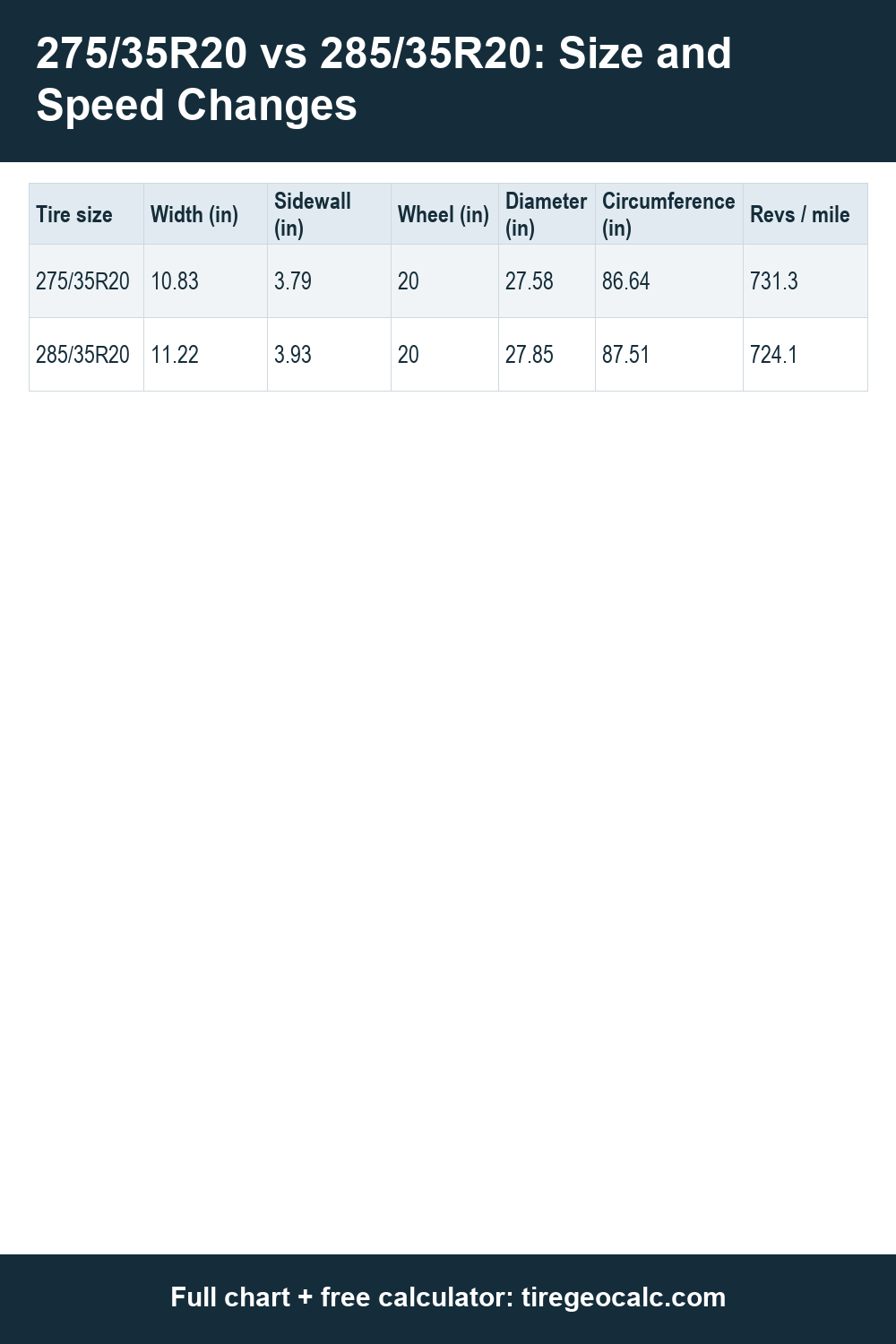
Broad rear tire candidates with a modest diameter difference
The candidate's greater width produces taller sidewalls at the same thirty five ratio. The wheel itself contributes no change, so the radius gain comes only from that sidewall increase. Keep the small vertical result beside the larger lateral width difference. A single diameter percentage cannot describe both aspects of the proposed assembly.
A rear axle change may alter the relationship with the front tires even if its own diameter change is modest. The vehicle documentation needs to establish permitted combinations and any drivetrain restrictions. This page does not know the front tire, wheel specification or load requirements. Record those facts before evaluating the pair as part of a complete setup.
Speed, radius and wheel position in this pair
With 275/35R20 as original, 285/35R20 changes the calculated outside diameter from 700.50 to 707.50 mm. The signed difference is +7.00 mm (+0.28 inches), or +1.00%. At an indicated 60 mph, original circumference calibration would give 60.60 mph on the candidate, a +0.60 mph shift. At an indicated 30 mph the corresponding value is 30.30 mph. These numbers compare two ideal circles rather than measuring the existing instrument error.
These broad performance rear proportions share the same twenty inch center and thirty five ratio. Applying that ratio to 285 rather than 275 mm adds 3.50 mm of sidewall and 7.00 mm of complete height. The resulting 3.50 mm ideal radius increase is separate from the broader shoulders an exact product might present. For a staggered car, preserve the front specification beside this rear comparison; the table does not know it. Someone investigating the candidate for a documented rear option still needs that full combination, while staying with the original retains the starting rear circle.
Put the dimensional result in context
Wide tire product information should include approved rim width and the conditions behind published dimensions. A wheel near one end of the approved range may not present the same measured section as the catalog's measuring wheel. Use the exact specifications in the clearance assessment. The nominal code remains a useful identifier but cannot replace product data where space is limited.
Frequently asked questions
Does a broad rear tire need a new front tire comparison too?
With 275/35R20 versus 285/35R20, the wider candidate also changes rear circumference. If a large coupe or sedan uses different tires front and rear, check the allowed complete combination before selecting the candidate. The table deliberately keeps the original rear size as its own reference; it cannot substitute for the missing front specification. Keeping 275/35R20 may preserve a documented existing setup, while researching 285/35R20 requires a separate reason and the corresponding wheel and vehicle evidence. Broad sections and matching wheel diameters do not settle those axle questions.
Why retain unrounded values when calculating travel for 275/35R20?
The displayed 27.58 inch height is rounded, while the geometric circumference uses the full 700.50 mm diameter. That yields 86.64 inches per turn and 731.29 revolutions per mile. Recalculating from a rounded cell can differ slightly; keep the definition and precision clear when comparing the result with another dimension source.
Can the wider rear code alone establish an approved rim range?
Approved rim ranges belong to the identified tire product, not merely to the shared twenty inch ending. Record the exact make and model and compare its wheel requirements with the installed rear wheel. A broad section plus a close calculated height does not settle that product specific pairing or the permitted axle combination.
Continue your comparison
These are nominal geometric calculations, not vehicle fitment approval. Check the vehicle manual and exact tire and wheel specifications, including load and speed ratings, approved rim width and clearance; consult the manual for any diameter change exceeding 3%.
Reference tables: Load index chart and Speed rating chart.